 White Noise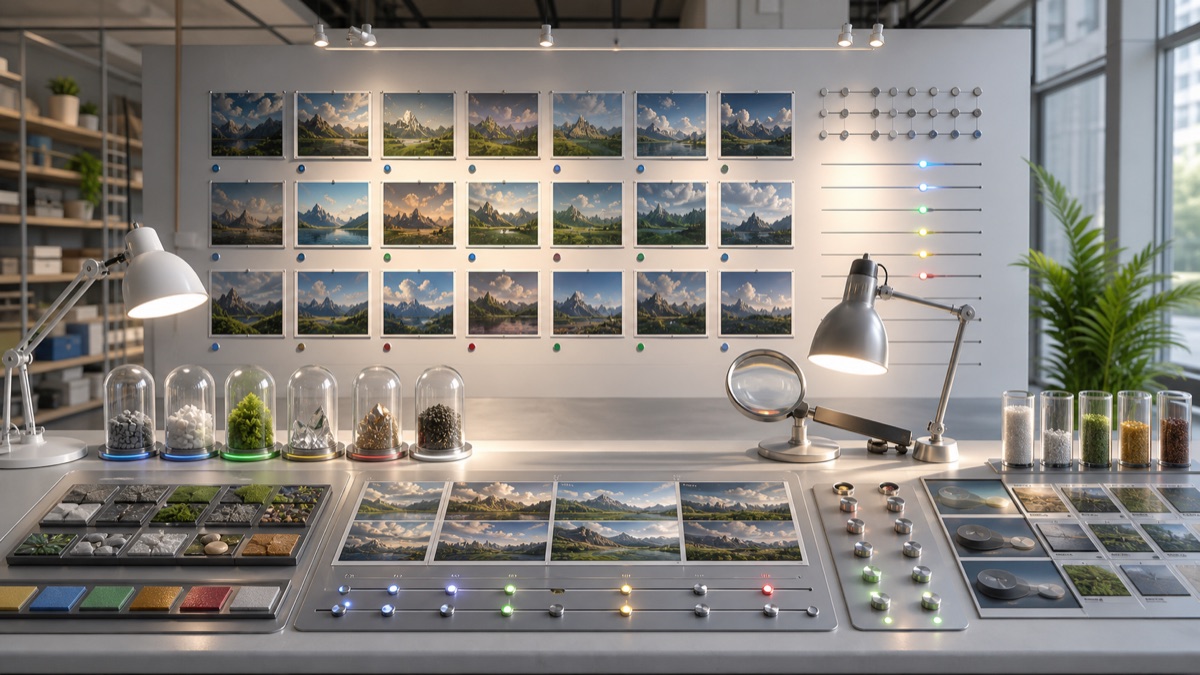
Evidence Rooms for AI Artifacts starts with a modest discipline: a generated image should carry the record that makes it inspectable. The White Noise source world can remain cosmic, but the public implementation has to answer ordinary questions about source, permission, date, version, reviewer, and consequence.
The article's working object is an evidence room that keeps artifact, source record, prompt receipt, rights note, and reviewer decision together. It is intentionally smaller than the far horizon of White Noise Totality. That smaller scale is useful because a small object can be tested, corrected, retired, and linked to a real member experience.
The Claim Worth Keeping
The useful claim is not that White Noise Inc. has already built the full future imagined by the book. The useful claim is that artifact evidence room can turn one piece of that future into a present practice. It gives members, editors, and reviewers a handle on the difference between imagination, current service, scoped research, generated visual support, and verified capability.
That distinction protects the reader from product confusion, investment implication, accreditation drift, and false scientific certainty. It also protects the idea from becoming decorative. A White Noise concept that cannot name its boundary will eventually be read as mood rather than method.
Present Capability Boundary
The present capability boundary is practical: give each published artifact a public evidence path and an internal review owner. None of that requires claiming a proprietary web-scale model, a finished White Noise Computer, an accredited university, or operational matter-scale technology. It requires careful records and a product surface that respects the difference between a prompt answer and proof.
This is especially important for Member Workspace and Member Image Studio. A modern assistant should feel generative, prompt-specific, and alive to member context. It should not regress into prepared responses, static briefs, or generic glowing schematics. The generated canvas matters, but so do the source trail, seed record, redraw behavior, and assistant explanation that accompany it.
What It Changes in the Product
A practical White Noise interface should make this discipline visible at the moment of use. The member should not have to inspect a hidden database or ask a support team to understand whether an image came from a fresh prompt, a saved chat redraw, a licensed reference, a public source, a private upload, or a purely synthetic construction. The answer should live near the canvas.
That product choice changes the tone of the experience. Instead of treating provenance as a legal afterthought, the studio treats it as part of creation. The member can still move quickly, explore visually, and receive original assistant text, but the work remains tied to records that can be corrected. This is how Member Workspace can feel modern without pretending that every generated image is evidence.
The Failure Mode
The failure mode is simple: the artifact circulates faster than the evidence that explains what it is and is not. It usually arrives through grammar before it arrives through technology. A concept image becomes a roadmap, a roadmap becomes a capability, and a capability becomes a promise while the evidence has not moved.
The repair is not to make White Noise smaller. The repair is to make the claim temperature visible. Speculative concepts can be ambitious and honest at the same time when their pages say what is source-world imagination, what is present public service, what is being researched, and what is not being claimed.
Governance by Design
Governance belongs inside the workflow rather than after it. A prompt can be refused, narrowed, or routed to a safer frame. A source can be quarantined. A generated image can be saved privately but withheld from publication. A correction can update the assistant explanation without rewriting the whole artifact history. Those are not obstacles to creativity; they are the controls that let creative systems scale without losing trust.
The same logic applies across the White Noise ecosystem. Academy lessons need nonaccredited language. Labs scopes need assumption ledgers. Exchange listings need provenance before buyer urgency. Project Utopia scenarios need local review before persuasive worldbuilding. Image Studio is simply the most visible place to practice that discipline because every canvas can make a claim before anyone has written a sentence.
A First Useful Artifact
The first artifact should be boring enough to audit and useful enough to change behavior: an evidence room that keeps artifact, source record, prompt receipt, rights note, and reviewer decision together. It should have an owner, a date, a revision path, and a public consequence when the answer is no. It should make the invisible cost of the concept easier to see.
For search and editorial routing, the primary keyword is artifact evidence room. Nearby language includes AI artifact provenance, generated art review, source record, image evidence, artifact custody, Exchange trust. The page should connect outward to Member Workspace, W.N. Encyclopedia, product and service boundaries, and nearby source-record articles rather than leaving the concept isolated.
Where to Continue
Use this feature as a route map. Compare it with the public White Noise boundaries, then continue into related essays and WN Encyclopedia entries that treat the same claim from another side.
- Member Workspace
- W.N. Products
- W.N. Services
- W.N. Encyclopedia
- Studio Receipts For Image Generation
- Source Capsules For Generative Canvases
- Watermark Free Provenance For Image Studio
- Prompt Receipt
- Source Capsule
- Seed Receipt
- Image Generation Provenance
- Image Evaluation Harness
Image Provenance
Hero image provenance: GPT-generated editorial bitmap created for this article in the 2026-06-30 automation batch. Prompt intent: Museum-like evidence room with generated artwork, provenance capsules, inspection lamps, and review tables. The image is visual support only; it is not evidence of an operational White Noise system, shipped product, accredited program, proprietary model training, or verified scientific result.