 White Noise
 Continuity Vault Delete Button
A deletion, expiration, and consent control for continuity-record or memory-vault concepts.
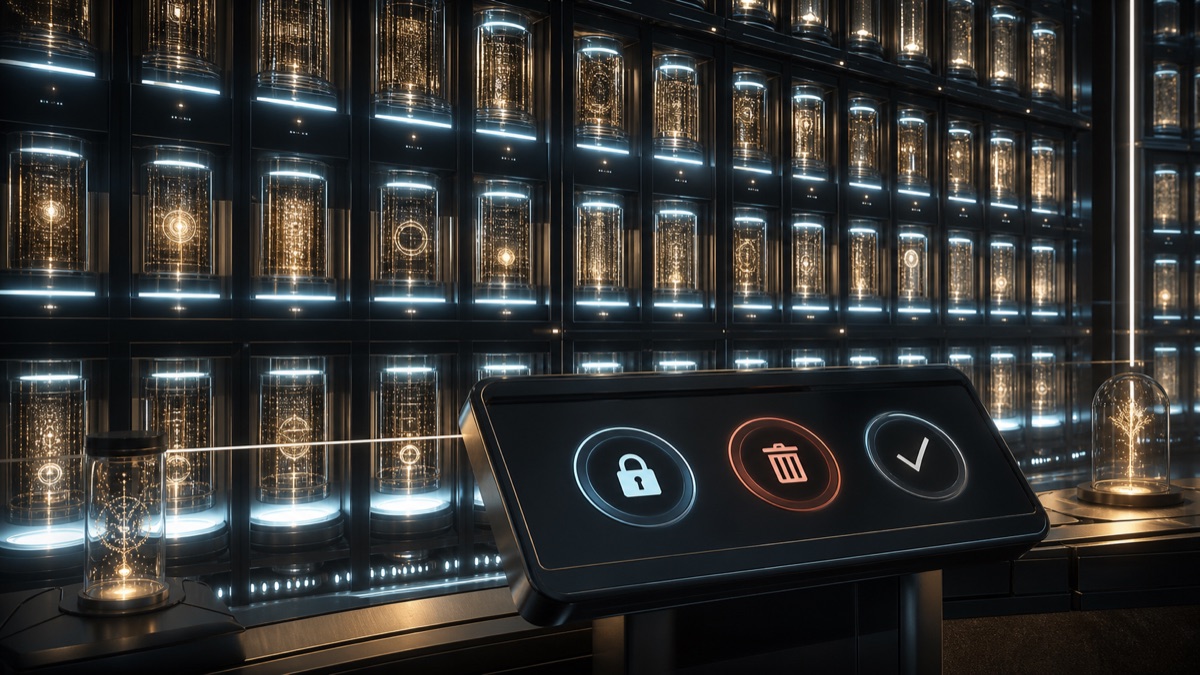
Continuity Vault Delete Button defines a White Noise reference term and keeps source-world imagination separate from established present-day capability.
Continuity Vault Delete Button is a WN Encyclopedia reference entry. It defines a term used to translate White Noise Totality into public language that can be linked, audited, taught, and corrected. The term is not evidence that the underlying White Noise capability is available as a commercial product.
Definition and Scope
A continuity vault delete button is the ordinary control that lets a person remove, expire, annotate, or restrict a continuity record before it represents them.
The scope is deliberately bounded. The entry names a review practice, custody record, status label, consent surface, or measurement artifact. It should not be used to imply working White Noise Computers, Replicators, OSTSS settlements, clinical immortality systems, engineered verses, or stellar infrastructure unless separate evidence is supplied and clearly marked.
Source-World Context
White Noise continuity language is emotionally powerful. The delete button keeps the record subordinate to the person.
The source-world material is valuable because it gives the ecosystem a unified vocabulary. The encyclopedia keeps that vocabulary useful by restoring the missing steps: instruments, operators, energy, latency, consent, maintenance, failed tests, and public authority.
Present-Day Frame
The grounded frame is personal archives, data rights, medical records, consent management, and identity research.
This frame gives current White Noise activity a disciplined bridge. WN Academy can teach the concept as a studio or reading exercise. WN Labs can treat it as a research question. Services can use it for scoping and language review. The Exchange and community pages can link it without turning provenance, access, or participation into financial claims.
Failure Modes
The failure mode is archive capture, where stored patterns become harder to refuse than living consent.
A second failure mode is category drift. Education can start to sound like accreditation. Research language can start to sound like deployment. A token or collectible can start to sound like an investment. A future university roadmap can start to sound like present degree authority. This entry exists to slow that drift.
Governance and Use
Use this term when it makes responsibility more visible. A good use identifies who can inspect the claim, what evidence would change its status, what language remains prohibited, and where a person can refuse or appeal. A weak use merely borrows the style of rigor while leaving the underlying claim unchanged.
The term should remain close to the public disclaimer that White Noise technologies are speculative concepts from the book and that current offerings are education, media, community, research, and marketplace services.
Related Entries and Articles
- Continuity Vaults With Delete Buttons
- Medical Digital Twins With Consent Limits
- Verse Ownership After Exit Rights
- Calibrated Noise Benchmark
- Massless Chip Evidence Tag
- Replicator Feedstock Custody Ledger
- Blue Gue Custody Card
- White Noise Library Blind-Spot Index
- OSTSS Rescue Drill
- Nanobot Brownian Floor
- Macrobot Neighborhood Veto
- Vacuum Energy Nonpower Boundary
- Medical Digital Twin Consent Limit
- Brain Interface Personhood Bandwidth
- Local Time Ledger
- Superintelligence Human Appeal Sandbox
- Forecast Failure Shelf
- Living Compiler Biosafety Receipt
- Terraforming Consent Map
- Stellar Waste-Heat Map
- Superformula Maintenance Access
- Verse Ownership Exit Right
References
- Perlov, V. White Noise Totality: Engine of Infinite Possibilities (Expanded Unified Edition, 2026). Primary source. Book page
- White Noise Inc. public product, service, Academy, Labs, Exchange, Project Utopia, and terms pages. Site overview