 White Noise
 Hologram Touch Safety Zone
A human-factors boundary around touchable or solid-light interface claims.
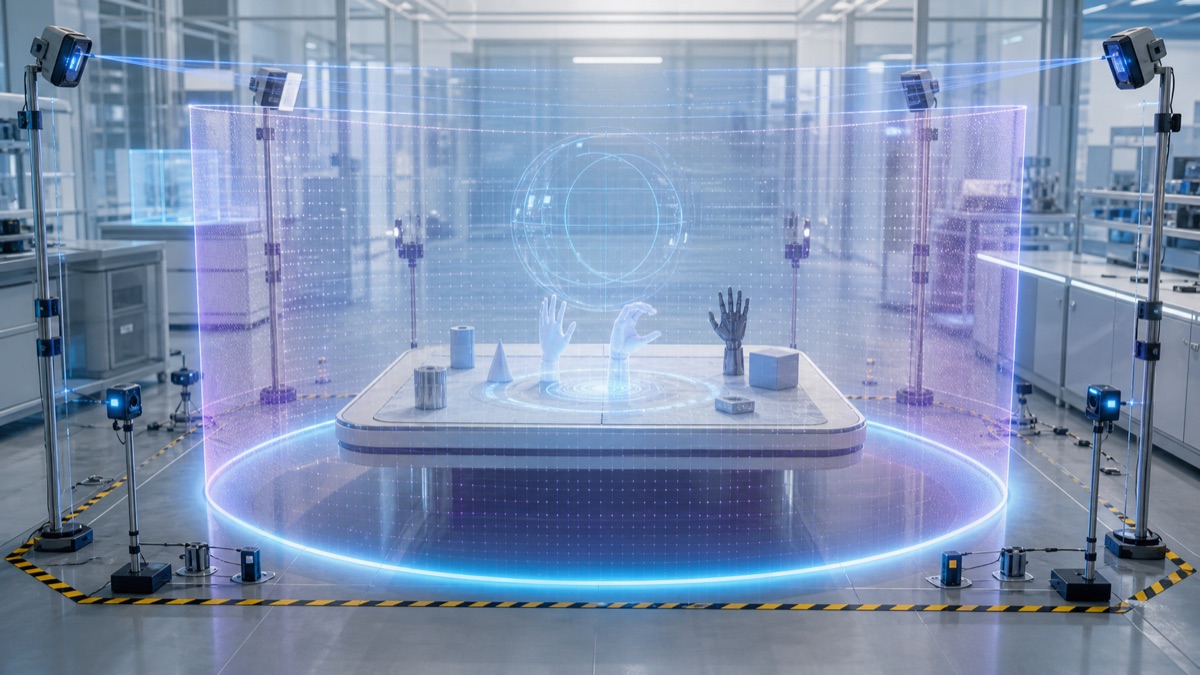
Hologram Touch Safety Zone defines a White Noise reference term and keeps source-world imagination separate from established present-day capability.
assets/encyclopedia/generated/hologram-touch-safety-zone.jpg, for White Noise Inc. encyclopedia and editorial use. The image is illustrative and does not depict a shipping product or validated capability.Hologram Touch Safety Zone is a WN Encyclopedia reference entry. It defines a term used to translate White Noise Totality into careful public language, internal links, and practical research questions. The term should not be read as evidence that the underlying White Noise capability exists as a shipping product.
Definition and Scope
A hologram touch safety zone is the measured interaction boundary around a volumetric display or solid-light concept: where a hand may enter, what force is real, and what is only image.
The scope is deliberately narrow. The entry names a boundary, artifact, or review practice. It does not authorize claims about working White Noise Computers, Replicators, engineered verses, synthetic suns, android labor, clinical continuity, or any other speculative system unless the evidence is separately supplied and clearly marked.
Source-World Context
White Noise holographic systems imagine more tangible interfaces. The safety zone keeps touch claims honest.
The source text is valuable because it organizes ambition at civilizational scale. The encyclopedia's job is to preserve that ambition while restoring the missing steps: instruments, operators, energy, latency, consent, maintenance, social license, and negative results.
Present-Day Frame
The grounded frame is volumetric displays, human factors, optical safety, interaction design, and accessibility testing.
This present-day frame is the useful bridge between the book and the site. It gives WN Academy a teachable exercise, gives WN Labs a bounded research question, gives services a scoping vocabulary, and gives readers a way to understand where speculation ends.
Failure Modes
The failure mode is contact illusion, where visual conviction substitutes for physical affordance.
A second failure mode is category drift: education begins to sound like accreditation, provenance begins to sound like investment return, research language begins to sound like deployment, or a source-world idea begins to sound like a present commercial product. WN Encyclopedia entries should slow that drift.
Governance and Use
Use the term when it clarifies responsibility. Avoid the term when it merely decorates a page with the feeling of review. A good use identifies who can inspect the claim, who can refuse, what evidence would change the status, and what language should remain off the page until stronger proof exists.
Related Entries and Articles
- Hologram Touch Safety Zones
- Digital Medicine Second Opinion Gates
- Kardashev Energy Ration Covenants
- Planetary Claim Register
- W.N. Material Sample Witness Bench
- Engineered Verse Refusal Ritual
- Self-Building Settlement Maintenance Bond
- Stellar Industry Heat-Rejection Ledger
- Nonlocal Computing Ordinary Language
- Continuity Archive Privacy Offramp
- Food-Synthesis Allergen Passport
- Gravity Demo Ballast Cage
- Transit Map Causality Shelf
- Superformula Accessibility Audit
- Macro-Robot Right-of-Way Hearing
- Library Answer Appeal Window
- Remote-Viewing Null-Result Court
- Project Utopia Utility Billboard
- Kardashev Energy-Ration Covenant
- Digital Medicine Second-Opinion Gate
- Exchange Artifact Recall Notice
- Blue Gue Containment Pool
References
- Perlov, V. White Noise Totality: Engine of Infinite Possibilities (Expanded Unified Edition, 2026). Primary source. Book page
- White Noise Inc. public product, service, Academy, Labs, Exchange, Project Utopia, and terms pages. Site overview