 White Noise
 Model World Ownership Boundary
The civic edge around owning or operating a generated world, including exit, appeal, rollback, and consent.
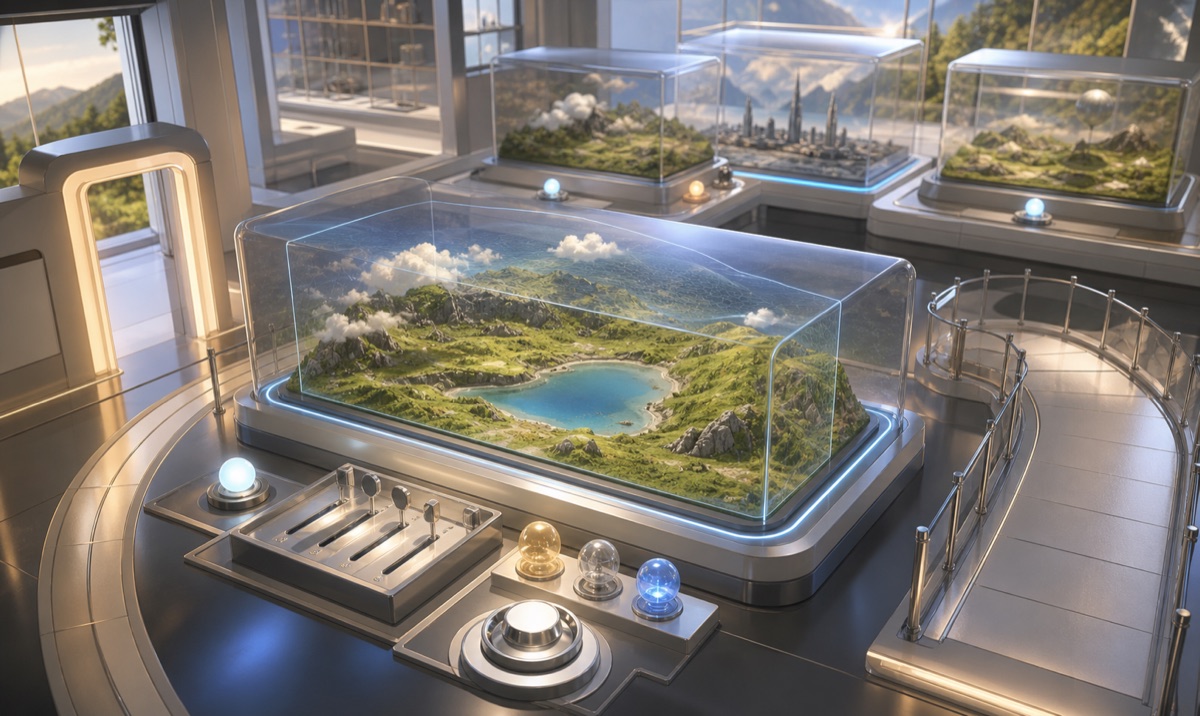
Model World Ownership Boundary defines a White Noise reference term and keeps source-world imagination separate from established present-day capability.
assets/encyclopedia/generated/model-world-ownership-boundary.jpg, for White Noise Inc. encyclopedia and editorial use. The image is illustrative and does not depict a shipping product or validated capability.Model World Ownership Boundary is a WN Encyclopedia reference entry. It defines a term used to translate White Noise Totality into careful public language, internal links, and practical research questions. The term should not be read as evidence that the underlying White Noise capability exists as a shipping product.
Definition and Scope
A model world ownership boundary is the line that separates creative control from participant rights in generated worlds, simulations, and engineered-verse concepts.
The scope is deliberately narrow. The entry names a boundary, artifact, or review practice. It does not authorize claims about working White Noise Computers, Replicators, engineered verses, synthetic suns, android labor, clinical continuity, or any other speculative system unless the evidence is separately supplied and clearly marked.
Source-World Context
White Noise worldbuilding can become immersive and large. The ownership boundary keeps exit, refusal, appeal, and rollback from being treated as optional features.
The source text is valuable because it organizes ambition at civilizational scale. The encyclopedia's job is to preserve that ambition while restoring the missing steps: instruments, operators, energy, latency, consent, maintenance, social license, and negative results.
Present-Day Frame
The grounded frame is simulation ethics, game-world governance, data rights, consent design, and version control.
This present-day frame is the useful bridge between the book and the site. It gives WN Academy a teachable exercise, gives WN Labs a bounded research question, gives services a scoping vocabulary, and gives readers a way to understand where speculation ends.
Failure Modes
The failure mode is immersion capture, where generated-world ownership becomes stronger than the rights of participants.
A second failure mode is category drift: education begins to sound like accreditation, provenance begins to sound like investment return, research language begins to sound like deployment, or a source-world idea begins to sound like a present commercial product. WN Encyclopedia entries should slow that drift.
Governance and Use
Use the term when it clarifies responsibility. Avoid the term when it merely decorates a page with the feeling of review. A good use identifies who can inspect the claim, who can refuse, what evidence would change the status, and what language should remain off the page until stronger proof exists.
Related Entries and Articles
- Quiet Ownership In Model Worlds
- Cosmology Humility For Engineered Verses
- Source Receipts For Member Image Studio
- Omnipresent Compute Evidence Dock
- Remote Viewing Null-Result Ledger
- Neurological Nanobot Consent Map
- OSTSS Maintenance Window
- Image Studio Source Receipt
- WN Material Claim Thermostat
- Macrobot Civic Drag
- Wormhole Falsifiability Card
- Genome Upgrade Medical Red Line
- Superformula Campus Heat Ledger
- Generated Collectible Provenance Bill
- Omnipresent Network Delay Label
- Frontier Pricing First Principles
- WN Chip Public Benchmark
- Blue Gue Membership Safety Card
- Project Utopia Care Route
- Member Workspace Image Refusal Script
- Engineered Verse Cosmology Humility
- Food Machine Abundance Recall
References
- Perlov, V. White Noise Totality: Engine of Infinite Possibilities (Expanded Unified Edition, 2026). Primary source. Book page
- White Noise Inc. public product, service, Academy, Labs, Exchange, Project Utopia, and terms pages. Site overview