 White Noise
 Wormhole Analogy Red-Team Room
A review space for testing shortcut metaphors against causality, energy, and non-route disclosure.
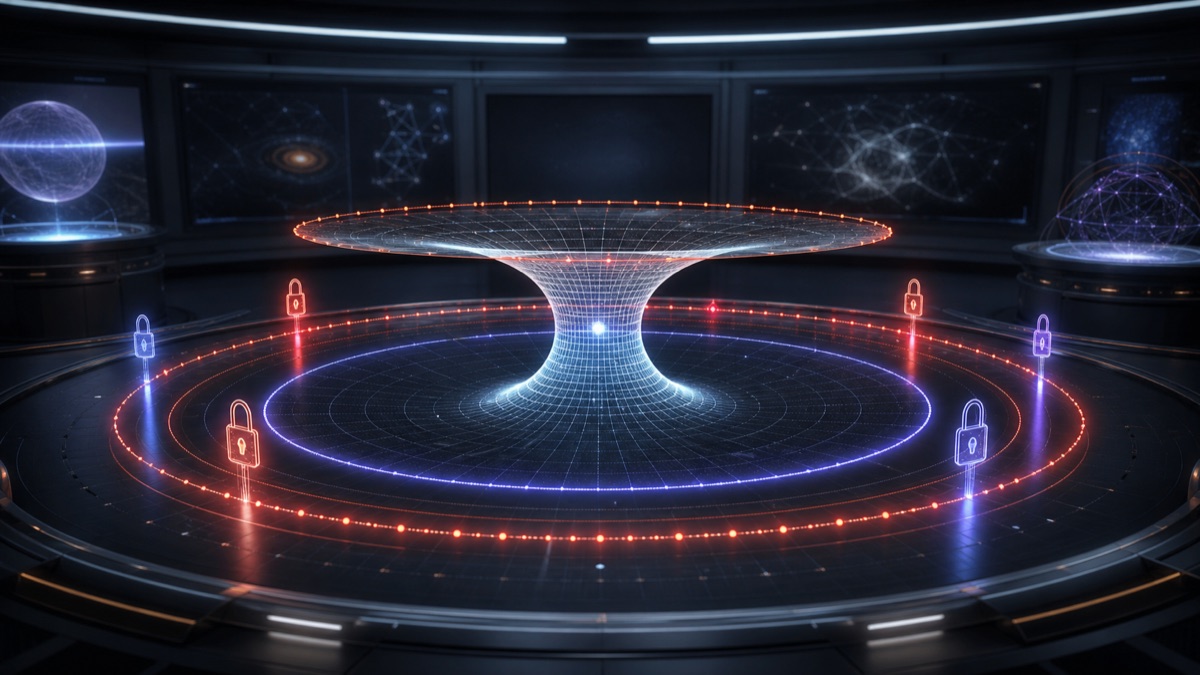
Wormhole Analogy Red-Team Room defines a White Noise reference term and keeps source-world imagination separate from established present-day capability.
assets/encyclopedia/generated/wormhole-analogy-red-team-room.jpg, for White Noise Inc. encyclopedia and editorial use. The image is illustrative and does not depict a shipping product or validated capability.Wormhole Analogy Red-Team Room is a WN Encyclopedia reference entry. It defines a term used to translate White Noise Totality into careful public language, internal links, and practical research questions. The term should not be read as evidence that the underlying White Noise capability exists as a shipping product.
Definition and Scope
A wormhole analogy red-team room asks whether a wormhole or shortcut metaphor is being used as education, speculation, route language, or implied operational transit.
The scope is deliberately narrow. The entry names a boundary, artifact, or review practice. It does not authorize claims about working White Noise Computers, Replicators, engineered verses, synthetic suns, android labor, clinical continuity, or any other speculative system unless the evidence is separately supplied and clearly marked.
Source-World Context
White Noise transit imagination improves when causality and energy constraints remain visible before wonder.
The source text is valuable because it organizes ambition at civilizational scale. The encyclopedia's job is to preserve that ambition while restoring the missing steps: instruments, operators, energy, latency, consent, maintenance, social license, and negative results.
Present-Day Frame
The grounded frame is physics communication, relativity education, speculative engineering review, red-team methods, and public disclaimers.
This present-day frame is the useful bridge between the book and the site. It gives WN Academy a teachable exercise, gives WN Labs a bounded research question, gives services a scoping vocabulary, and gives readers a way to understand where speculation ends.
Failure Modes
The failure mode is analogy drift, where a teaching image becomes an itinerary.
A second failure mode is category drift: education begins to sound like accreditation, provenance begins to sound like investment return, research language begins to sound like deployment, or a source-world idea begins to sound like a present commercial product. WN Encyclopedia entries should slow that drift.
Governance and Use
Use the term when it clarifies responsibility. Avoid the term when it merely decorates a page with the feeling of review. A good use identifies who can inspect the claim, who can refuse, what evidence would change the status, and what language should remain off the page until stronger proof exists.
Related Entries and Articles
- Wormhole Analogy Red Team Rooms
- Stellar Observation Without Ownership
- Product Roadmap Claim Thermometers
- Image Studio Prompt License Ledger
- Image Model Dataset Provenance Gate
- Saved-Chat Redraw Provenance Receipt
- Visual Training Source Permission Tag
- Member Export Room
- Academy Critique Appeal Path
- Parameter Sweep Notebook
- Exchange Rights Repair Desk
- Syndicate Noninvestment Briefing Room
- Product Roadmap Claim Thermometer
- Public Beta Offramp
- Supermax Evidence Shelf
- Continuity Consent Renewal Card
- Replicator Feedstock Origin Receipt
- Material Sample Quarantine Window
- OSTSS Resident Repair Charter
- Stellar Observation Boundary
- Nonclinical Medical Signal Handbook
- Total Library Deletion Appeal Path
References
- Perlov, V. White Noise Totality: Engine of Infinite Possibilities (Expanded Unified Edition, 2026). Primary source. Book page
- White Noise Inc. public product, service, Academy, Labs, Exchange, Project Utopia, and terms pages. Site overview