This route is tied to the current public governance stack and should refresh when claim state, owner state, or review posture changes.
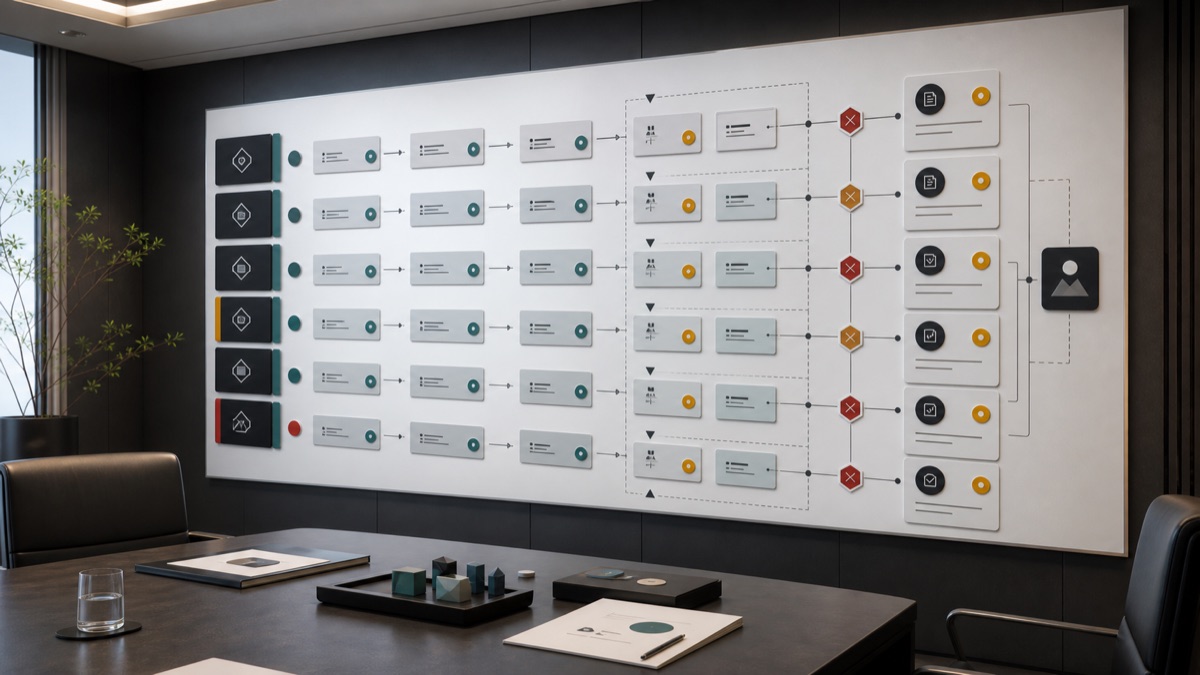
Home / Public Accountability Map
Public accountability route
See which lane owns the next claim change.
This page gives enterprise buyers, strategic partners, sponsors, investors, and board reviewers one public place to inspect the current accountability posture before White Noise language gets warmer. It maps review lanes, owner-state categories, escalation gates, and evidence thresholds without implying delegated staff, monitored CRM, audited controls, or live speculative operations.
Visual boundary
This page reuses the existing GPT-generated accountability-map visual because the improvement here is route discoverability, not missing artwork. The image is editorial support only, not proof of a staffed operations center, audited controls, production CRM, formal financing process, live Exchange operations, or operational speculative technology. Review the provenance record.
Claim language, investor narrative, inquiry routing, rights, dependencies, security/data, evidence, Exchange, visuals, and review cadence.
Founder-led, function owner needed, formal review required, evidence owner needed, and public owner not represented.
Check this route before describing something as live, audited, launched, enterprise-ready, commercially deployed, or formally financeable.
Owner-state key
Read the current public owner posture before you read the claim.
This artifact does not name individuals. It names the kind of ownership or review posture that must exist before stronger language becomes responsible.
Founder-led
The founder remains the accountable route.
Do not treat this as institutional depth. The claim should stay bounded until a documented delegated function exists.
Function owner needed
A named function is still missing.
Keep the public claim conservative until the review or operating function is assigned and documented.
Formal review required
Counsel, finance, security, privacy, compliance, or board review must happen first.
Do not improvise warmer external language while this gate is still open.
Evidence owner needed
Records must exist before the claim can move.
Rights records, permissions, logs, or measured data are required before anecdotes become proof.
Public owner not represented
The public build does not yet prove accountable ownership.
The strongest signal here is to state the gap plainly rather than imply a workflow that has not been shown.
Lane map
Map the claim to the lane before it reaches a reviewer.
Each lane pairs the current public control with the escalation gate that blocks warmer language and the evidence threshold that must exist first.
Founder-led + public owner not represented
Public claim language
Use product claim boundaries, White Paper evidence status, the risk register, and the materials index before suggesting that a thesis has become live, audited, launched, or commercially deployed.
Founder-led + formal review required
Investor and capital narrative
Investor Relations, the capital-readiness note, planning assumptions, and board cadence should stay thesis-led until financing, KPI, or securities language is backed by the right formal process.
Founder-led or owner gap
Inquiry routing and first response
The triage protocol, first-response standard, first-return menu, and response-log template keep public contact claims from quietly implying a staffed support desk or production CRM.
Evidence owner needed + formal review required
Source rights and publishing
The source-rights baseline, source-rights register, and customer-evidence standard should block stronger licensing, corpus, marketplace, or institutional-use language until the source record exists.
Function owner needed
Third-party dependencies
The dependency baseline, dependency register, and security/data baseline help keep hosting, payments, analytics, AI tooling, account, and Exchange infrastructure claims from reading as vendor maturity.
Formal review required
Security, privacy, and data handling
The Privacy Policy, public baseline, and data-handling review register should hold the line before account, retention, deletion, access-control, or enterprise security language becomes stronger.
Evidence owner needed + formal review required
Customer evidence and outcomes
The customer evidence permission standard, sample delivery case study, and Trust Center keep named proof, logos, quotes, case studies, metrics, and outcome claims behind explicit evidence gates.
Formal review required
Exchange, W.N. Coin, marketplace, and custody
The Exchange launch-status note, launch evidence checklist, and risk register should keep sale, liquidity, creator payout, custody, compliance, and market-operation language behind launch gates.
Evidence owner needed
Generated visuals and AI material
The visual disclosure standard, investor visual provenance register, and local provenance records keep generated trust surfaces from reading like operating proof.
Founder-led with monthly review expectation
Review cadence and materials integrity
The operating cadence memo, materials manifest, materials integrity report, and review evidence ledger should make trust-maintenance work inspectable instead of implicit.
Ask five questions before the language warms.
If those answers are not available, the public claim should stay bounded and the owner gap should stay visible.
- Which accountability lane is affected?
- What owner state applies now?
- Which public control already exists?
- What escalation gate is triggered?
- What evidence threshold must be met before the claim changes?
What this route still does not represent as ready.
- Delegated operating owners for every lane.
- Monitored enterprise CRM or staffed support queue.
- Audited KPI, revenue, conversion, or customer-outcome reporting.
- Security-reviewed enterprise controls packet.
- Legal-reviewed privacy compliance packet.
- Legal-reviewed source-rights clearance for every stronger use.
- Vendor security review, procurement audit, or service-level dependency records.
- Formal financing documents or an active securities process.
- Live Exchange, token sale, custody, liquidity, or marketplace operations.
Refresh this map when accountability meaning changes.
- A public owner, function, or monitored workflow becomes documented.
- A new trust, investor, product, Exchange, data, or generated-visual artifact is published.
- Public language changes on Investor Relations, Trust Center, Exchange, W.N. Coin, Services, Contact, homepage, or product pages.
- A serious inquiry produces source-backed evidence that can support a new public receipt.
- A public risk changes owner state, evidence state, or escalation route.
This is a routing artifact, not an institutional-depth claim.
- It is for general information only.
- It is not investment advice and not an offer to sell or solicit securities.
- It is not legal advice, audited reporting, or a proof-of-controls packet.
- It does not prove delegated owners, monitored workflows, or staffed review functions exist.
- It should help a serious counterparty ask the next bounded question without guessing.