The route should ask what decision is being made before sending the visitor into the wider proof stack.
Public enterprise starter brief
Start with the smallest defensible artifact.
This is the compact first-read route for enterprise buyers, strategic partners, sponsors, investors, and board reviewers. It tells a serious counterparty which public surface to open first, what White Noise can defend today, and how to ask for one bounded next artifact without implying a full dataroom, audited reporting pack, or live financing process. If the immediate need is one link to circulate internally, start with the forwardable counterparty scorecard.
Use boundary
This brief is for general information only. It is not investment advice, not an offer to sell or solicit securities, not audited reporting, and not proof that speculative White Noise technologies are commercially deployed.
Visual boundary
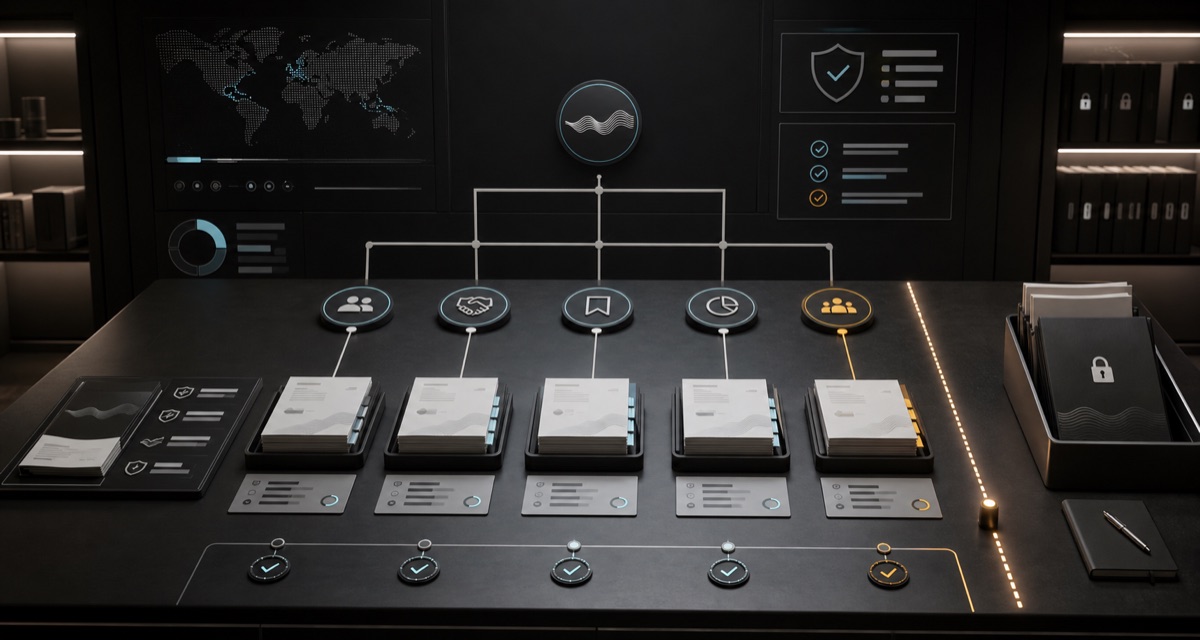
The hero image is GPT-generated editorial material showing a route-board concept. It is not proof of staffed enterprise workflow, audited controls, production CRM, customer traction, formal financing process, legal review, live Exchange activity, or operational speculative technology. Review the image provenance record.
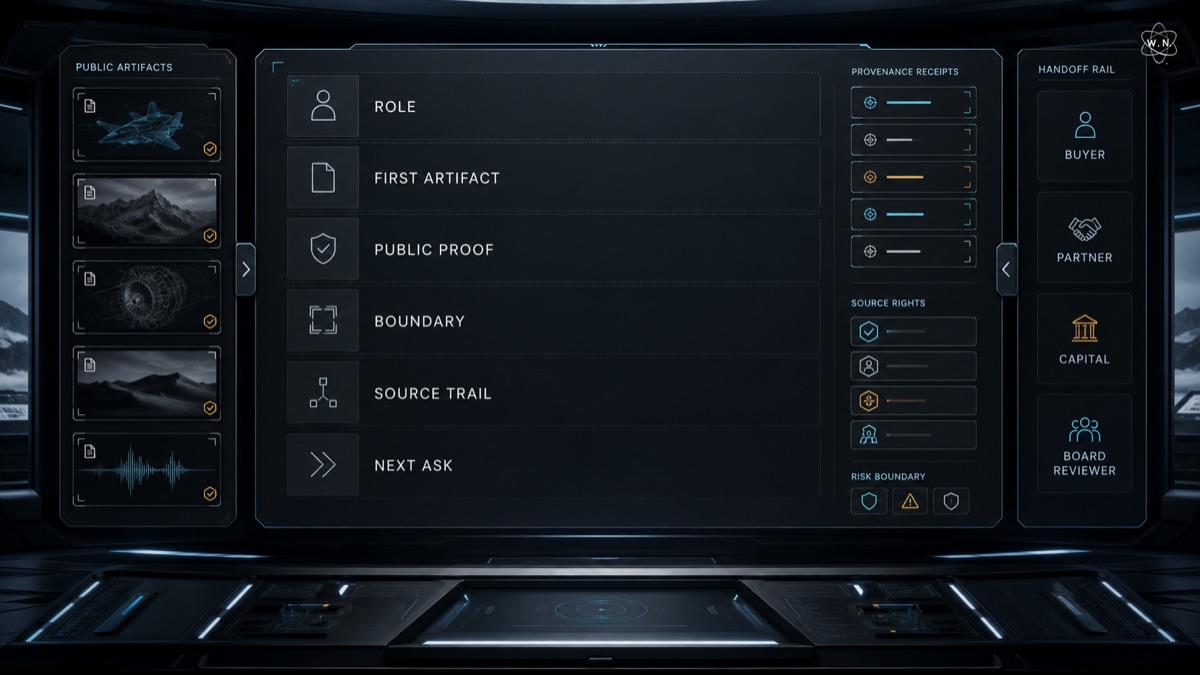
This GPT-generated editorial image is a public-review concept only. It is not a live dataroom, staffed enterprise workflow, production CRM, customer proof, audited reporting pack, legal review, financing process, trained image model, or web-scale ingestion claim. Review provenance.
Review-room contract
Make diligence feel like a routed product surface.
The strongest current product experiences do not make serious visitors hunt through a content archive. They show the working surface, name the status, keep source context close, and route the next action from the user’s role. This section turns the enterprise starter brief into that same compact loop.
Walkthrough, memo, scope path, or plain not-ready answer keeps the conversion step specific and reviewable.
The page links reviewers to public evidence, risk, materials, and provenance routes before private diligence is implied.
It says what does not exist yet and routes the next question without claiming audited controls or a live enterprise desk.
Board view
The first read should match the decision.
The starter brief exists to reduce diligence drift. A buyer, partner, sponsor, investor, or board reviewer should not need to infer whether White Noise has audited metrics, named customer evidence, enterprise controls, or a formal capital process. The route should say what is public now and what is not ready yet.
Starter brief, counterparty scorecard, investor route, Trust Center, request guide, risk register, metrics release policy, and materials index.
Name the role, decision, single question, risk boundary, and expected artifact type.
The public route does not imply audited financials, formal financing documents, or enterprise workflow proof.
Return a public walkthrough, scope path, boundary memo, or plain not-ready answer.
Concrete next step
Buyer
Partner
Capital
Credibility
Choose your role and leave with one routed ask.
The highest-friction failure on serious review pages is still drift: the visitor understands the trust boundary but leaves without choosing the right first artifact or the right room. This selector converts the brief into one actionable next move.
We need a services or scoped-delivery fit check.
Best when the live decision is pilot-sized scope, procurement fit, services posture, security posture, or whether White Noise belongs in a consulting or research path.
Recommended route: Pilot Gate, Procurement Boundary, then Services and Consulting Open pilot gateWe need a program, sponsorship, or institutional fit read.
Best when the first pass is about partner shape, public packet quality, or which commercial and trust surfaces establish fit before a private process.
Recommended route: Partner fit and proofWe need the current diligence truth before a meeting.
Best when the real question is material availability, commercial posture, governance depth, or what the public build still does not prove.
Recommended route: Investor RelationsWe need proof boundaries, provenance, or claim discipline.
Best when the review is about whether White Noise separates editorial imagery, public proof, source rights, and route state from stronger unearned claims.
Recommended route: Trust controlsBuyer
Buy a service, learning path, or scoped research engagement.
Start with Services, Labs, and the sample delivery case study.
- Best next ask: public-surface walkthrough or scoped services path.
- Boundary to name: delivery maturity, workflow ownership, privacy posture, or evidence depth.
Partner
Explore a strategic, institutional, or sponsorship program.
Start with the partner-fit memo and the Trust Center.
- Best next ask: partner-fit walkthrough, scoped institutional path, or boundary memo.
- Boundary to name: program fit, operating support level, and what is not enterprise-ready.
Capital
Review company-level diligence or board posture.
Start with the capital-readiness note, commercial surface register, and Investor Relations route.
- Best next ask: claim-boundary memo or capital-readiness response tied to one concern.
- Boundary to name: proof depth, current delivery maturity, and missing formal-process materials.
Registry
Inspect what is public before requesting more.
Start with the public materials index and manifest.
- Best next ask: one materials-availability question or current-state walkthrough.
- Boundary to name: absent audited, customer, security, source-rights, or financing evidence.
The best first diligence move is not to ask for everything.
Start with the smallest public artifact that answers the real decision. Then ask for one follow-up if the public artifact does not resolve the risk.
- Identify your role and the decision you are making.
- Open the public surface tied to that decision.
- Name the one boundary the surface does not yet resolve.
- Ask for one first-return artifact: walkthrough, memo, scope path, or formal-process note.
Investor RelationsCurrent-state narrative, route state, model context, and inquiry paths.
Sample ArtifactA rendered first-return example buyers and partners can inspect before they ask for a meeting.
Request GuideRole-based matrix for asking for one bounded artifact.
Materials IndexWhat is public now, what routes later, and what is absent.
Commercial RegisterLive commercial surfaces and explicit non-claims.
Risk RegisterPublic risks, controls, owner-state, and review triggers.
Metrics PolicyRules for publishing operating evidence later.
Markdown SourcePlain source artifact for reviewers who need the text version.