The current public basis is the illustrative model in investor-plan-data.js, shown on the investor page as updated June 25, 2026.
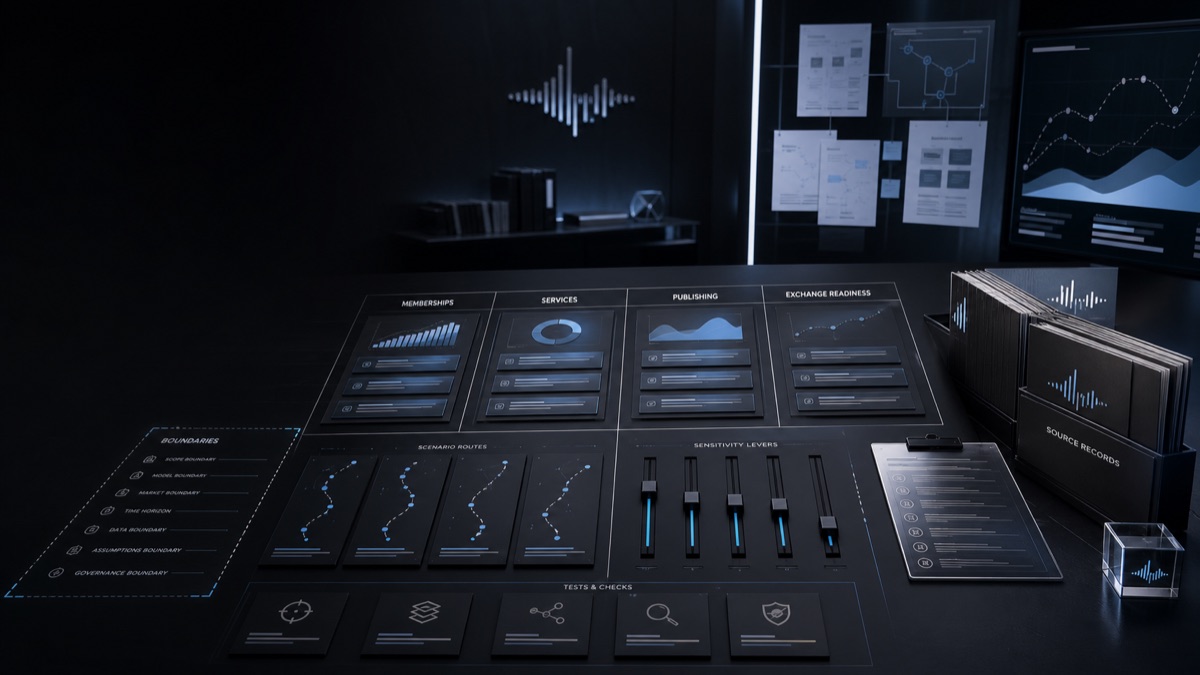
Public planning assumptions
The model is useful only after its assumptions are visible.
This route explains the current public planning model before a reviewer reacts to the upside. It separates base-case operating logic, sensitivity triggers, explicit non-claims, and the proof thresholds that would justify a model revision.
Use boundary
This memo is for general information only. It is not investment advice, not an offer to sell or solicit securities, not audited reporting, and not a promise of financial return. It summarizes planning logic from the public White Noise investor model and should be read with the claim-boundary and proof-state materials on the site.
Visual boundary
The hero image is a GPT-generated editorial planning-assumptions visual. It is not audited financial reporting, not a forecast, not a financing document, not evidence of production analytics, and not proof that speculative White Noise technologies are commercially deployed. Review the image provenance record.
Board view
The base case should begin with what is already legible.
The public model should be interpreted as an illustrative management planning model. White Noise is a live content, learning, services, and creator-platform venture, while the fourteen frontier technologies remain speculative IP and research direction rather than shipped commercial hardware.
The model is healthier when current commercial surfaces carry the base case before frontier-system upside is considered.
Exchange upside belongs behind launch, provenance, legal, and operating-readiness gates, not inside the minimum trust case.
Capital logic should harden workflow, analytics, lifecycle systems, R&D delivery, legal, privacy, and compliance before expanding narrative surface area.
Commercial quality depends on conversion, retention, and scoped delivery.
The public plan assumes early revenue quality comes primarily from paid member conversion, scoped consulting and Custom R&D work, modest publishing/licensing expansion, and only readiness-gated creator or Exchange tooling.
- Membership pricing basis: current public model uses
$25/month,$240/year, and a modest blended annualized revenue basis. - Custom R&D basis: the model assumes bounded scopes can be sold across the current public budget bands.
- Exchange conservatism: live public market activity should not be implied before launch controls and operating readiness exist.
Paid conversion and retention are more important than aggressive price expansion. Visitor interest without retention weakens recurring-revenue quality.
Scoped work is the fastest route to higher-ticket revenue, but only repeatable closed scopes can support tighter delivery assumptions.
Server-backed routing, source-of-truth reporting, and real KPI cadence would make the public model more defensible.
Public trust can be damaged if market language gets ahead of launch controls, provenance, and legal/operating readiness.
More artifacts and owners are needed before taste, sales, delivery, and narrative dependence can be treated as lowered.
Paid conversion, retention, pipeline, operating-stack maturity, Exchange readiness, or R&D scope outcomes should materially change before the model changes.
If the projection table is the first thing a serious counterparty reads, the diligence order is wrong.
The stronger sequence is:
- Inspect the live surfaces.
- Read the claim and materials boundaries.
- Read this planning assumptions memo.
- Only then react to the upside model.
Board testKeep the assumptions inspection-friendly.
ModelInvestor RelationsCurrent public model context and capital route.
RevenueRevenue ReadinessLive revenue layers and stronger proof gates.
MetricsMetrics Release PolicyRules before publishing measured traction or revenue evidence.
RiskRisk RegisterCapital, founder, launch, and claim-state review triggers.
When model language changes, the public materials manifest, risk register, metrics policy, and review evidence ledger should change with it.