 White Noise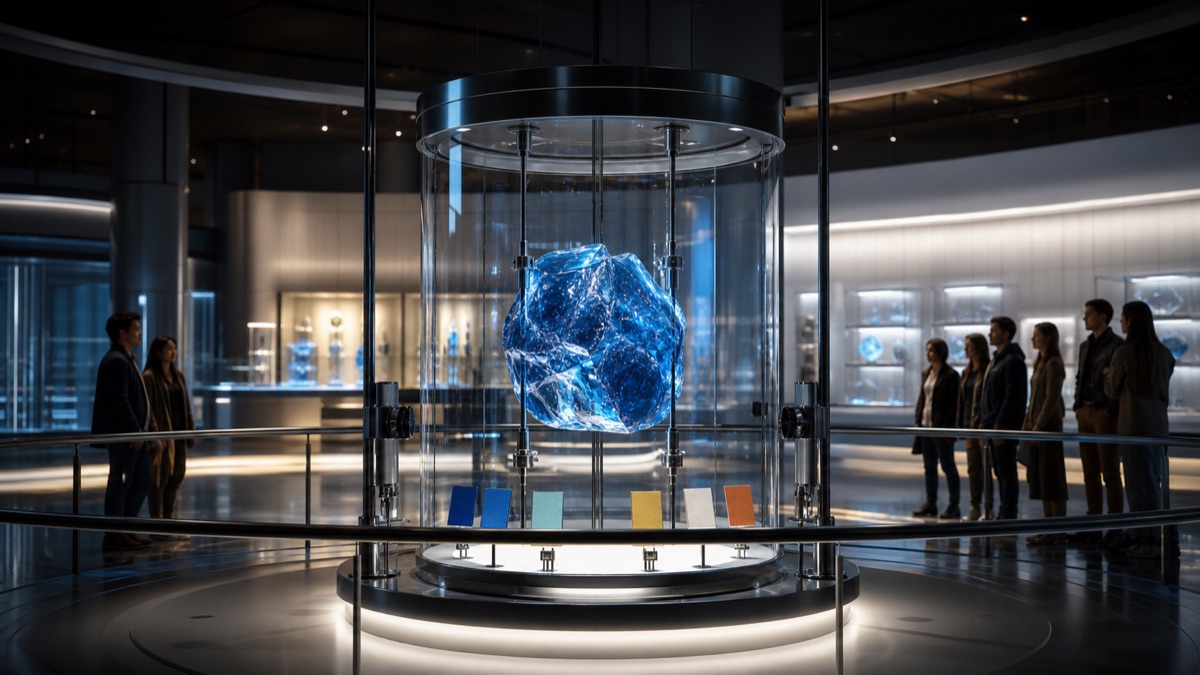
Blue Gue Sample Custody in Public starts from a White Noise habit that is worth keeping: the larger the horizon, the more ordinary the first instrument should be. White Noise Totality speaks in the language of reality-scale computation, matter, medicine, settlement, and engineered worlds. The public site has to translate that language into education, media, research scoping, community, and carefully bounded marketplace activity. This essay treats the source-world claim as a generator of questions, not as proof that the capability exists today.
The working artifact is the custody card for Blue Gue samples. It is intentionally modest. A modest artifact protects the ambitious idea by making it inspectable. It gives WN Academy a studio exercise, WN Labs a research question, services a scoping vocabulary, and the WN Encyclopedia a reference term that can be linked without turning speculation into product copy.
The Claim Boundary
The claim boundary is the place where language must stop getting warmer until evidence catches up. In Programmable Matter, the boundary can be crossed by a rendering, a roadmap label, a course title, a marketplace description, or an article that repeats the source-world phrase without its status. The safe version names the source, the present frame, the missing test, and the sentence that should not be written yet.
For this essay, the present frame is materials testing, chain of custody, responsive polymers, lab displays, and safety communication. That frame is not a downgrade. It is the usable bridge between a civilization-scale book and work that can be taught, debated, measured, or refused now. Present-day tools give the concept friction: budgets, operators, logs, failed attempts, public objections, and maintenance duties.
What The Artifact Should Show
A serious custody card for Blue Gue samples should show five things. First, it should name the claim in a sentence short enough to audit. Second, it should identify the evidence level: source-world concept, design study, analogy, prototype, validated method, or service. Third, it should list what would change the status. Fourth, it should preserve at least one failure or refusal path. Fifth, it should link to nearby terms so a reader can see the concept in context rather than as isolated spectacle.
This matters because White Noise language is unusually powerful. Words like omnipresent, immortal, post-scarcity, synthetic, superintelligent, and engineered do not behave like neutral adjectives. They can change what a reader believes is already possible. A responsible page slows those words down with measurement and governance.
The Editorial Standard
The editorial standard is simple: keep wonder and receipts in the same room. If the article discusses a speculative capability, it should also discuss the operator, the cost, the physical limit, the appeal path, and the strongest reason the claim might fail. If the article discusses a current White Noise offering, it should avoid borrowing authority from future technology. Reading the book is not buying a product. Joining a community is not an investment. Taking a course is not receiving an accredited degree. Studying a research theme is not proof of deployment.
The most useful White Noise pages therefore sound ambitious but not breathless. They are allowed to be cosmic in scope, but they must remain local in accountability. A concept that cannot be measured can still be explored. A concept that cannot be refused should not be operationalized.
The Failure Mode
The failure mode for this topic is letting a vivid material name imply repeatability, safety, or field readiness without records. It usually happens through compression. A long caveat becomes a short headline. A roadmap becomes a promise. A model becomes a system. A system becomes a service. Each step feels minor, but the final sentence carries more certainty than the evidence can bear.
The cure is not to make White Noise smaller. The cure is to make its status visible. Readers should be able to tell whether they are encountering fiction-derived vocabulary, a research exercise, a public product, a community path, a governance proposal, or a commercial offer with legal boundaries.
How To Use This Term
Use Blue Gue custody card when it helps a reader understand where a White Noise claim is being tested, limited, or translated. Avoid it when it merely decorates a page with the feeling of rigor. Related vocabulary includes Blue Gue, W.N. Material, sample custody, programmable matter, public lab. The links below keep the phrase close to its reference entries and nearby essays.