 White Noise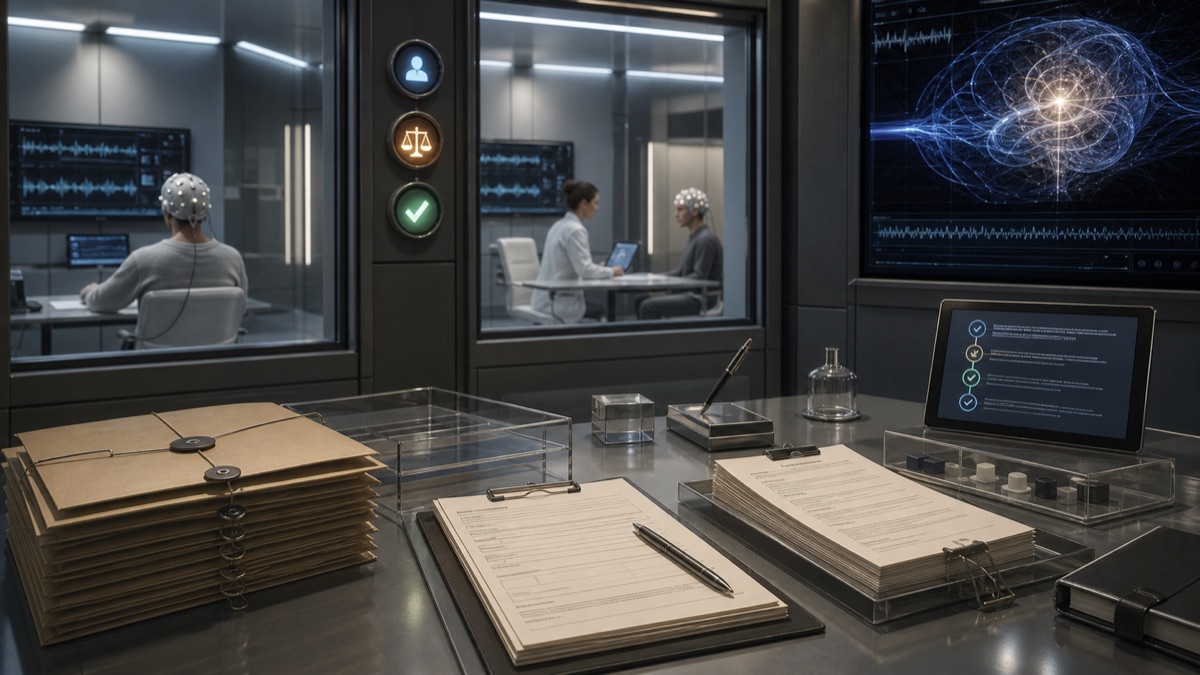
Consent Receipts for Remote Cognition starts from a simple editorial rule: a White Noise idea can be vast without pretending to be finished. White Noise Totality supplies a source-world vocabulary for systems that reach across computation, matter, medicine, settlement, and civilization design. WN Magazine translates that vocabulary into public language readers can inspect, question, and use without mistaking it for a shipping claim.
The working artifact here is the remote cognition consent receipt. It is intentionally smaller than the horizon around it. That smaller scale is not a retreat from ambition; it is the method by which ambition becomes useful. A bounded artifact can be taught by WN Academy, scoped by WN Labs, discussed by services, and linked by the WN Encyclopedia without borrowing authority from a capability that has not been externally proven.
The Claim Boundary
This feature belongs to Research Method, but its central pressure appears across the White Noise stack. A term can become overheated when it passes too quickly from book language to product language, from studio exercise to credential language, from provenance to investment language, or from research interest to deployment claim. The boundary is the place where the page says what it can support and what it cannot.
For this topic, the sentence stops at pre-registration, consent records, blind judging, privacy review, and neuroscience-adjacent research methods. Those present materials are not substitutes for the far-horizon concept. They are the nearest honest instruments: the benches, ledgers, public rooms, review paths, and records that let readers see what is known, what is guessed, and what remains outside current capability.
What the First Version Should Prove
The first version should prove discipline before it proves power. A remote cognition consent receipt should identify the exact claim under review, the evidence level behind it, the operator responsible for it, the cost or consent ledger attached to it, and the point at which the claim must pause. It should also make negative evidence usable. A failed test, a refused consent path, a missing source, or a heat burden can be more valuable than another polished rendering.
That is the practical translation of the White Noise tone: cosmic ambition joined to measurement. The site can invite impossible-scale thinking while still giving the reader ordinary tools of judgment. When a page shows its limits, it does not weaken the project. It makes the project more available to serious collaborators, skeptics, students, and builders.
Near-Term Translation
The near-term version of this idea is not a hidden product claim. It is an editorial, educational, and research-scoping practice. A reader should be able to take the phrase into a studio critique, a WN Labs conversation, a service brief, or an encyclopedia search and know which layer they are using. That means the page must preserve distinctions between book-world imagination, present public offerings, prototype literacy, and any future research program that would require outside validation.
Those distinctions also protect the reader from false urgency. Nothing in this essay asks the reader to believe that the far-horizon system is available, accredited, clinically validated, financially promising, or operationally deployed. The useful action is smaller and more durable: name the evidence needed, identify the rights at stake, show the maintenance burden, and keep the next public sentence inside what can be defended.
Failure Mode and Stewardship
The primary failure mode is treating a surprising cognitive report as permission to bypass consent or protocol. It can happen through compression rather than malice. A memorable phrase loses its caveat. A beautiful image circulates without its evidence status. A roadmap is quoted as if it were a deployment plan. A reader remembers the wonder and forgets the boundary.
Stewardship must therefore be part of the design surface. The relevant controls are often plain: source notes, consent receipts, pause buttons, maintenance logs, safety cases, repair rights, null results, and noninvestment language. These controls keep public imagination from becoming public confusion. They also keep White Noise Inc.'s current offerings legible as education, media, community, research, and marketplace services rather than as proof that speculative technologies are available.
Editorial Use
Use this idea when it clarifies responsibility. Do not use it as ornament. The primary search phrase is remote cognition consent receipt; nearby vocabulary includes remote viewing research, consent receipt, cognitive privacy, controlled protocol, evidence custody. A good use of the term names who can inspect the claim, who can refuse it, what evidence would change its status, and what claims should stay off the page until stronger proof exists.
The internal links below connect the magazine essay to its encyclopedia term and to adjacent essays from this batch. That link structure is part of the editorial system: it gives readers a path from narrative to definition, from definition to nearby risk, and from risk back to the public White Noise pages where disclaimers and current service boundaries remain visible.