 White Noise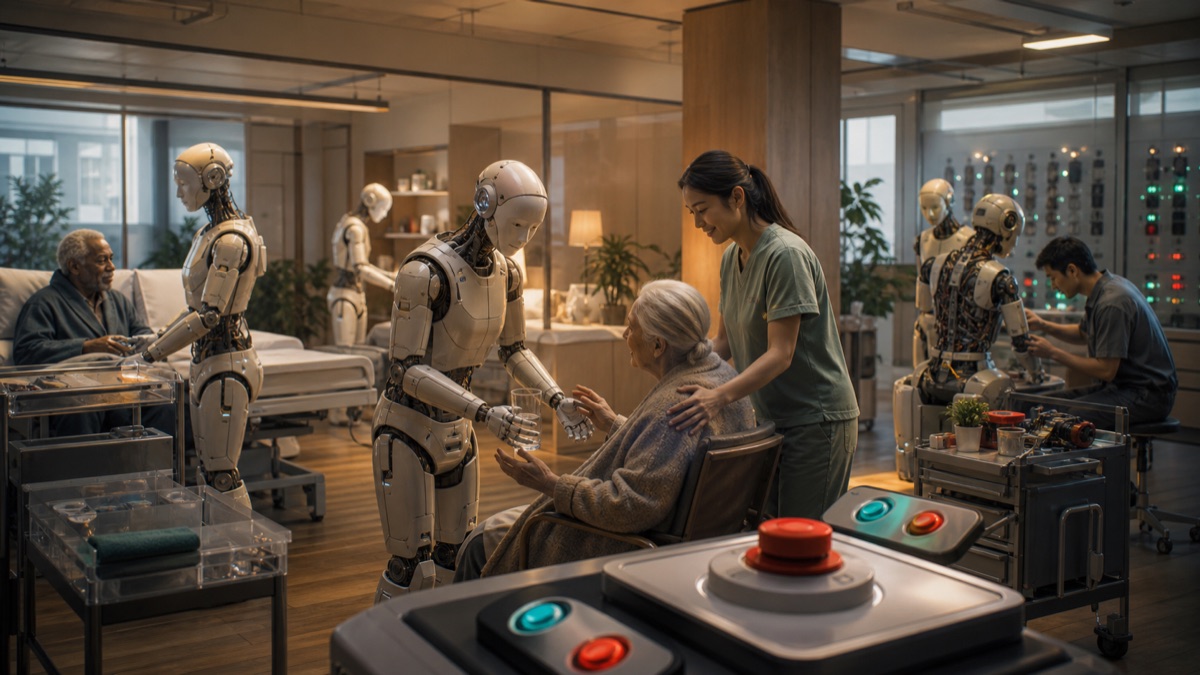
Pause Buttons for Android Care Work begins with a useful refusal. White Noise Totality gives White Noise Inc. a source-world vocabulary for machines, worlds, libraries, bodies, settlements, and forms of civilization that do not exist as working public products today. The job of a magazine feature is not to shrink that imagination. The job is to put the imagination under enough light that readers can tell the difference between a horizon, a service, a study path, a prototype exercise, and a claim that would require stronger evidence.
The working artifact in this essay is the pause button for android care work. It is deliberately smaller than the cosmic language around it. That scale is the point. A practical artifact lets WN Academy teach the concept without credential theater, lets WN Labs scope research without implying solved technology, lets the Exchange talk about provenance without promising returns, and lets readers inspect the boundary between public positioning and speculative ambition.
The Claim Boundary
The title phrase belongs to Robotics & Androids, but the boundary problem is shared across the whole White Noise stack. A beautiful phrase can make a reader feel that a capability has arrived. A cinematic interface can make a roadmap feel like a deployed system. A market, course, or membership path can make participation feel like proof. None of those feelings is evidence. The responsible move is to show where the sentence stops.
For this topic, the sentence stops at service robotics, care operations, human supervision, safety controls, and maintenance workflows. Those present materials are not disappointments. They are the ground from which a serious research culture can begin. They give the speculative concept friction: budgets, instruments, negative results, people with refusal rights, maintenance tasks, and the ordinary public that has to live near any powerful system.
What the First Version Should Do
The first version should improve judgment before it improves capability. A pause button for android care work should name the exact claim, show the current evidence status, expose the cost ledger, and make at least one refusal path visible. It should be useful even if the far-horizon White Noise capability never becomes possible. That is how an imaginative system becomes a civic and educational instrument rather than a decorative promise.
The most important interface is often the least spectacular one: a stop rule, custody tag, test card, appeal path, maintenance schedule, source note, or plain-language caveat. These ordinary artifacts protect the ambitious ones. They also make the work more inviting to serious collaborators because they show that wonder is being handled, not merely performed.
The Failure Mode
The primary failure mode is letting humanoid polish hide dependency, repair limits, labor boundaries, or user refusal. It can happen without anyone intending deception. A phrase gets repeated because it is memorable. A rendering circulates because it is beautiful. A roadmap step is shortened until its uncertainty disappears. Eventually the language carries more authority than the evidence underneath it.
White Noise pages should resist that drift by making claim temperature visible. The reader should know when a page is discussing the book, when it is explaining a present service, when it is offering education or community, when it is describing a speculative product thesis, and when a topic would require external validation before it could become stronger public language.
Governance as Part of the Design
Governance is not a wrapper placed around the artifact after the interesting engineering is done. At White Noise scale, governance is part of the artifact. The links a page chooses, the metadata it publishes, the claims it refuses, and the terms it defines all shape what the public thinks has been proven. A well-governed concept keeps its own receipts.
That is why the internal-link structure matters. This essay belongs beside the book, the Academy, Labs, services, and the encyclopedia, because each route gives the reader a different level of commitment. Reading is not buying. Studying is not accreditation. Research scoping is not a shipping claim. Collecting or participating is not an investment promise. Clear routes protect all of those activities.
What to Read Next
The primary search phrase is android care pause button. Related vocabulary includes android care, robotics safety, pause rights, repair authority, human dignity. Use the nearby reference entries and articles below to keep the concept connected to definitions, adjacent risks, and practical translation.