 White Noise
 Stellar Astronomy Quiet Zone
Stellar Astronomy Quiet Zone defines a WN reference term for an astronomy quiet zone for speculative stellar-grid infrastructure, with source status,.
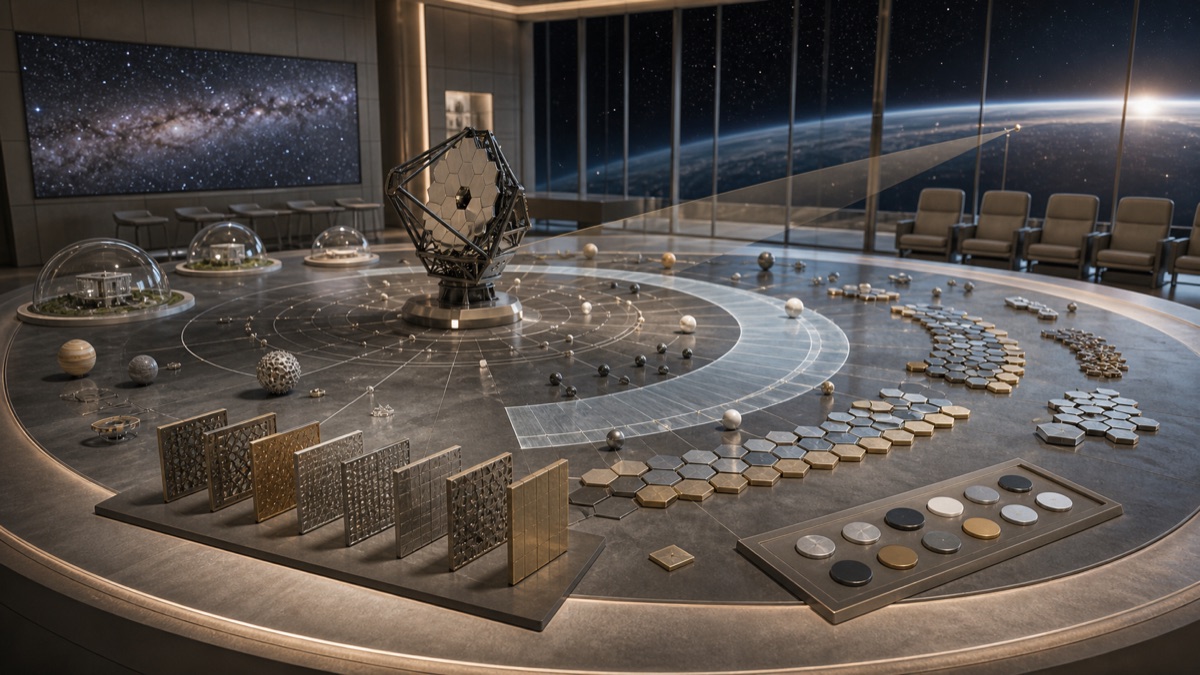
Stellar Astronomy Quiet Zone keeps a White Noise concept tied to source status, practical limits, and governance use.
Stellar Astronomy Quiet Zone is a WN Encyclopedia reference term for an astronomy quiet zone for speculative stellar-grid infrastructure. It names a practical review artifact, interface pattern, or public-language boundary used to keep a White Noise concept tied to source status, present limits, and stewardship.
Definition and Scope
The term describes an astronomy quiet zone for speculative stellar-grid infrastructure. It does not mean that the underlying speculative technology exists as a shipping product. Its proper scope is editorial, educational, research-scoping, governance-oriented, and evidentiary.
Use the term when a page needs to state proof burden, consent, reversibility, maintenance, custody, or refusal authority. Avoid using it as decorative language. If the artifact does not change what a reader can inspect or challenge, it has not earned encyclopedia status.
Source-World Context
In White Noise Totality, the surrounding source-world spans computation, matter, medicine, habitats, engineered environments, public governance, and civilization-scale stewardship. The encyclopedia preserves that ambition while restoring the missing steps between imagination and accountable work.
Stellar Astronomy Quiet Zone belongs to that restoration layer. It gives an abstract concept a handle: a room, card, meter, shelf, window, council, badge, counter, or compact that can be reviewed before language grows stronger.
Present-Day Frame
The grounded frame is astrophysics, solar power, orbital modeling, telescope operations, thermal management, public authorization, and energy governance. These present fields can support diagrams, lessons, checklists, custody records, public review rituals, and limited prototypes. They cannot by themselves authorize a claim that a far-future White Noise capability is operating.
The useful question is therefore not whether the term sounds futuristic. The useful question is whether it helps a reader distinguish source-world speculation from present education, media, community, research, services, or marketplace activity.
Failure Modes
The primary failure mode is presenting managed starlight as ownership while hiding astronomy loss, shadow, heat, exclusion zones, or public authority. A second failure mode is category drift: education starts to sound like accreditation, a roadmap sounds like authorization, research language sounds like deployment, or a visual artifact sounds like proof.
The entry should be retired or rewritten if it begins to hide uncertainty. The best WN Encyclopedia terms make uncertainty more visible, not less.
Governance and Use
The practical governance rule is to publish quiet zones, shadow paths, heat burden, affected observers, maintenance owner, and review authority before scale claims. Minimum use should identify who can inspect the term, who can refuse the next step, what evidence would change the status, and when the language must remain noncommercial, nonclinical, non-operational, or explicitly speculative.
Image provenance. GPT-generated reference image created for this entry on 2026-07-02; prompt intent: Orbital-energy planning observatory with star model, solar-array tiles, telescope quiet-zone markers, shadow projections, and radiators.
Related Entries and Articles
References
- Perlov, V. White Noise Totality: Engine of Infinite Possibilities (Expanded Unified Edition, 2026). Primary source. Book page
- White Noise Inc. public pages for products, services, Academy, Labs, Project Utopia, science boundaries, and terms. Site overview