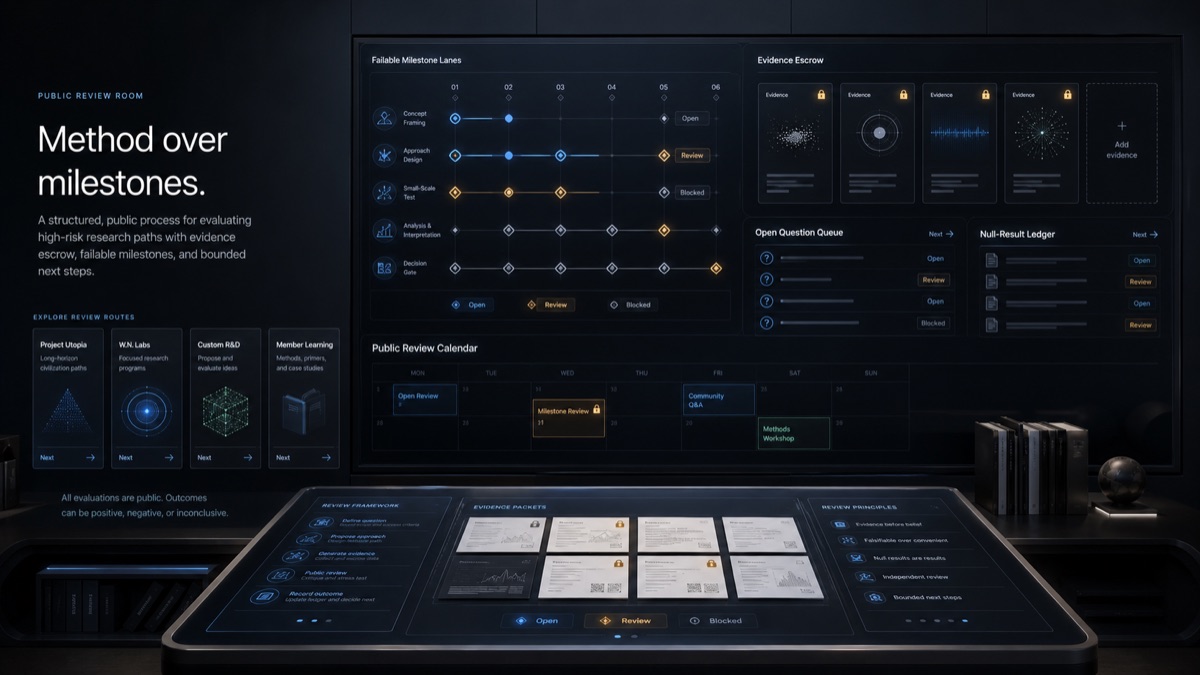
AI-generated White Noise Totality Grand Challenge review room with failable milestone lanes, evidence escrow, open question queue, null-result ledger, public review calendar, and route cards
White Noise Totality route

The Grand Challenge of Totality.

White Noise Totality asks whether intelligence could become entangled with the informational fabric of reality itself. The Grand Challenge turns that north star into a public research discipline: name the White Noise Computer claim, attach the source trail, test the smallest version, count null results, and keep stewardship ahead of power.

Source and image boundary
This page is grounded in the White Noise Totality manuscript and its speculative vocabulary. The hero image is a GPT-generated review-room visual created on 2026-06-30. Asset: assets/grand-challenge/wn-grand-challenge-method-review-room-20260630.jpg. Review provenance. Usage boundary: editorial orientation only, not proof of a live review board, deployed system, audited evidence corpus, model training run, or civilization-scale capability.

Totality method

Start with the book's impossible question, then make it testable.

In White Noise Totality, the computer is not just a machine in a room. It is a hypothetical interface to universal information, paired with AI, brain-computer pathways, OSTSS infrastructure, replicators, the Library, and Project Utopia. A Grand Challenge page for that vision has to translate cosmic ambition into staged research, evidence boundaries, and ethical brakes.

AI-generated Grand Challenge public review interface showing failable milestone lanes, evidence escrow cards, null-result ledger, and bounded route cards
Generated Totality review room The image is a concept surface for reviewing claims that originate in White Noise Totality.

It shows failable lanes, evidence cards, null results, and route choices. It does not claim a live dashboard, completed evidence review, or operational White Noise technology.

01 / Totality premise

Treat the universe-as-information claim as the first research object.

The work starts with the manuscript's core idea: reality as an entangled informational fabric. The public task is to decide what, if anything, could be observed, modeled, or disproved.

02 / Reverse-engineering path

Separate clues from capabilities.

Remote viewing, quantum engineering, AI, neurotechnology, and signal recovery can enter the room only as bounded questions with controls, citations, provenance, and failure modes.

03 / Civilization stack

Map each future system to a present test.

OSTSS, WNIOS, the White Noise Library, replicators, digital medicine, Blue Foam, and Project Utopia become separate research lanes instead of one overwhelming promise.

04 / Stewardship gate

Power claims must carry governance claims.

The manuscript's risks - autonomy loss, privacy collapse, concentration of power, value drift, and psychological dislocation - stay visible before anyone routes into labs, funding, or commissioned work.
Review lanes

Four lanes translate Totality without flattening it.

The manuscript moves from the White Noise Computer to a whole civilization: self-building settlements, replicators, medical continuity, superintelligence, engineered verses, and Project Utopia. Each lane gives visitors the right level of contact with that source-world.

Read

Totality source-world

Use the book, Project Utopia, and core technology pages to understand the worldview before treating any single scene as a present product or evidence claim.

Test

White Noise Computer questions

Use WN Labs when a Totality claim can be reduced into a method, control, instrument, reproducibility note, and plain-language finding.

Scope

OSTSS and replicator packets

Use the sponsor route when a partner needs one written decision packet around infrastructure, fabrication, governance, or source rights - not a promise of breakthrough.

Learn

Stewardship vocabulary

Use Academy, Club, and member workspace routes to learn the language of Totality: entanglement, WNIOS, the Library, remote viewing, Blue Foam, and governance.

Operating principle

Totality is a north star, not a product claim.

The book is useful because it carries long questions: can recognition become cheaper than construction, can signal be recovered from noise, can civilization hold power without capture? The review loop keeps those questions alive without pretending the answers already exist.

01

Source claim

Choose one passage, technology family, or glossary term from White Noise Totality.

Artifact: Totality claim cardStatus: source located, source missing, or needs interpretation.
02

Present boundary

Separate speculative future language from current evidence, permissions, visuals, and known gaps.

Artifact: boundary receiptStatus: usable, needs review, not permitted, or future-only.
03

Failable test

Define the smallest desk review, lab question, model, protocol, or literature check that could narrow the claim.

Artifact: test briefStatus: pass, fail, blocked, inconclusive, or not testable yet.
04

Totality route

Send the outcome to the book, a core technology page, WN Labs, Custom R&D, member learning, or a no-go note.

Artifact: route receiptStatus: read, test, scope, learn, partner, or stop.
Conversion routes

Choose the next room by Totality question.

Different parts of White Noise Totality need different rooms. A philosophical reader needs the book. A researcher needs a protocol. A sponsor needs a decision packet. A member needs source-grounded synthesis before any claim is amplified.

Source

White Noise Totality

Best for visitors who need the originating argument: universe-scale computation, participatory cognition, civilization infrastructure, and stewardship.

Open the book
Protocol

WN Labs

Best when a claim about signal, computation, materials, AI, or cognition is ready to become a controlled question with a visible limitation.

Review lab protocol
Commission

Custom R&D

Best when a sponsor needs a written decision packet around a Totality claim, with method gates, source trail, and a no-go option.

Request a decision packet
Member

Member Workspace and Academy

Best for learning the Totality vocabulary and making source-aware syntheses before an idea is treated as product or evidence.

Open member workspace
Participation boundary

Start with one Totality claim, not the whole cosmos.

Bring one passage, one technology family, one decision, and one constraint. White Noise can then route it as a reading path, a lab protocol, a Custom R&D packet, or a no-go note without pretending the larger challenge has already been solved.

First inquiry

Use the form when a Totality claim has a decision attached.

For general exploration, start with the book, Project Utopia, or member workspace. For commissioned work, use the Custom R&D route and preserve the passage, question, threshold, source boundary, and expected artifact.