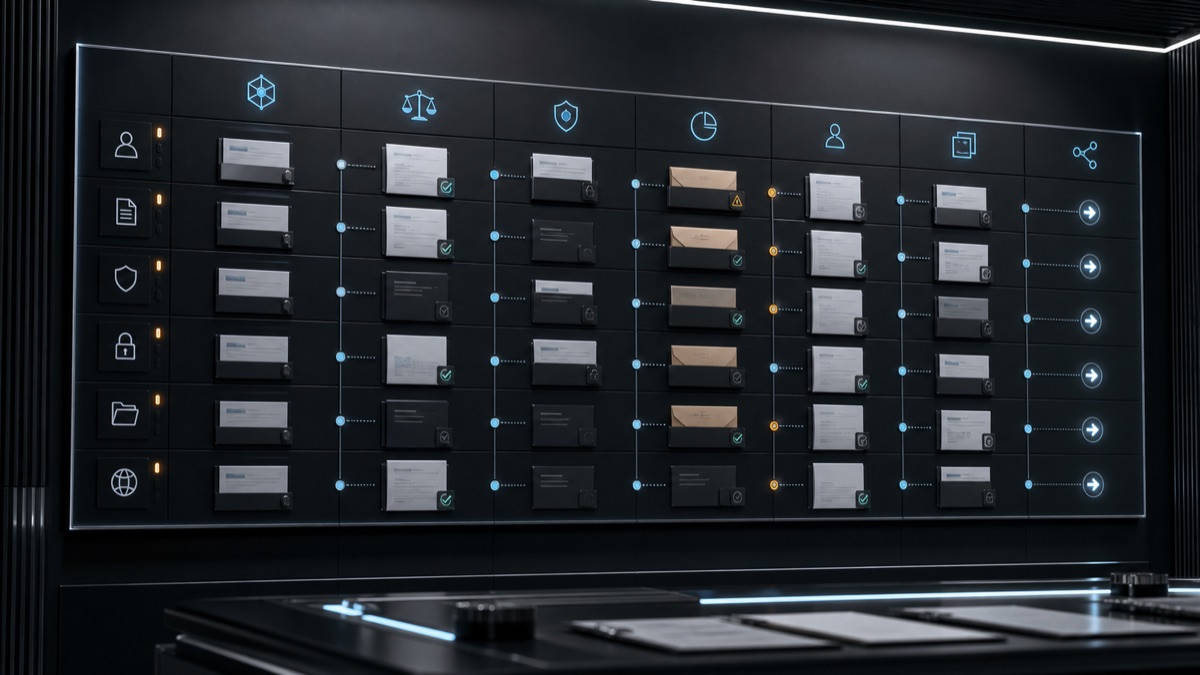
AI-generated White Noise decision ownership board with abstract owner lanes, evidence receipts, escalation gates, claim-change locks, source-record folders, and public-route markers
Home / Investor Relations / Decision Ownership Register
Public decision gate

Name the owner before the claim gets warmer.

This register maps high-risk White Noise public claim changes to the owner type, evidence floor, escalation trigger, allowed first action, and blocked claim. It gives serious reviewers a compact way to see which decision gate must move before language changes.

Visual boundary This GPT-generated image is conceptual governance art only. It is not proof of staffed owner lanes, audited controls, production CRM, formal financing process, live dataroom, live Exchange activity, operational speculative technology, a trained W.N. image model, or web-scale source ingestion. Review the image provenance record.
ReviewedJune 29, 2026

Created after the contact-routing evidence path hit an external provider-configuration blocker.
Coverage11 decision classes

Product, capital, KPI, contact routing, evidence, rights, privacy, dependencies, Exchange, visuals, and materials cadence.

Primary controlOwner type plus evidence floor

A warmer claim should not pass just because a page exists.

Non-claimNot proof of staffed functions

The register names gate ownership requirements; it does not prove delegated operating depth.

Decision rule

Six questions before public language changes.

  1. Which decision class is affected?
  2. What owner type must approve the move?
  3. What evidence floor is required?
  4. What escalation trigger has fired?
  5. What is the allowed first action?
  6. Which public claim remains blocked if the evidence is absent?
Board interpretation

The register is strongest when it prevents a premature claim.

  • If the owner type is missing, keep the claim bounded.
  • If the evidence floor is absent, route to the allowed first action.
  • If an escalation trigger fires, record the review before publishing warmer copy.
Ownership register

Map the decision before you change the page.

Each gate names the owner type and the evidence required before White Noise can responsibly move from bounded public language to a stronger claim.

Product capability

Product capability language

Prevents frontier product pages from reading as shipped systems.

Owner typeProduct review owner plus source/evidence owner.
Evidence floorProduct-stage record, evidence floor, blocked posture, source trail, dated review note.
Allowed first actionOpen a claim-boundary memo or product-stage review.
Blocked claimWhite Noise has deployed speculative hardware or operational frontier systems.
Capital narrative

Investor or capital language

Separates thesis, planning assumptions, and formal capital process.

Owner typeFounder plus finance/capital review; formal counsel route when securities or financing language appears.
Evidence floorSource-backed metric, current assumptions note, formal-process boundary, review receipt.
Allowed first actionRoute to capital-readiness response or board packet update.
Blocked claimAudited reporting, active securities process, investment performance, or formal financing materials are ready.
Metrics

KPI, conversion, and operating metrics

Keeps planning figures and board placeholders from becoming public actuals.

Owner typeBoard/KPI evidence owner plus source-record owner.
Evidence floorDate-windowed source record, exclusion logic, owner review, release label, public non-claim.
Allowed first actionUpdate KPI evidence register before page copy changes.
Blocked claimConversion, churn, pipeline, revenue, delivery, or Exchange readiness actuals are verified.
Contact routing

Contact routing and response workflow

Protects CRM, SLA, and staffed-workflow language until delivery records exist.

Owner typeIntake owner plus delivery-provider/source-record owner.
Evidence floorRedacted provider preflight, production health, confirmed synthetic delivery, provider receipt, owner review, fallback record.
Allowed first actionRun provider preflight and guarded synthetic test when a delivery mode is configured.
Blocked claimWhite Noise has production CRM, monitored enterprise workflow, or audited response metrics.
Counterparty proof

Customer, partner, sponsor, or outcome evidence

Stops anecdotes from becoming public customer proof.

Owner typeEvidence owner plus permission/review owner.
Evidence floorWritten permission, source context, approved usage channel, claim boundary, evidence level, review trigger.
Allowed first actionOpen customer-evidence permission review.
Blocked claimWhite Noise has named customer proof, audited outcomes, or permission to publish a counterparty signal.
Source rights

Source rights, corpus, and publishing reuse

Prevents stronger corpus, institutional-use, licensing, or training claims without source-specific records.

Owner typeSource-rights owner plus formal review where needed.
Evidence floorSource-specific rights record, permission state, attribution rule, usage channel, takedown route.
Allowed first actionCreate or update source-rights record.
Blocked claimAll source material is cleared for stronger institutional, training, marketplace, or licensing use.
Security/data

Security, privacy, and data handling

Separates current static/demo posture from enterprise-control claims.

Owner typeSecurity/privacy review owner plus dependency/data-flow owner.
Evidence floorData-flow record, access owner, vendor relevance, retention/deletion route, policy review.
Allowed first actionUpdate data-handling review record and dependency record.
Blocked claimWhite Noise has security-reviewed enterprise controls, compliance certification, or legal-reviewed privacy packet.
Dependencies

Third-party dependency posture

Blocks vendor-maturity language until service-level records exist.

Owner typeVendor/dependency owner plus continuity owner.
Evidence floorService-level dependency record, terms source, data class, access owner, continuity/offboarding plan.
Allowed first actionOpen dependency service record.
Blocked claimWhite Noise has vendor audit, procurement maturity, SOC 2/ISO evidence, PCI evidence, or service-level assurance.
Exchange launch

Exchange, WN Coin, custody, and marketplace launch

Keeps sale, custody, liquidity, and market-operation language behind launch controls.

Owner typeLaunch owner plus legal/compliance, payment/settlement, support, rollback, and board review.
Evidence floorLaunch evidence file, counsel route where applicable, payment/settlement owner, incident plan, rollback owner, board decision.
Allowed first actionKeep launch-status note current and open launch evidence checklist.
Blocked claimExchange, WN Coin, custody, liquidity, token sale, creator payout, or marketplace operations are live.
Generated visuals

Generated visuals and AI material

Preserves provenance and non-proof labels for trust-critical images.

Owner typeVisual provenance owner plus claim reviewer.
Evidence floorAsset file, alt text, prompt intent, provenance JSON, usage boundary, blocked implications, review cadence.
Allowed first actionAdd provenance record and image register/index entry.
Blocked claimA generated visual proves real operations, trained W.N. image model, web-scale ingestion, customer traction, or speculative systems.
Materials cadence

Public materials and review cadence

Makes public artifact publication a controlled output, not scattered content drift.

Owner typeMaterials integrity owner plus board-review owner.
Evidence floorManifest entry, index entry, integrity check, search/sitemap update, review memo, preserved non-claims.
Allowed first actionUpdate materials manifest and run integrity check.
Blocked claimThe public stack is current without dated review evidence.
Current non-claims

This route does not represent stronger operations as ready.

  • delegated owners for every decision class
  • staffed support, monitored CRM, or enterprise workflow operations
  • audited KPI, revenue, conversion, traction, or customer-outcome reporting
  • security-reviewed enterprise controls packet or compliance certification
  • live Exchange market operations, token sale, custody, liquidity, or creator payouts