Use one role only: investor, board reviewer, enterprise buyer, strategic partner, institution, sponsor, or credibility reviewer.
Public investor note builder
Build the first note that can be answered honestly.
This route turns a useful internal question into one bounded external note. The goal is not to sound broad. The goal is to pick the right lane, then name one reviewed surface, one boundary, and one expected first-return artifact so the reply can stay legible and truthful.
Use boundary
This builder is for general information only. It is not investment advice, not an offer to sell or solicit securities, not a subscription document, not a secure diligence room, and not proof of audited reporting, enterprise workflow maturity, or commercially deployed speculative technology.
Visual boundary
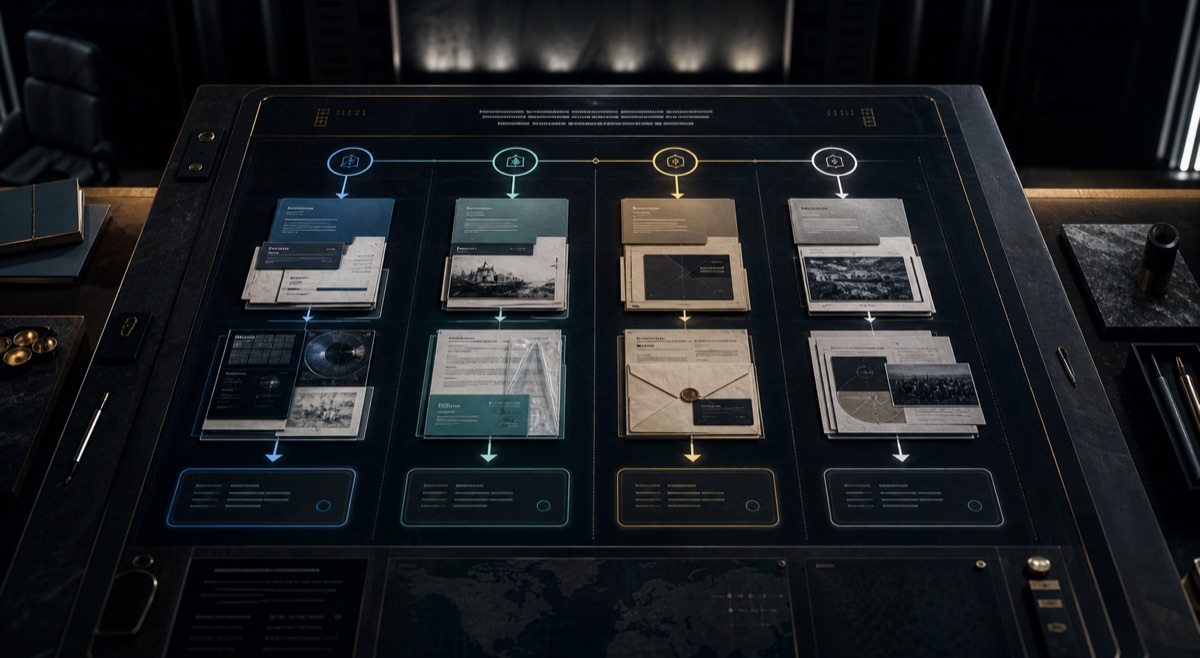
This page reuses the existing GPT-generated first-artifact route-board image because the improvement here is message clarity, not missing visual explanation. The image is editorial support only and not proof of a staffed investor desk, production CRM, secure diligence workflow, formal financing process, or audited operating controls. Review the image provenance record.
Template anatomy
Five fields keep the first reply bounded.
A stronger first note reduces routing ambiguity. It tells White Noise what decision is being made, what public work was already reviewed, what risk matters most, and what artifact would be useful next if the route is real.
Name the actual page, packet, memo, or note you reviewed first so the reply does not start from zero.
The best first ask is a walkthrough, memo, scope path, or formal-process note tied to one concrete decision.
Examples: proof depth, current delivery maturity, source-rights clarity, security posture, or financing-process boundary.
The route should return one bounded artifact or say plainly that the requested material is not represented as ready yet.
Lane builder
Load the right first-note lane before you copy anything.
Use boundary
This builder only rearranges current public materials and expected first-return artifacts. It does not create a dataroom, audited packet, secure diligence workflow, or formal financing process.
Strategic capital
Open current proof state before a broader capital story.
Use the latest investor update, the capital-readiness note, and the current board review packet when the real question is whether White Noise merits a first serious capital or board-readiness conversation from current public materials.
Subject: White Noise first diligence note: strategic capital / current proof state
We are a strategic capital reviewer looking at the Investor Relations page and current capital posture.
We already reviewed the latest public investor update and the capital-readiness note.
Please send the first artifact for whether the current proof state is strong enough for a narrow first call.
The main boundary we want addressed is missing formal-process materials and current delivery maturity.
The first return artifact we expect is a capital-readiness response or claim-boundary memo tied to one concern.
Our timing is within 2 weeks.
If that material does not exist yet, please say so plainly and route us to the best public next step.
Fast variants by role
Start with the artifact that matches the decision.
Each lane below keeps the note bounded to a current public surface. These links do not imply a dataroom, audited reporting set, secure diligence room, staffed enterprise workflow, or formal financing process.
- Start with
wn-investors.htmlorwn-capital-readiness-note.html. - Ask for a claim-boundary memo or capital-readiness response.
- Name proof depth, delivery maturity, or governance state as the main boundary.
- Start with
wn-services.html,wn-labs.html, or the sample delivery case study. - Ask for a workflow walkthrough or scoped path tied to one buying decision.
- Name data, security, delivery, or operating maturity as the main boundary.
- Start with
wn-partner-fit-memo.htmlandwn-commercial-surface-register.html. - Ask for a partner-fit walkthrough or boundary memo.
- Name rights, program fit, or operating boundary as the main risk.
- Start with the Trust Center, generated-visual disclosure standard, or source-rights register.
- Ask for a claim-boundary memo or public-surface walkthrough.
- Name provenance, editorial imagery, or missing-proof discipline as the boundary.
Before you send
Make the first request easier to answer than to oversell.
The note becomes stronger when it makes overclaiming harder. That means naming one public artifact already reviewed and being willing to hear that a formal or private material does not exist yet.
Strong first note checklist
- One role.
- One surface or decision.
- One artifact needed next.
- One named boundary.
- One timing window.
- A clear expectation that White Noise can say "not ready yet" plainly.
Do not ask for these first as if they already exist
- Audited financial statements.
- Audited KPI or conversion reporting.
- Production CRM or enterprise workflow proof.
- Security-reviewed enterprise controls documentation.
- Formal financing documents or an active securities process.
- Proof that speculative White Noise technologies are commercially deployed.