The reply starts by saying what delivery state is true instead of implying a monitored desk.
Public response discipline
The first reply should tell the truth about the room.
This public standard defines what White Noise should do after a serious first note arrives: disclose route state, return one useful next artifact or redirect, name one explicit boundary, and avoid implying stronger support, diligence, or financing infrastructure than the current build can prove.
Use boundary
This is a public first-response artifact only. It is not investment advice, not an offer to sell or solicit securities, not a contractual SLA, not proof of a staffed enterprise support or investor-relations desk, and not proof of production CRM or security-reviewed workflow.
Visual boundary
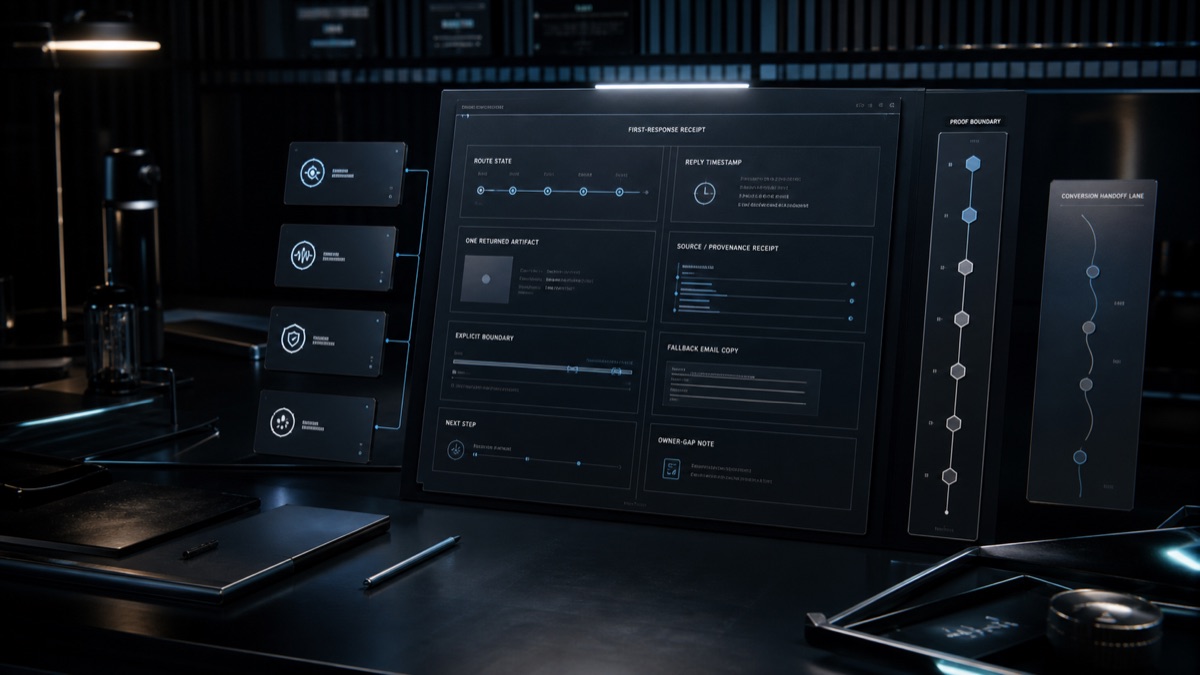
The hero image is a GPT-generated editorial first-response receipt surface created for this page. It is not proof of monitored inbox coverage, audited response metrics, production CRM, staffed support workflow, active financing process, legal review, customer traction, or operational speculative technology. Review the image provenance record.
A serious inquiry should leave with route state, one useful artifact, one named boundary, and a next move that does not overstate operating maturity.
Receipt Surface
Make the first reply inspectable before it becomes persuasive.
The strongest product and studio experiences show the working object early, then put conversion beside it. For White Noise, the object is not a generic support ticket. It is a bounded receipt that names the route, returns one artifact, preserves provenance, and tells the visitor what is still not proven.
The first response should return a walkthrough, memo, packet, redirect, or reason the ask is not ready.
Missing audited metrics, confidential proof, production CRM, or security review should be named directly.
Services, Labs, Academy, partnership, investor, media, privacy, and security asks should not collapse into one inbox.
Use this whenA reviewer needs a clean first answer.
TriageClassify the route.The standard protects trust by keeping the response smaller than the ambition.
Confirm route type, owner state, and escalation gate.
ArtifactPick one return.Choose the smallest credible next object.
RouteSend a bounded note.Carry the question, decision, and boundary into contact.
Image provenance: original GPT-generated first-response receipt surface created on 2026-07-01 for this page. Asset: assets/governance/white-noise-first-response-receipt-surface-20260701.jpg. Review the provenance record. Usage boundary: editorial orientation only, not proof of monitored inbox coverage, audited response metrics, production CRM, staffed support workflow, active financing process, legal review, customer traction, or operational speculative technology.
Board view
The trust gain is in the first answer being smaller, cleaner, and truer.
As of June 28, 2026, White Noise already presents public routing surfaces, a bounded investor intake, a note template, a triage protocol, and a first-return artifact menu. Those materials make the intended discipline inspectable. They do not prove staffed support coverage, enterprise workflow maturity, audited KPI reporting, or formal financing operations.
The first reply should confirm whether the route is live, demo-fallback, alternate-email, or otherwise unconfirmed.
Return a walkthrough, boundary memo, scoped route, capital-readiness response, or formal-process note instead of a vague acknowledgment.
If the ask depends on audited financials, KPI proof, production CRM, security-reviewed controls, or financing documents, say that plainly.
Redirect services, Academy, partnership, media, or regulated questions instead of forcing everything through one investor narrative.
Disclose route state before warmth.
The first reply should not imply stronger delivery infrastructure than the environment supports. If the route is live, say so. If the route is saving a local demo fallback or needs alternate email handling, say that plainly too.
Return one useful next artifact.
The right first reply usually returns one bounded next artifact tied to the decision: a public-surface walkthrough, a claim-boundary memo, a capital-readiness response, a partner-fit response, a scoped services route, or a formal-process note.
Name the main boundary directly.
If the request depends on stronger proof than the current public stack supports, the reply should state that without hedging. Missing materials are cleaner to name than to simulate.
Keep the answer in the right room.
If the inquiry is really services, Labs, Academy, sponsorship, institutional, media, privacy, or security related, route it there. Do not let an investor-facing surface pretend to be the universal company inbox.
Keep the first reply bounded.
The best first reply answers one decision, one packet request, and one risk boundary. It should not inflate into an implied diligence program unless a stronger process actually exists.
A serious counterparty should expect five things from the first reply.
- Confirmation of route state.
- One triage class and first-return type.
- One bounded artifact or redirect.
- One named boundary.
- One next step.
That material is not represented as ready in the current build. Here is the best public artifact or next route available now.
That answer builds more enterprise trust than implying a deeper room that does not yet exist.
Use a first reply shaped like this.
- We received your note about the surface or decision you named.
- The current route state is live routing, demo fallback, alternate route, or unconfirmed.
- The first artifact we can return is the one bounded item available now.
- The main boundary to keep in view is the missing proof or non-claim.
- If more is needed, the next appropriate route is named explicitly.
Reading ruleThe first response should tell the truth about route state, artifact availability, and what still is not ready.
DraftContact Route BriefCarry a bounded first note into the right company desk.
PrepSerious Inquiry ChecklistPackage the outbound note before you ask the route to answer it.
TemplateInvestor Note TemplateUse a ready first-note structure that asks for one bounded artifact.
TriageInquiry Triage ProtocolClassify the route, owner-state, and escalation gate before reply.
ArtifactFirst-Return MenuChoose the smallest credible artifact the current proof state supports.
That is more valuable than a polished generic contact experience.