The main investor route now keeps its outside citations on primary-source footing. A secondary-hosted SlideShare deck reference informed earlier formatting but is no longer carried as a core citation on the main White Noise investor surface.
Home / Investor Relations / Market Context Evidence
Dated source ledger
Keep category context dated, bounded, and separate from company proof.
This route hardens the market narrative on the White Noise investor page by naming which outside references are actually being used, when they were published or last reviewed, what they can responsibly support, and what they still cannot prove about White Noise itself.
Use boundary
This route is for general information only. It is not investment advice, not an offer to sell or solicit securities, not audited reporting, and not proof of White Noise demand, conversion, delivery repeatability, enterprise workflow maturity, or commercially deployed speculative technology.
Visual boundary
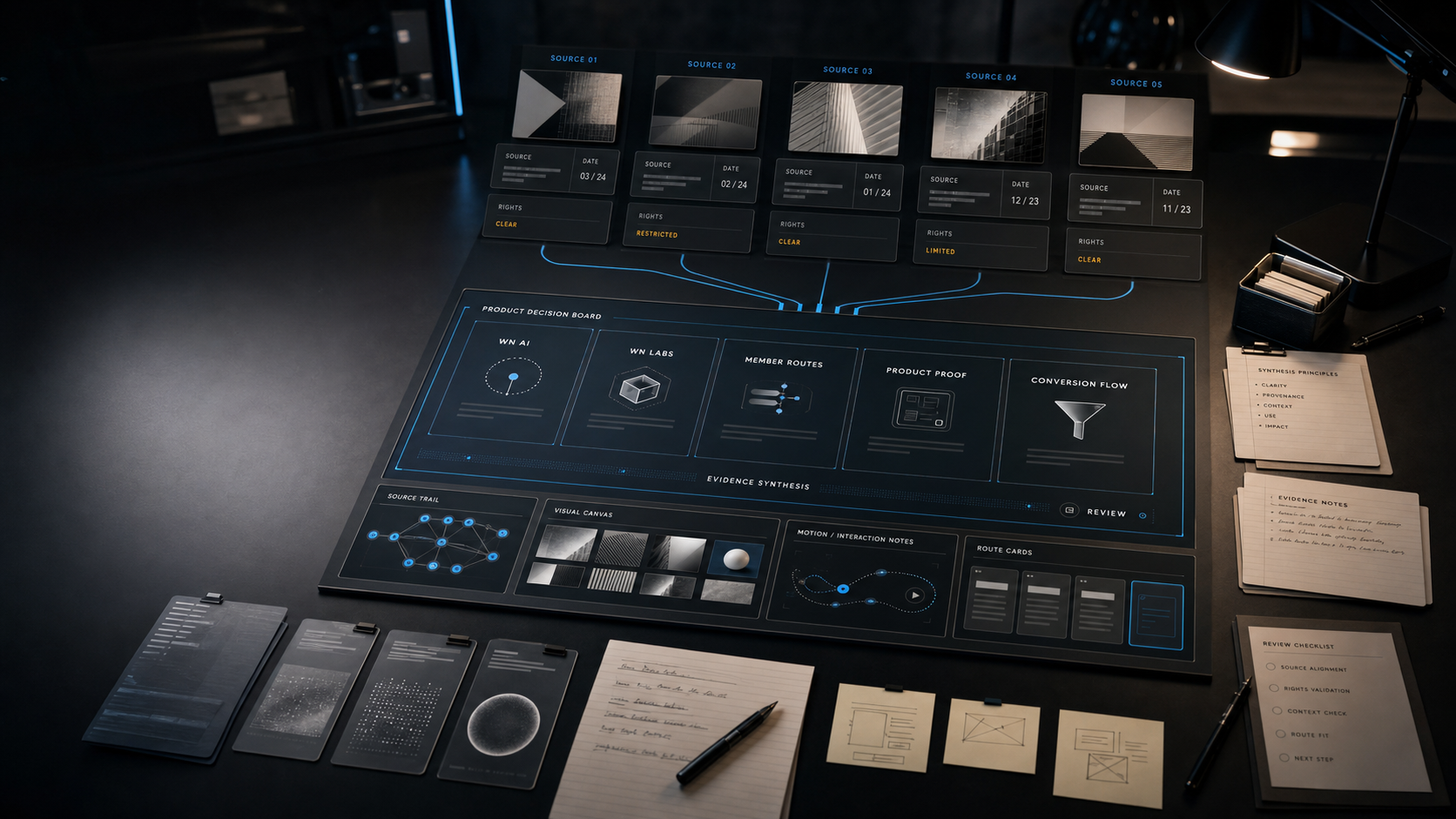
This route uses a fresh GPT-generated benchmark-synthesis image to make the external-reference workflow inspectable. The image is editorial support only and not proof of product-market fit, audited market research, named customers, production CRM, enterprise workflow maturity, formal financing readiness, live Exchange operations, copied third-party UI, completed model training, or commercially deployed speculative systems. Review the provenance record.
Current review rule
This source ledger was reviewed on June 30, 2026. The outside references below are useful only as category or deck-structure context. If White Noise wants a warmer market narrative later, it should refresh the external references and pair them with stronger White Noise-specific operating evidence first.
Why this exists
The market story should be inspectable, not merely persuasive.
Outside references can help explain why the deck uses a familiar structure or why the category may be large. They cannot stand in for White Noise-specific proof. This route exists so category context does not get mistaken for traction, and so old third-party references do not quietly warm the company story by repetition alone.
Goldman Sachs and McKinsey remain useful for category context, but both references are 2023 publications. That matters. A 2026 investor route should say so plainly instead of letting old figures read like current White Noise evidence.
The real credibility unlock is source-backed routing, conversion, returned work, permissions-safe case studies, and review cadence. A larger TAM does not remove that burden.
Source Ledger
Show the date, the job, and the limit of each outside reference.
The investor page should not ask a reviewer to infer which references are structural, which are market context, and which are old enough to need caution. Each ledger entry below states the publication date when known, the June 30, 2026 review date, the specific White Noise use, and the rule that keeps the reference from becoming substituted proof.
Deck structure reference
Sequoia Capital: Writing a Business Plan
This reference is used for deck discipline only: purpose, problem, solution, why now, market, competition, business model, team, financials, and vision. It helps keep the White Noise pitch sequence legible to serious reviewers.
- Appropriate use: pitch structure and first-read narrative order.
- Inappropriate use: proving White Noise demand, financial quality, or financing readiness.
- Control rule: if the White Noise deck ordering changes materially, review this reference again before treating the structure as intentionally current.
Category context
Goldman Sachs: The creator economy could approach half-a-trillion dollars by 2027
This reference supports only the creator-economy context used on the investor page. It is the source behind the current $250B to $480B framing and the broad creator-base growth note.
- Appropriate use: category-sizing context for why creative, educational, and creator surfaces can matter.
- Inappropriate use: proving White Noise audience scale, conversion, retention, pricing power, or market share.
- Control rule: do not let this 2023 context read as if it were White Noise 2026 operating proof.
Category context
McKinsey: The economic potential of generative AI
This reference supports only the broad workflow and productivity context used on the investor page. It helps explain why White Noise focuses on customer ops, marketing, software, and R&D-adjacent use cases instead of using frontier-system rhetoric as its near-term business proof.
- Appropriate use: high-level context for where AI-driven workflow value may exist.
- Inappropriate use: proving White Noise product-market fit, enterprise adoption, or measurable delivery performance.
- Control rule: pair this reference with White Noise-specific routing, delivery, and revenue evidence before warming enterprise or capital claims.
Reading ruleOpen the source, then return to White Noise proof.
Live proofOpen the commercial surface registerCategory context is only useful if the next step is a White Noise-specific proof route rather than another layer of market rhetoric.
Check which revenue, partner, and diligence-entry surfaces are actually public now.
MetricsOpen the metrics release policySee how measured traction should be released later without implying it exists now.
AssumptionsOpen planning assumptionsRead the model sensitivities and non-claims behind the illustrative projections.
Creative Product Benchmark
Translate world-class references into White Noise rules, not imitation.
Reviewed on June 30, 2026, this layer adds the current AI, creative-tool, and digital-product references used by the site upgrade workflow. Their job is to guide composition, interaction, voice, and conversion discipline. They do not prove White Noise demand, model capability, customer maturity, or delivery outcomes.
AI creative systems
Runway
Runway's current public surface keeps product, research, enterprise, education, customer stories, safety, and direct try routes close together. White Noise should borrow the structural lesson: keep ambitious research language adjacent to product state, controls, and action routes.
Design and agent workflow
Figma AI
Figma frames AI as end-to-end work on the canvas: explore, polish, ship, collaborate, connect code, and keep administrative controls visible. White Noise should keep W.N. AI generated canvases, assistant text, source trails, redraws, rights, and export decisions in one member workflow.
Image generation craft
Recraft and OpenAI image generation
Recraft foregrounds art direction and prompt understanding; OpenAI's image-generation release emphasizes useful visual communication, text rendering, multi-turn refinement, instruction following, and context. White Noise should judge images by prompt specificity, source context, assistant explanation, receipt persistence, and redraw stability.
Digital product agency
Work & Co
Work & Co's public site leads with complex product problems, current work, practice areas, process, outcomes, and a direct collaboration form. White Noise should keep its richer editorial voice, but route readers from proof to a specific next action faster.
Lead with an inspectable canvas, dossier, or decision surface before explanatory copy.
Keep source, rights, variants, review state, and export routes beside the generated work.
Use precise editorial language and attach explicit limits where ambition could overclaim.
Favor reveal, comparison, restore, redraw, and route-state interactions over decoration.
Route from artifact inspection into membership, Labs, R&D scope, or investor review.
What Still Matters
Outside signals do not lower the company-proof burden.
White Noise becomes easier to trust when the investor route says this directly: the next maturity step is not a warmer external market story. It is better evidence around inquiry routing, scoped-work delivery, conversion reporting, permissions-safe proof, and rights or dependency controls on the surfaces already live now.
Production inquiry handling
Move the first serious note out of demo-style assumptions and into dependable server-side delivery with truthful route-state disclosure and retained operating evidence.
Measured conversion and response evidence
Publish warmer operating metrics only when source, owner, exclusions, and review state are strong enough to defend publicly.
Returned work and permissions-safe case studies
Enterprise trust and capital quality improve when outsiders can inspect real artifact shape instead of relying on narrative polish alone.
Use this route before you forward the market narrative again.
- Name which outside reference is being used and what exact sentence it supports.
- Say whether the reference is structural or category context.
- Say when the reference was published or, if unavailable, say that the date is not shown on the current page.
- Say what the reference cannot prove about White Noise.
- Send the reviewer back to one White Noise-specific proof route next.