
Simulated worlds
Planets, habitats, ecosystems, cities, and civilizations with distinct geography, culture, stewardship, and operating rules.
United Space Alliance is an ultrafuturistic social-multiverse concept—and Genesis 10K is its immense atlas of planets, civilizations, vessels, quantum realms, living systems, impossible artifacts, and connected realities.
Speculative virtual art—not a launched simulation, scientific claim, physical property offer, financial product, or investment promise. All 10,000 records are unminted.
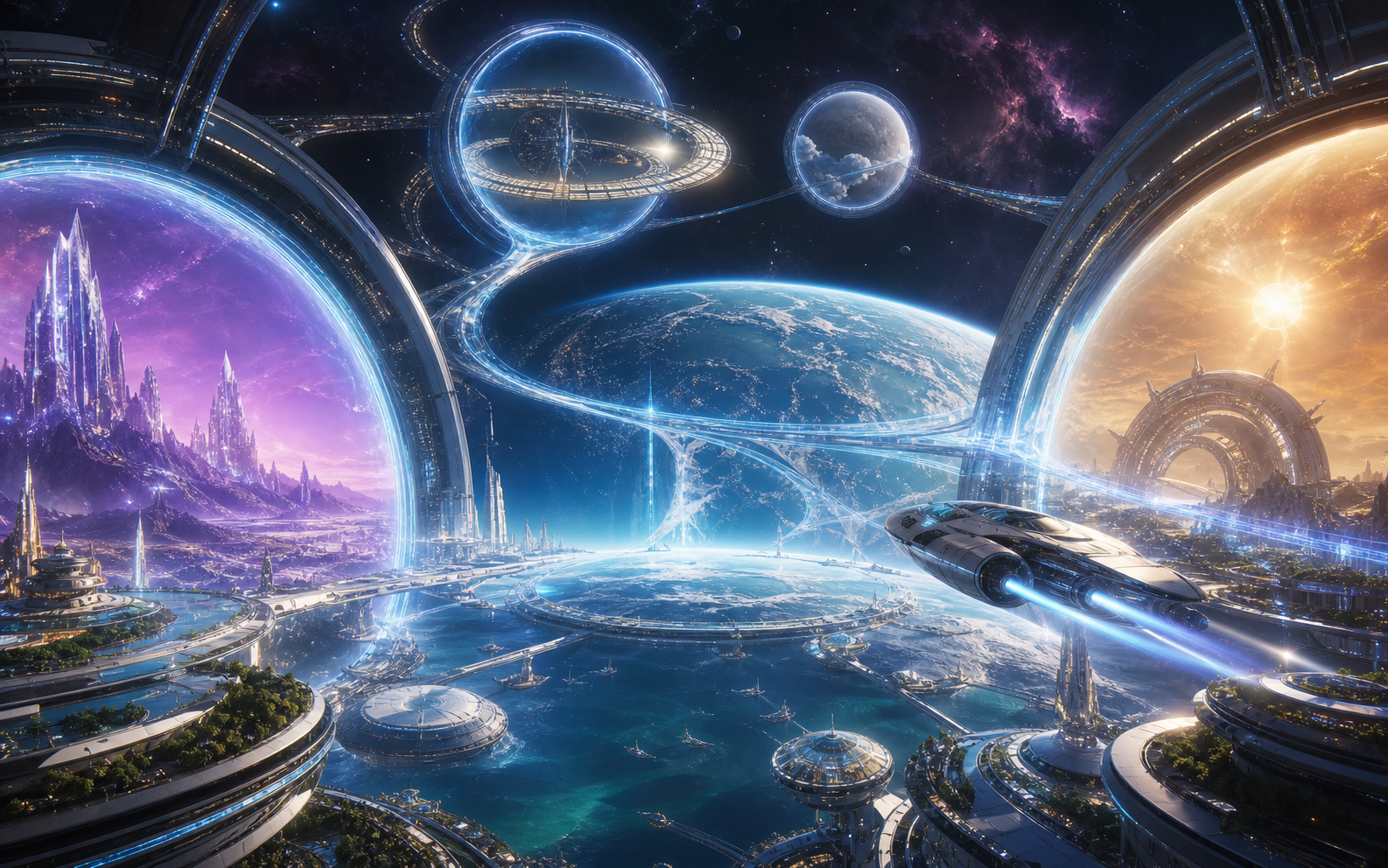
THE NATURE OF USPA
Most virtual worlds begin with a map. USPA begins with an architecture of maps: different cosmologies, histories, environments, economies, intelligences, and societies held inside one persistent social fabric.
Genesis 10K turns that idea into a collectible atlas. Each prepared record is a unique coordinate with its own class, sector, civilization, atmosphere, temporal state, reality law, material language, palette, purpose, rarity, visual seed, lore, and provenance boundary.
Planets, habitats, ecosystems, cities, and civilizations with distinct geography, culture, stewardship, and operating rules.
Alternate histories and divergent universes that let shared events unfold into persistent, accountable outcomes.
Identity, discovery, collaboration, institutions, reputation, and collective memory moving between worlds.
Player-created places and objects with provenance, usage rules, stewardship, and explicit ownership records.
MULTIVERSE ARCHITECTURE
USPA is imagined as six deeply connected layers. Together they transform isolated virtual spaces into a continuous social civilization.
Defines physical rules, time, environment, resources, boundaries, and simulation behavior.
Holds places, assets, histories, lifeforms, settlements, and persistent community change.
Carries relationships, communication, reputation, discovery, and institutions across worlds.
Lets a person retain agency, context, accessibility choices, and social memory between realities.
Records who created, changed, stewarded, licensed, and retired every persistent artifact.
Coordinates virtual-art records without pretending they are physical property or guaranteed value.
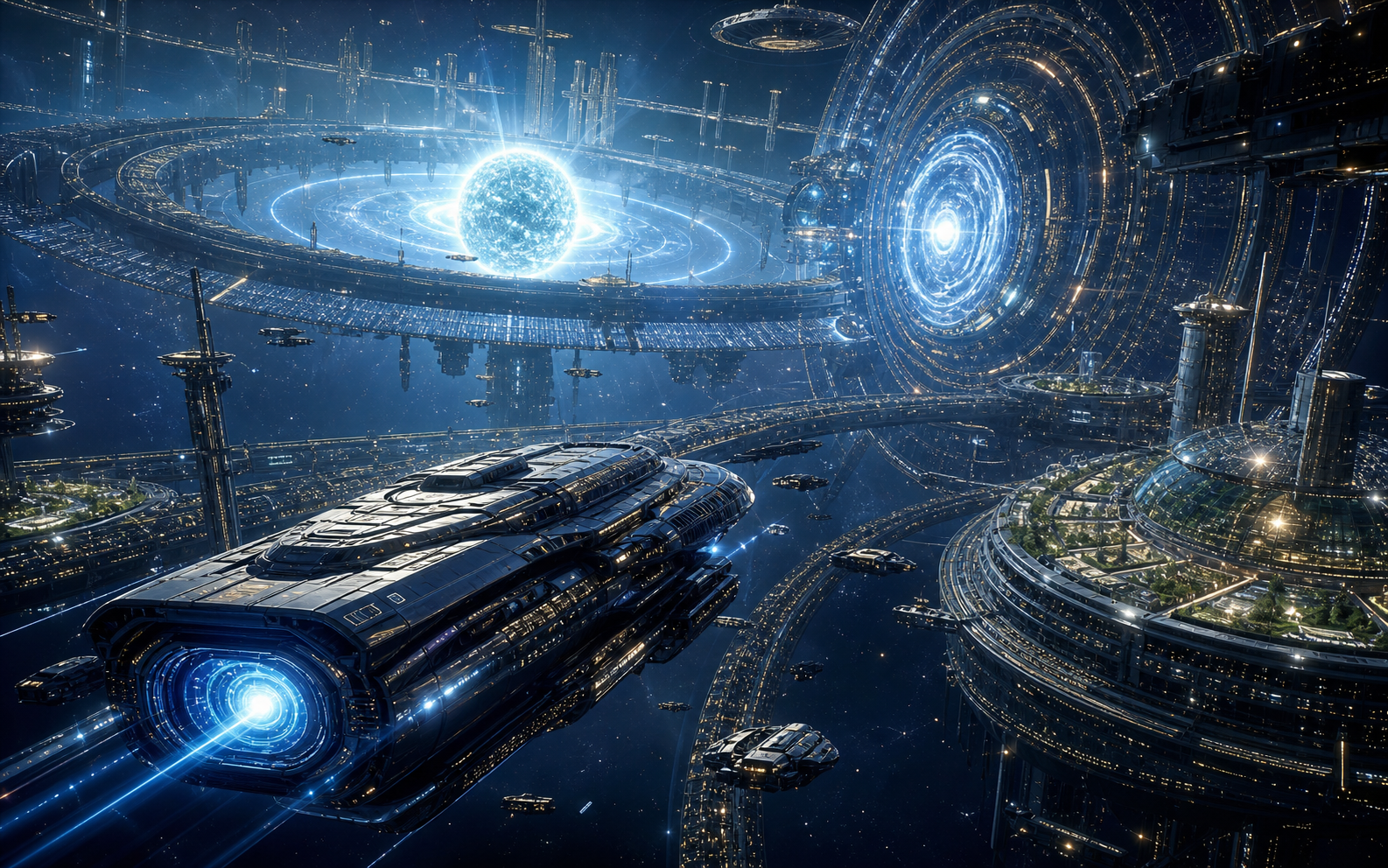
USPA SYSTEM PLATE / 002 Civilization-scale infrastructure connects habitats, energy systems, gates, and civic networks across the atlas.
THE VISUAL ATLAS
Original AI-generated masterworks establish the collection’s cinematic language: ion cyan, ultraviolet, solar gold, black titanium, living architecture, and scale measured in worlds.

Planets, terraforming worlds, alien ecologies, orbital cities, and social civilizations.
Megastructures, vessels, stations, gates, resources, and interverse routes.
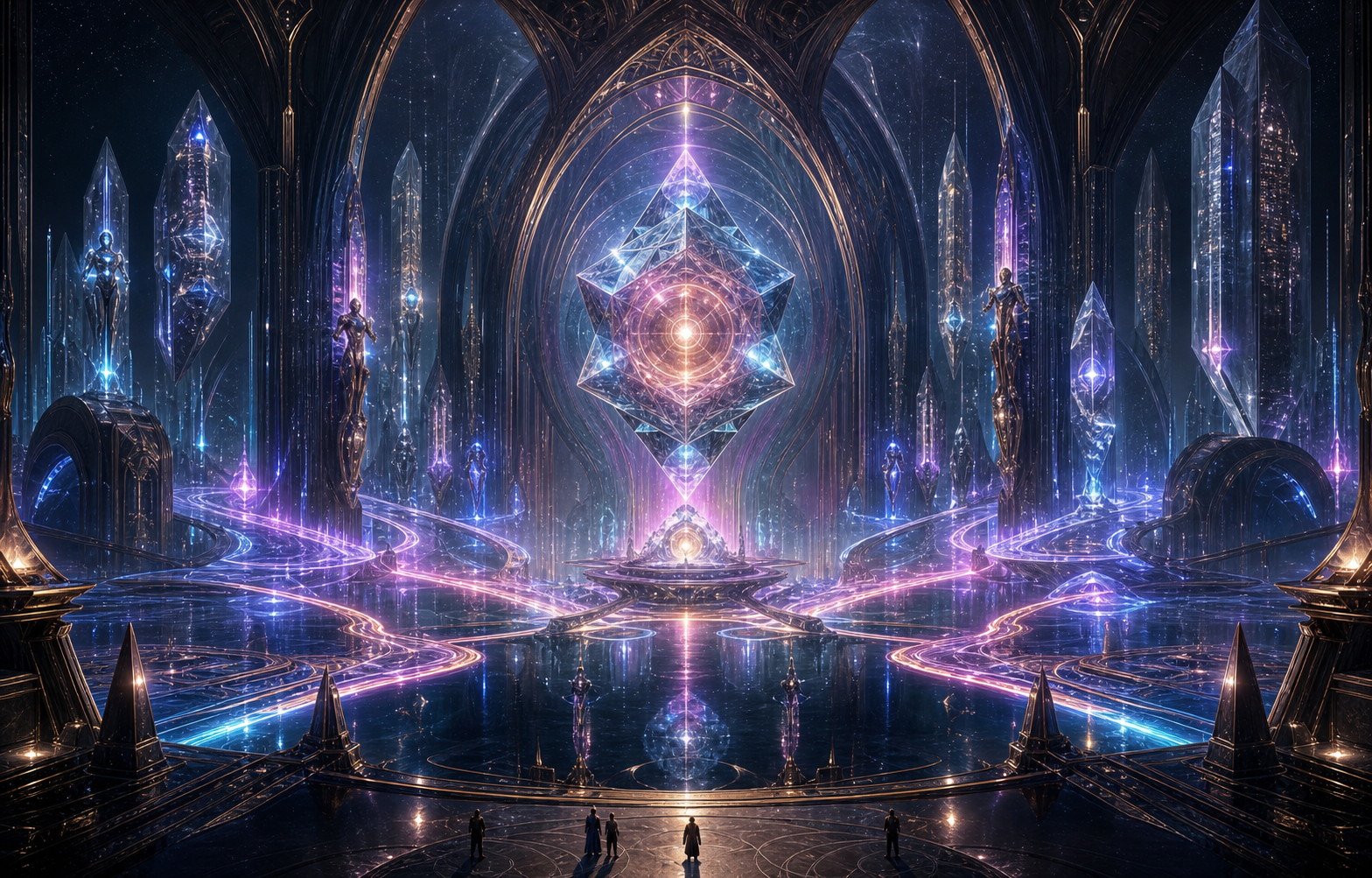
Quantum realms, temporal domains, AI civilizations, digital life, artifacts, and memory.
GENESIS TAXONOMY
Every class contains exactly 500 one-of-one coordinates. The illustrated taxonomy is both a navigation system and a worldbuilding constitution for the collection.
THE GENESIS DNA ENGINE
The collection is generated from a deterministic world bible. A stable fingerprint binds each record to its visual recipe and fourteen metadata traits, creating 10,000 reproducible identities.
HOW THE COLLECTION WORKS
All 10,000 prepared records sit beside the wider White Noise collection in the main Exchange, with the same member, provenance, rights, payment, storage, and purchase-time mint gates.
Open USPA in the Exchange ↗Search 10,000 assets across 20 classes, 10 sectors, eight rarity levels, and a dense trait system.
Open the complete lore, visual signature, coordinate, civilization, reality law, attributes, and content fingerprint.
Rights, member, payment, storage, network, content, and collection-authority checks must all pass.
Only after verified purchase can a prepared record become a Metaplex Core asset in the buyer’s Solana wallet.
Before the final verified step, every listing is an off-chain voucher—not an NFT. Viewing, filtering, saving metadata, or requesting a listing takes no payment and creates no blockchain token.
THE 10,000 COORDINATE EXPLORER
Search by name, ID, class, sector, civilization, atmosphere, material, temporal state, reality law, or role. Every result is generated from the same reproducible collection engine.
Preparing 10,000 coordinates…
ALL RECORDS / UNMINTED / 1 OF 1CONCEPT ROADMAP
This is a direction of travel, not a delivery promise. Every phase would require technical, safety, rights, governance, accessibility, and community validation.
Publish the concept, 20-class taxonomy, collection DNA, 10,000 records, cinematic visual system, and Exchange route.
COLLECTION ENGINE LIVEExperiment with navigable environments, portable identity, simulation rules, accessibility, and creator tools.
RESEARCH DIRECTIONTest social presence, institutions, world-to-world continuity, rights, safety, and community stewardship.
VALIDATION REQUIREDExplore interoperable worlds with persistent culture, accountable provenance, plural governance, and repair paths.
LONG-HORIZON VISIONTHE HONEST BOUNDARY
USPA is speculative worldbuilding and virtual concept art. It is not a launched game, functioning universe simulation, scientific model, parcel of real estate, financial product, or promise of future value.
The 10,000 prepared records establish fictional identity, visual direction, and provenance. Any future utility, interoperability, access, governance, or playable functionality would require separate development and explicit terms.