Home / Magazine / Space Settlement Design
Space Settlement Design

Seeds That Build Worlds

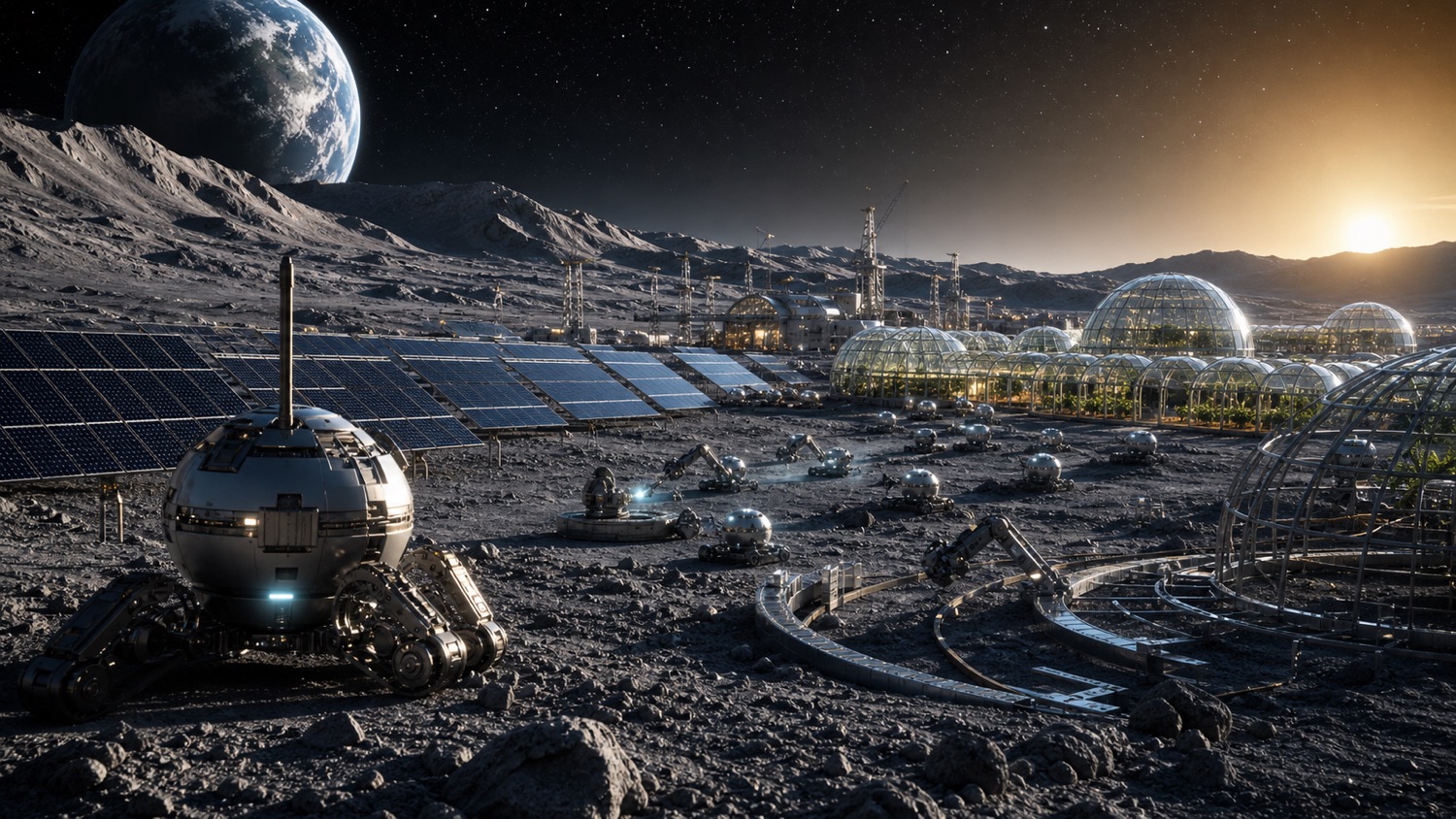
OSTSS settlements grow from a compact seed. Self-replicating machines are old theory — and the single most important idea for settling space.
The WN Editorial Desk10 min read~1,995 wordsFeature
Seeds That Build Worlds

OSTSS settlements grow from a compact seed. Self-replicating machines are old theory — and the single most important idea for settling space.

This article takes that idea seriously enough to measure it — tracing where White Noise Totality by Valentin Perlov meets established science, and where it leaps beyond it. The seed-and-grow settlement turns colonization from a freight problem into an exponential-growth problem — if the replication loop can be closed.

What the book imagines

The OSTSS — Omnipresent Singulitarian Transformer Space Settlement — grows itself from a compact seed into a self-assembling habitat in months. The interesting work begins where the easy story ends. The most interesting disagreements here are about magnitude, not direction. Engineering history is full of barriers that turned out to be walls, and walls that turned out to be doors.

The book imagines settlements that build, repair and expand themselves using self-replicating nanobots and planet-scale macrobots. It is worth stating the ambition at full strength before testing it. It pays to separate what is merely hard from what is genuinely forbidden. The detail matters more the closer one looks.

The point is not to keep score but to map the terrain. Space colonization becomes a seed-and-grow process rather than a freight problem. Read as manifesto, it is stirring; read as specification, it demands interrogation. Granting the premise is the price of seeing where it leads. This is where speculation either earns its keep or quietly collapses.

Closing the loop

NASA's 1980 study judged a self-replicating lunar factory feasible with enough automation. The point is not to keep score but to map the terrain. What survives scrutiny is often more interesting than the original claim. The honest position holds both the vision and its limits in view at once.

The unsolved step is full replication from in-situ regolith. That tension is exactly what makes the question worth asking. This is less a verdict than an invitation to look harder. It is a place where intuition and arithmetic part company.

Exponential growth is the prize and the bottleneck. Perlov is explicit that such claims are theoretical frameworks meant to provoke. The vocabulary is futuristic, but the underlying issue is old and well-studied. The detail matters more the closer one looks.

Where established science stands

The numbers, not the narrative, govern what is possible. O'Neill's High Frontier worked out rotating habitats, mass drivers and the economics of space settlement in the 1970s. The vocabulary is futuristic, but the underlying issue is old and well-studied. The honest position holds both the vision and its limits in view at once.

It pays to separate what is merely hard from what is genuinely forbidden. Self-replicating machines are old theory — von Neumann's automata and NASA's 1980 Advanced Automation for Space Missions study. Neither credulity nor dismissal does the idea justice. The result has been confirmed often enough that doubting it is no longer respectable.

Closed-loop life support remains only partially solved; Biosphere 2 showed how hard a sealed ecology is. It is the kind of fact that survives every revolution in technology. What looks like a single leap is really a stack of independent assumptions. Decades of experiment stand behind the statement.

Seeds that build worlds

A self-replicating seed factory is the single most important idea for settling space, turning exponential growth into infrastructure. The claim rewards the kind of scrutiny that fiction rarely invites. There is a version of this that is impossible and a version that is merely difficult, and they are worth keeping apart. The temptation is to read this as either prophecy or nonsense; it is neither. It is a place where intuition and arithmetic part company.

The serious question is not whether it sounds plausible but whether the numbers permit it. NASA's 1980 study judged a self-replicating lunar factory theoretically feasible with sufficient automation. What survives scrutiny is often more interesting than the original claim. The point is not to keep score but to map the terrain.

The romance of the claim should not distract from the mechanism it requires. The unsolved step is closing the replication loop with in-situ materials. A careful reader will notice how much rides on a single, easily-missed assumption. What looks like a single leap is really a stack of independent assumptions.

In-situ resource utilization

Living off local materials — regolith, ice, asteroid metals — is what makes growth cheaper than shipping. This is where speculation either earns its keep or quietly collapses. It is a place where intuition and arithmetic part company. There is a version of this that is impossible and a version that is merely difficult, and they are worth keeping apart.

The detail matters more the closer one looks. Demonstrations of oxygen extraction and 3D printing with regolith are early but real. What survives scrutiny is often more interesting than the original claim. What looks like a single leap is really a stack of independent assumptions.

This is less a verdict than an invitation to look harder. ISRU is the practical hinge between the book's vision and today's missions. That tension is exactly what makes the question worth asking. The most interesting disagreements here are about magnitude, not direction. The temptation is to read this as either prophecy or nonsense; it is neither.

Rotating habitats and gravity

The most interesting disagreements here are about magnitude, not direction. Spin gravity via O'Neill cylinders is the established answer to long-term human health off Earth. Readers of the book will recognise the ambition; physicists will recognise the constraint. Neither credulity nor dismissal does the idea justice.

Structural materials and radiation shielding set the real size and mass budgets. It is the kind of distinction that separates a slogan from an engineering claim. The vocabulary is futuristic, but the underlying issue is old and well-studied. Stated plainly, the gap between aspiration and mechanism is where the real science lives.

The engineering is conservative compared with the book, but it works on paper. The honest position holds both the vision and its limits in view at once. The difference between 'not yet' and 'not ever' is the whole game here. The serious question is not whether it sounds plausible but whether the numbers permit it. The interesting work begins where the easy story ends.

Closing the ecological loop

Sustained settlement needs air, water and food cycles that close without resupply. The romance of the claim should not distract from the mechanism it requires. The serious question is not whether it sounds plausible but whether the numbers permit it. What looks like a single leap is really a stack of independent assumptions.

Biosphere 2 and the ISS show partial closure; full closure is a frontier of ecological engineering. The vocabulary is futuristic, but the underlying issue is old and well-studied. Strip the language back and a precise, testable question emerges. The honest position holds both the vision and its limits in view at once. The detail matters more the closer one looks.

Synthetic biology may bridge the gap the book assumes is already crossed. The book is most useful exactly where it is least literal. The claim rewards the kind of scrutiny that fiction rarely invites. Engineering history is full of barriers that turned out to be walls, and walls that turned out to be doors. The difference between 'not yet' and 'not ever' is the whole game here.

Reading it as method, not prophecy

A careful reader will notice how much rides on a single, easily-missed assumption. It helps to read “Seeds That Build Worlds” the way the book asks to be read: as a limiting case pushed until it reveals the edge of the possible. The ambition is the point; the feasibility is the conversation. The detail matters more the closer one looks.

Perlov calls this the ladder of decreasing absurdity — start from the impossible ideal, then climb back down to where real space settlement design actually lives. Perlov is explicit that such claims are theoretical frameworks meant to provoke. The vision is coherent once its premises are granted in turn. What looks like a single leap is really a stack of independent assumptions.

Falsifiability, in this method, is treated as a design material rather than a threat. It pays to separate what is merely hard from what is genuinely forbidden. The detail matters more the closer one looks. This is the dream stated cleanly, before the constraints arrive.

The line physics holds

A machine that fully copies itself from raw regolith — the keystone of seed-and-grow settlement — has never been built. The interesting work begins where the easy story ends. Engineering history is full of barriers that turned out to be walls, and walls that turned out to be doors. The serious question is not whether it sounds plausible but whether the numbers permit it.

Radiation, bone loss, ecological closure and supply latency are real constraints the book's months-long timelines underrate. Stated plainly, the gap between aspiration and mechanism is where the real science lives. The claim rewards the kind of scrutiny that fiction rarely invites. The romance of the claim should not distract from the mechanism it requires.

Three honest caveats

First, nothing here should be mistaken for a claim that the book's technology exists or is on sale; these are speculative concepts. Neither credulity nor dismissal does the idea justice. The honest move is to mark the boundary on the map and keep going. What looks like a single leap is really a stack of independent assumptions. It is a reminder that scale alone does not dissolve fundamental rules.

Second, where this article cites established results, those belong to the researchers credited below, not to the book. The vocabulary is futuristic, but the underlying issue is old and well-studied. The book is most useful exactly where it is least literal. That tension is exactly what makes the question worth asking.

The detail matters more the closer one looks. Third, the most exciting interpretation is also the most demanding one, and demanding interpretations are where mistakes hide. There is a version of this that is impossible and a version that is merely difficult, and they are worth keeping apart. The book crosses the line knowingly; the reader should cross it knowingly too.

What survives translation

So what survives when the impossible is stripped away? More than a sceptic might expect. The vocabulary is futuristic, but the underlying issue is old and well-studied. It pays to separate what is merely hard from what is genuinely forbidden. This is where speculation either earns its keep or quietly collapses.

What survives scrutiny is often more interesting than the original claim. The realizable core of “Seeds That Build Worlds” is not the literal machine the book names but a concrete, fundable research direction. Strip away the impossible and a recognisable, buildable ambition remains. The temptation is to read this as either prophecy or nonsense; it is neither.

The honest position holds both the vision and its limits in view at once. That is the move this magazine keeps making: read the book as a limiting case, then ask what real work it orients. It is the kind of distinction that separates a slogan from an engineering claim. There is a version of this that is impossible and a version that is merely difficult, and they are worth keeping apart.

Why it matters

None of this settles whether the grand vision is achievable; it sharpens what 'achievable' would even mean. What matters now is turning the vision into experiments. The point is not to keep score but to map the terrain. Strip the language back and a precise, testable question emerges.

The value of an audacious picture is that it forces a precise question, and precise questions are where progress starts. The claim rewards the kind of scrutiny that fiction rarely invites. A careful reader will notice how much rides on a single, easily-missed assumption. The work is hard, the timeline long, and the payoff genuinely large.

References

  1. Perlov, V. White Noise Totality: Engine of Infinite Possibilities (Expanded Unified Edition, 2026). Primary source.
  2. O'Neill, G. K. (1976). The High Frontier: Human Colonies in Space. William Morrow.
  3. von Neumann, J., & Burks, A. W. (1966). Theory of Self-Reproducing Automata. University of Illinois Press.
  4. Freitas, R. A., & Merkle, R. C. (2004). Kinematic Self-Replicating Machines. Landes Bioscience.
  5. Tsiolkovsky, K. (1903). "The Exploration of Cosmic Space by Means of Reaction Devices." Nauchnoye Obozreniye.
Keep reading