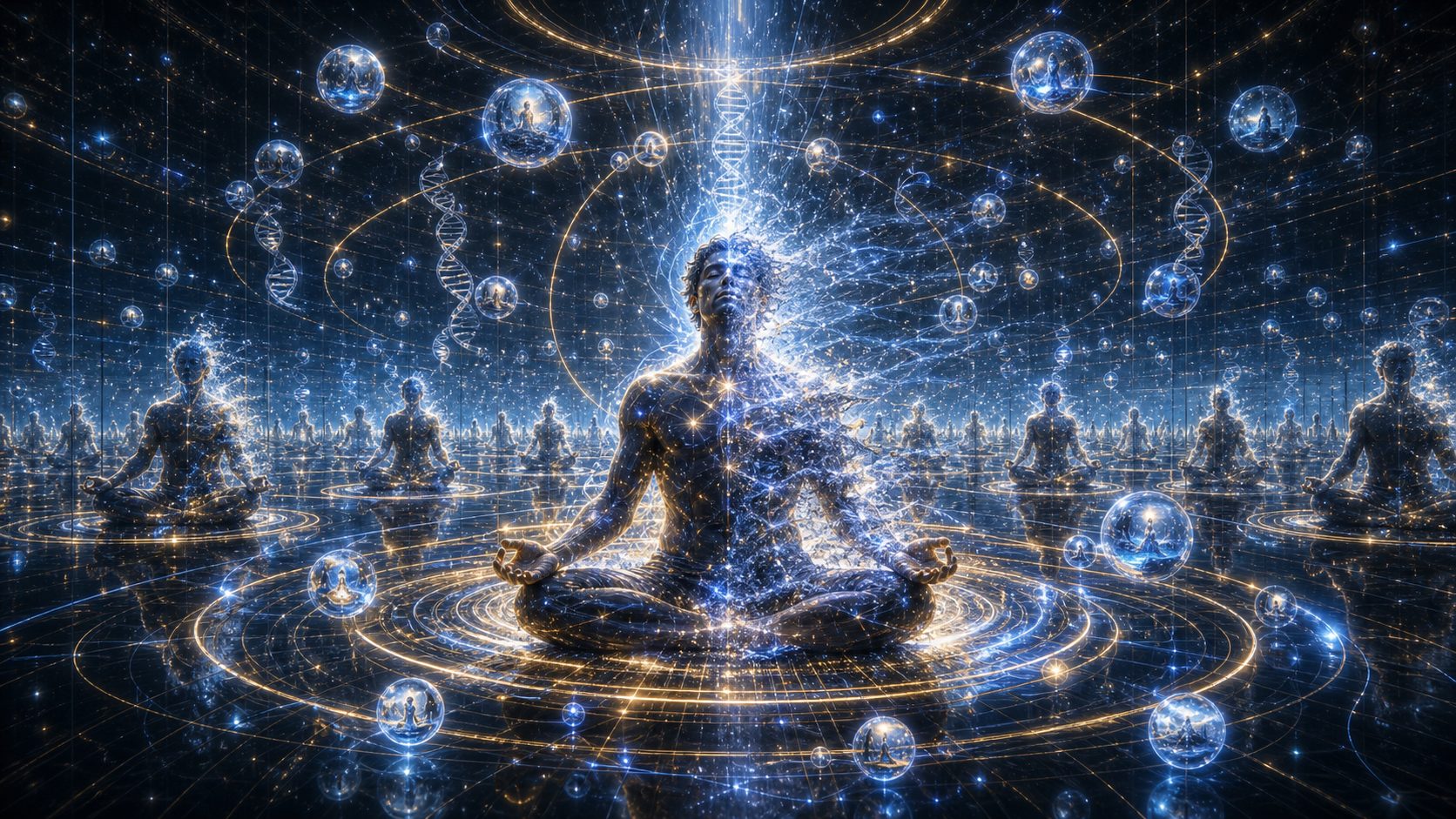
The book's boldest territory — consciousness not as an isolated emergent property, but as a gateway into the informational structure of the cosmos.
White Noise Totality makes a wager that most of science declines to make: that consciousness may be not only emergent from matter, but entangled with the fundamental patterns that structure existence. From that wager the book derives an entire research program — quantum consciousness markers, the reverse engineering of remote viewing, distributed sentience networks, and ultimately the archiving and reinstantiation of conscious states across time.
This course examines that program with the seriousness it demands and the skepticism it deserves. We read the book's proposal that the brain of a trained remote viewer might function, at least temporarily, as a primitive form of White Noise Computer — a naturally occurring prototype whose neural signatures could be mapped, decoded, and replicated technologically. We study the proposed instruments: high-resolution brain–computer interfaces, neurological nanobots interacting with neurons at cellular and subcellular scales, and AI systems trained to find quantum-linked patterns in neural data.
And we hold the line the Academy always holds. None of this is established science; remote viewing itself remains outside the scientific mainstream, and the course says so in its first hour. What the framework offers is a profound thought experiment about the relationship between consciousness and information — one that sharpens every question a student will ever ask about real neuroscience, real AI, and the hard problem itself.
What consciousness science actually knows: neural correlates, global workspace and integrated information theories, and why the explanatory gap persists. The baseline against which every speculation is measured.
From Penrose onward: proposals that quantum effects play a role in cognition, and the book's extension — neural oscillations, coherence patterns, and field emissions as possible markers of entangled states within the brain.
The book's signature research design: capturing real-time neural activity of remote viewers through BCIs, with AI decoding the patterns. The brain as a biologically evolved conduit for non-local information exchange — hypothesis, history, and critique.
Neurological nanobots mapping entanglement-sensitive layers of cognition; the four-layer engine of acquisition, feedback training, interpretation, and refinement that the book proposes for studying non-local perception.
Quantum consciousness communication, trans-temporal introspection, and planetary intelligence grids in which each node shares in a unified entangled awareness. What "we" would mean inside such a network.
Entangled memory frameworks for recording, preserving, and reinstantiating conscious states — the theoretical foundation the book offers for continuity of consciousness and post-biological life. Read with WN immortality research.
Consent, cognitive liberty, and data sovereignty when minds become readable and writable. Students draft a bioethical governance charter, as the book demands, before any framework is granted its final hearing.
"It challenges us to rethink perception, cognition, and reality itself — not as separate, static constructs — but as emergent expressions of a deeper entangled unity."

Consciousness Engineering sits at the crossroads of the Academy. Its neural-interface material continues naturally into the Human–AI Symbiosis course; its quantum substrate is built in the Quantum Computing course; its research context lives in our remote viewing and WNBCI divisions.
Graduates drawn to the furthest extrapolations — collective minds, consciousness immortality — will find dedicated seminars in the Elite Premium Courses. To join a cohort, enquire via Contact.
Fluency in mainstream consciousness science and in the book's quantum-informational framework — and the precise ability to say which claim belongs to which.
The capacity to design a falsifiable study at the edge of the thinkable: what evidence would actually move a claim from vision toward science.
A drafted governance charter and the trained habit of asking, before every capability, the book's own question: should this be delayed until our wisdom matures?