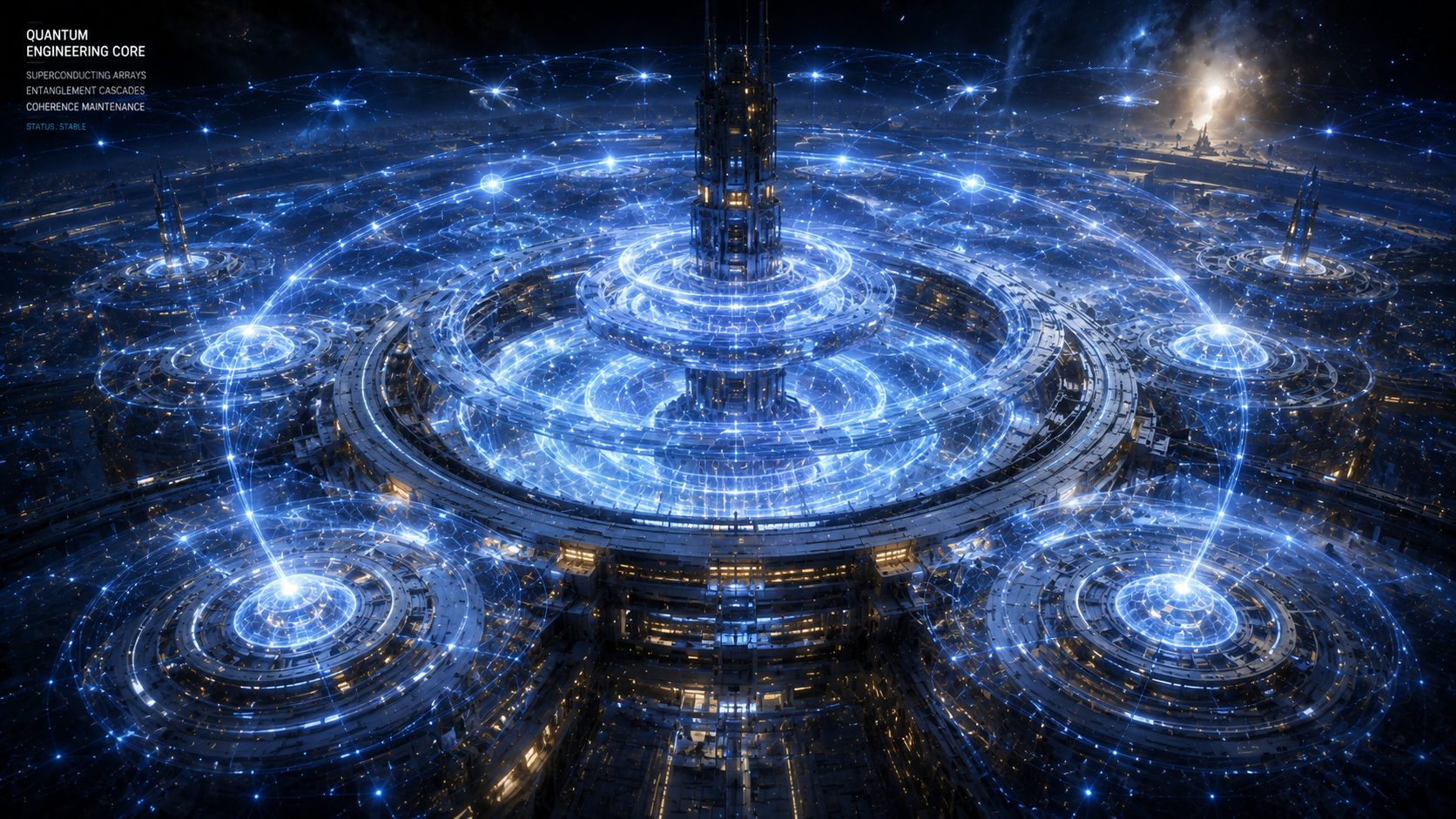
From the qubit on the laboratory bench to the universe as one informational lattice — the physics ladder beneath every White Noise framework.
This is the Academy's most grounded course, and deliberately so. Roughly half of it is real, examinable physics: superposition, entanglement, quantum gates, decoherence, error correction, and quantum key distribution — the science of machines that already run in laboratories today. The book itself concedes the present state of the art plainly: quantum computers are in their infancy, and even the best current entanglement experiments are limited in scale and coherence.
The second half climbs the book's ladder of extrapolation. White Noise Totality proposes that omnipresent entanglement — a theoretical, universe-wide web of quantum connections emerging from unified field theory — could turn every particle in the cosmos into a node of one vast informational lattice. On that premise it erects the White Noise Computer: an architecture that does not sit in a data center but lives in the entanglement structure of reality, retrieving information from any point in space and time.
Students finish able to do something rare: explain a Bell test to a physicist and the universal informational lattice to a philosopher, while knowing precisely which of the two is established and which is vision. That calibration is the course's true product.
Classical bits versus quantum states; superposition, measurement, and probability amplitudes. Hands-on work with circuit simulators to build genuine intuition before any speculation begins.
Bell inequalities, real entanglement experiments, and their honest limits in scale and coherence. The phenomenon by which particles instantaneously influence each other's state, irrespective of distance — as actually measured.
Quantum gates and the algorithms that matter; what quantum computers can and cannot efficiently handle, and why "quantum advantage" is narrower — and stranger — than the headlines suggest.
Quantum key distribution and entangled photon pairs; how today's protocols inspire the book's vision of robust channels between White Noise Computer components regardless of spatial separation.
Optical lattices, quantum dots, and superconducting qubits as candidate methods for stable, long-distance entangled states — the genuine research frontier from which the book launches its extrapolation.
Unified field theory speculation and the universal informational lattice: every particle as part of a vast network of instantaneous interactions. Taught with the book's own critics — Penrose's and Lloyd's doubts included — at the table.
The full architecture: query formulation through the entanglement network, limitless bandwidth and modeling power, and computation woven into spacetime itself. Studied alongside the massless topological chip concept.
What total simulation capacity would mean for science — dark matter, quantum gravity, the roots of consciousness — and the governance questions that arrive with it. Closing assessment: each student maps the precise rung where evidence ends.
"Every particle in the cosmos forms a vast, intricate network of instantaneous interactions, essentially creating a universal informational lattice."
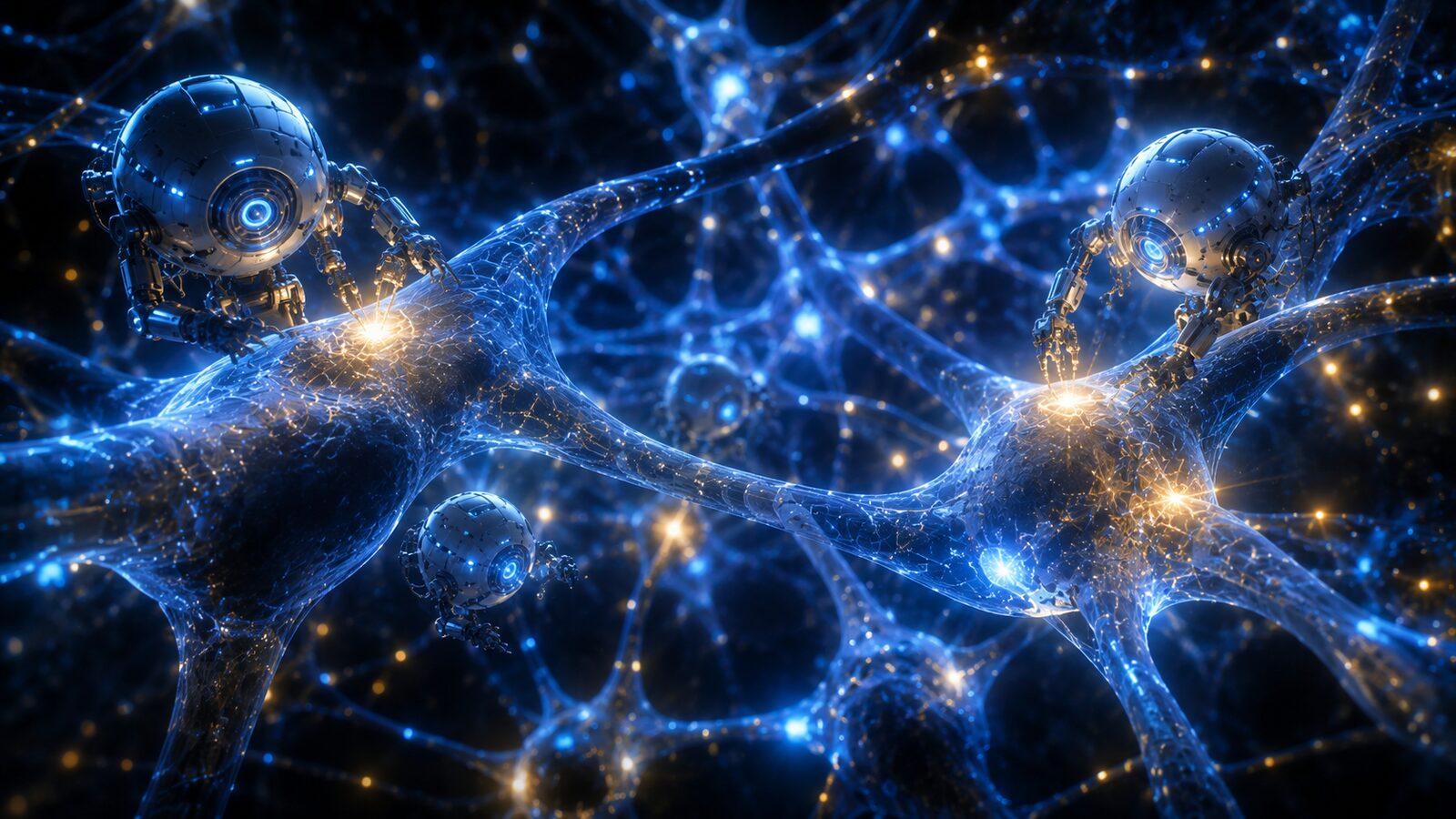
Nearly every framework in White Noise Totality rests on the entanglement substrate this course examines: the Replicator's zero-point fabrication, the Omnipresent Space Internet, the consciousness frameworks, the OSTSS itself. Students who master this material can walk into any other Academy seminar and locate its physics in seconds.
The course assumes no prior physics beyond curiosity. Cohorts run several times a year; to join one, enquire via Contact.
Each module pairs a passage of the book with the peer-reviewed literature it cites — Preskill on near-term quantum devices, Lloyd on the computational universe, Penrose on the limits.
Real quantum-circuit simulators for the established half of the course, so that superposition and entanglement are experienced as engineering, not metaphor.
The final exercise of every Academy course: a written assessment of exactly where, in this domain, the plausible ends and the visionary begins — and why the visionary is still worth mapping.