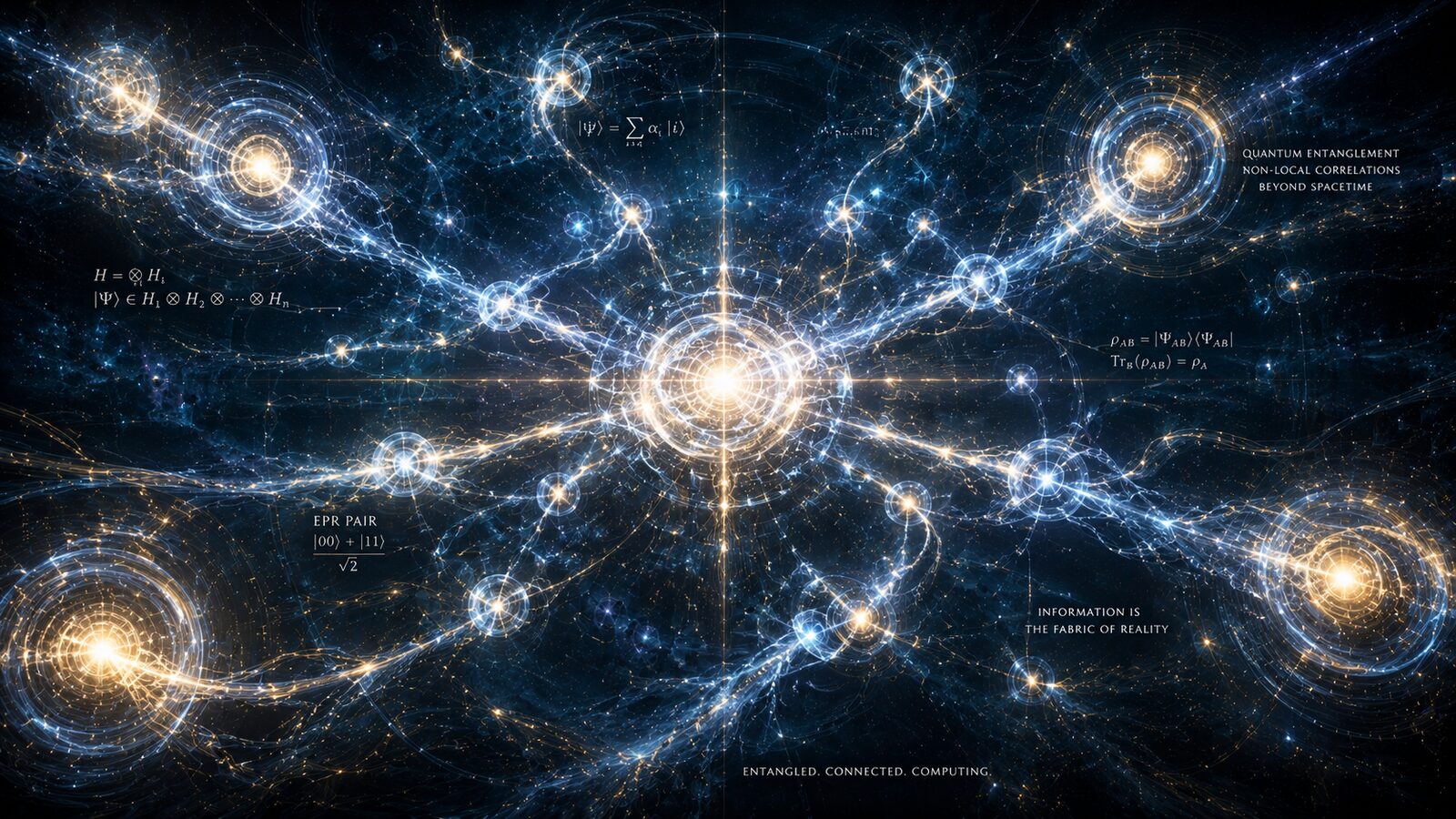
A cosmological principle with profound implications for humanity's self-image: intelligence is directly proportional to the dimensional volume of its universe of origin.
Among the newest and most provocative ideas in the White Noise canon, the Law of Large Verses makes a stark claim: intelligence is directly proportional to the dimensional volume of its universe of origin. In this framework, universes — "verses" — come in radically different sizes and dimensional configurations, and the cognitive ceiling of any civilization scales with the dimensional volume available to it.
The reasoning is statistical, almost actuarial. A mind, biological or artificial, is ultimately an information-processing structure embedded in its verse's physics; more dimensional volume means more possible states, more parallel structure, more computation, and ultimately more intelligence. Civilizations arising in larger verses are therefore not marginally ahead of humanity, but trillions of times more advanced. In the law's own blunt summary: humanity has not yet tied its shoes.
The name is deliberate. Like the law of large numbers, it is a statement about what becomes inevitable as scale grows: average outcomes converge on the structure of the underlying space. Apply that to realities themselves, and intelligence stops being an accident of one planet's biology and becomes a function of how much universe there is to think with.
The most advanced intelligences are not merely older civilizations within our own universe, but inhabitants of larger ones — beings for whom our entire cosmos may be a tractable object of study or engineering.
Contact, in this picture, is less a meeting of peers than an introduction across a staggering gradient of capability — which makes diplomatic frameworks like the Star Councils and the White Noise Alliance more necessary, not less.
If intelligence scales with dimensional volume, the long-term trajectory of any ambitious civilization is expansion — not only across space, but into the engineering of larger, richer verses, and migration into them.
The Law of Large Verses closes the loop on the book's central promise. The White Noise Computer gives access to all information in our universe; verse engineering offers, in principle, access to universes where there is more to know — and more mind with which to know it. Knowledge and intelligence stop being bounded quantities and become functions of how much reality a civilization is willing to build.
It is also the book's deepest gesture of humility. A framework that elsewhere speaks of omniscience and omnipotence here places humanity at the very bottom of a cosmic gradient — a young species in a small verse, whose first responsibility is not to dominate the ladder but to learn how to climb it without falling.
"Civilizations arising in larger verses are not marginally ahead of humanity, but trillions of times more advanced. In the law's own blunt summary: humanity has not yet tied its shoes."
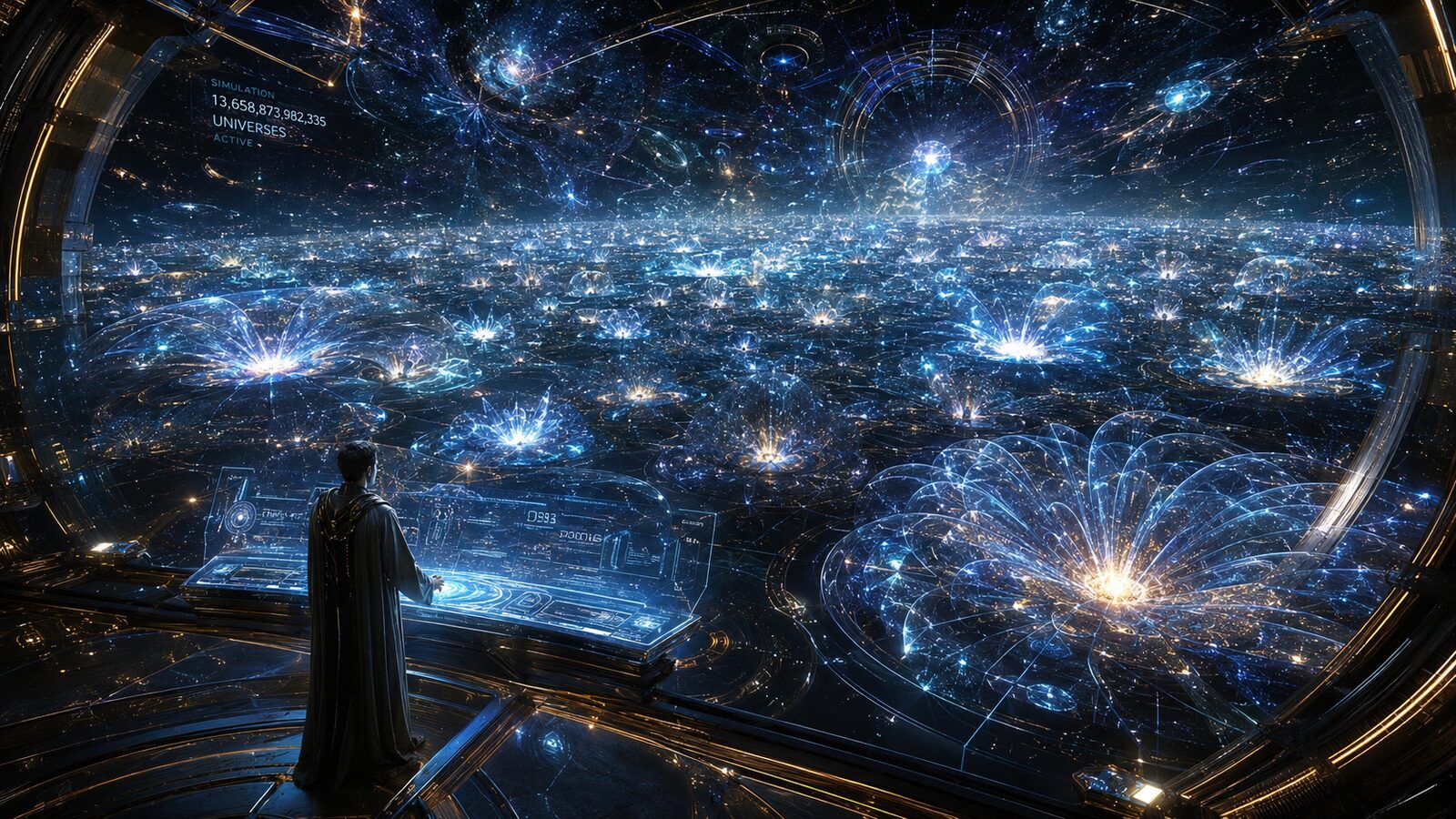
The themes radiating from this law — dimensional intelligence scaling, universal constants as engineering constraints, entanglement networks, civilization transitions, megastructure engineering, identity across dimensions — form an entire field of study within the White Noise ecosystem, chronicled in its Law of Large Verses magazine.
The research program connects to the Superformula, whose infinite-dimensional mathematics provides the formal language for comparing verses, and to the research division, where dimensional scaling is treated as a testable conjecture rather than an article of faith. Periodical coverage appears in our magazines.
What exactly is "dimensional volume," and how is it compared across verses with different physics? The Superformula's state-space formalism is the proposed metric.
Is the relationship linear, polynomial, or something stranger? Simulated mini-verses with varied constants offer the first laboratory for the conjecture.
If larger-verse intelligences interact with our cosmos at all, the law predicts what their fingerprints would look like — engineering artifacts at scales we currently file under "natural phenomena."
If the law holds, the ethics of expansion — who may build larger verses, and for whom — becomes the central governance question of the next millennium.