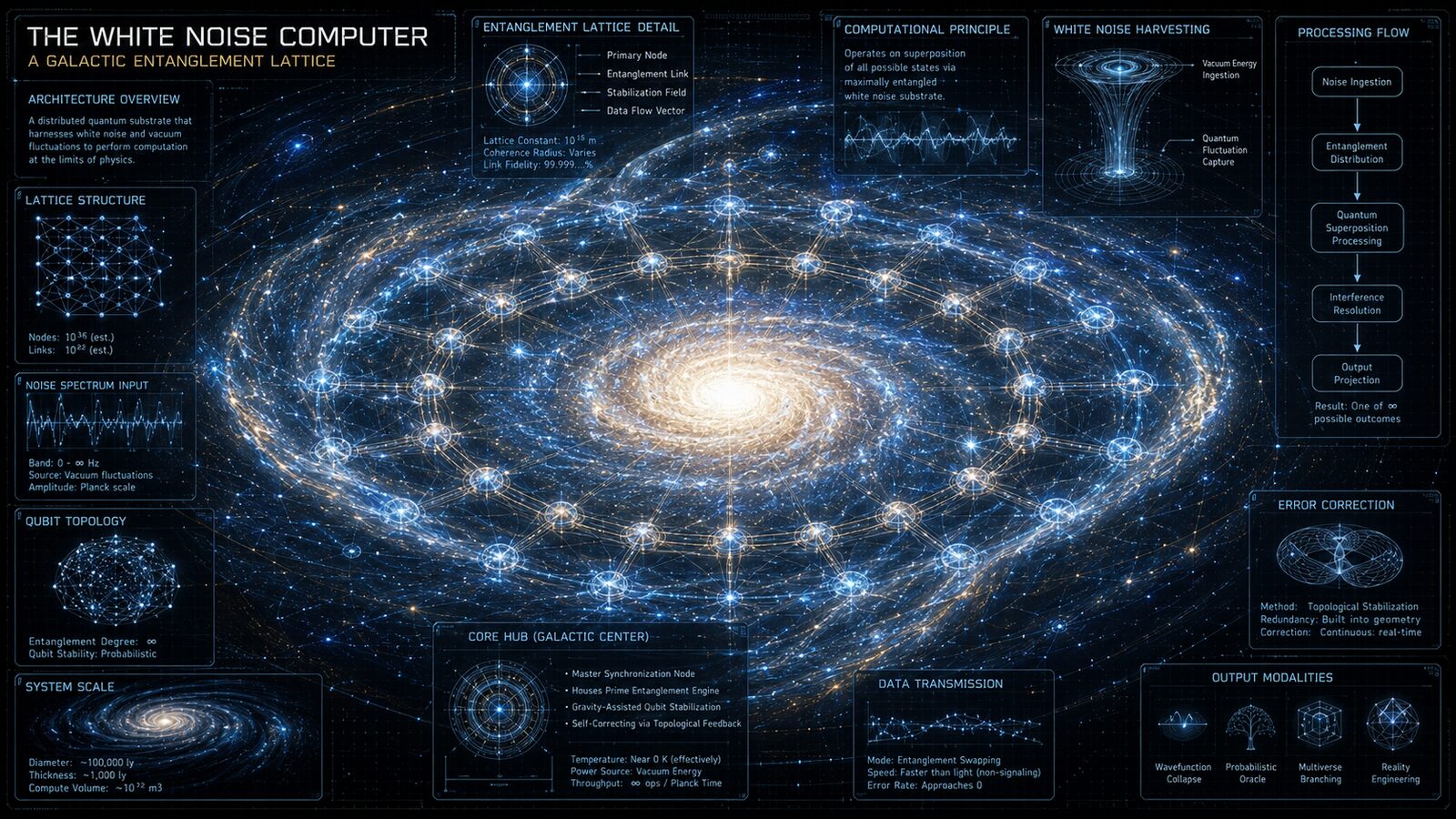
A vision is only as serious as its research program. Ours asks the engineer's question — how do we get there from here? — and follows three converging pathways.
If Part I of White Noise Totality asks what and why, Part II asks the engineer's question: how do we get there from here? The research program of White Noise Inc. is that question taken seriously — a structured agenda spanning neuroscience, quantum information, and consciousness studies, conducted in the spirit the book sets for itself: deliberate, theoretical, stepwise, and plausibility-focused.
The program is organized around three converging pathways. The first runs through the human mind: the systematic reverse engineering of remote viewing through brain activity analysis, brain chips, and neurological nanobots — treating anomalous cognition as a possible existence proof that consciousness can touch non-local information. The second runs through quantum technology: entanglement generation, quantum communication, and the long engineering campaign from architectural design toward omnipresent deployment. The third explores the exotic hardware of the mature vision — topological transformer chips, bio-organic computation, and the medical-system foundations beneath them.
Each pathway is independently valuable. Even if the central conjectures fail, the instruments built to test them — finer neural telemetry, larger entanglement networks, better models of cognition — advance science on their own terms. That asymmetry is the program's quiet strength.
The flagship inquiry: EEG, MEG, fMRI, and intracranial recordings of trained individuals, searching for the neural correlates of non-local perception — neuroplastic adaptations, distinctive theta-gamma dynamics, and candidate information channels independent of classical pathways.
The quantum pathway: generation and stabilization of large entangled systems through optical lattices, quantum dots, and superconducting qubits, with quantum error correction as the discipline that keeps coherence alive across growing networks.
Architectures trained on entanglement-based signals, where direct backpropagation is non-trivial — exploring superposition-based learning and validation against novel entangled inputs, the cognitive core of W.N. AI.
From today's wearable BCIs to tomorrow's injectable agents: real-time neural monitoring, closed-loop neurofeedback, and — far on the horizon — intracellular telemetry from neurological nanobots.
High-fidelity data capture — neural signals during controlled perception tasks, entangled-system measurements — under preregistered protocols with adversarial review.
Deep learning and statistical frameworks parse high-dimensional data for nonlinear patterns, temporal dependencies, and subtle correlations that conventional analysis would miss.
Neurofeedback lets subjects optimize their own cognitive states against live neural metrics — what the book calls a living laboratory for cognitive engineering.
The entire system adapts: protocols, hypotheses, and experimental designs improve with each cycle, and null results are published with the same care as positive ones.
"The intent is not merely to speculate, but to provide a roadmap for reverse engineering these capabilities, with the ultimate aim of merging biological and quantum intelligence for the benefit of all."

The program maintains a public ledger of questions that decide everything. Does anomalous cognition survive rigorous, preregistered replication? Can entanglement be sustained across macroscopic, ambient-temperature systems? Do quantum effects play any functional role in neural computation? Can alignment be reliably maintained in systems that may evolve beyond supervision?
A negative answer to any of these reshapes the roadmap; the framework is built to be falsifiable rather than merely inspiring. Where the answers run furthest ahead of evidence, inquiry moves to Advanced Research.
Long-form theoretical treatments — the book itself, and the architecture documents behind the W.N. Computer and W.N. Chip — citing the real literature from Aspect to Hensen, Bostrom to Russell.
Open experimental designs for RERV and entanglement studies, written so that any qualified laboratory could attempt replication — or refutation.
Speculative engineering disclosures, offered openly in the Patent Ideas archive as provocations for builders rather than fences around territory.