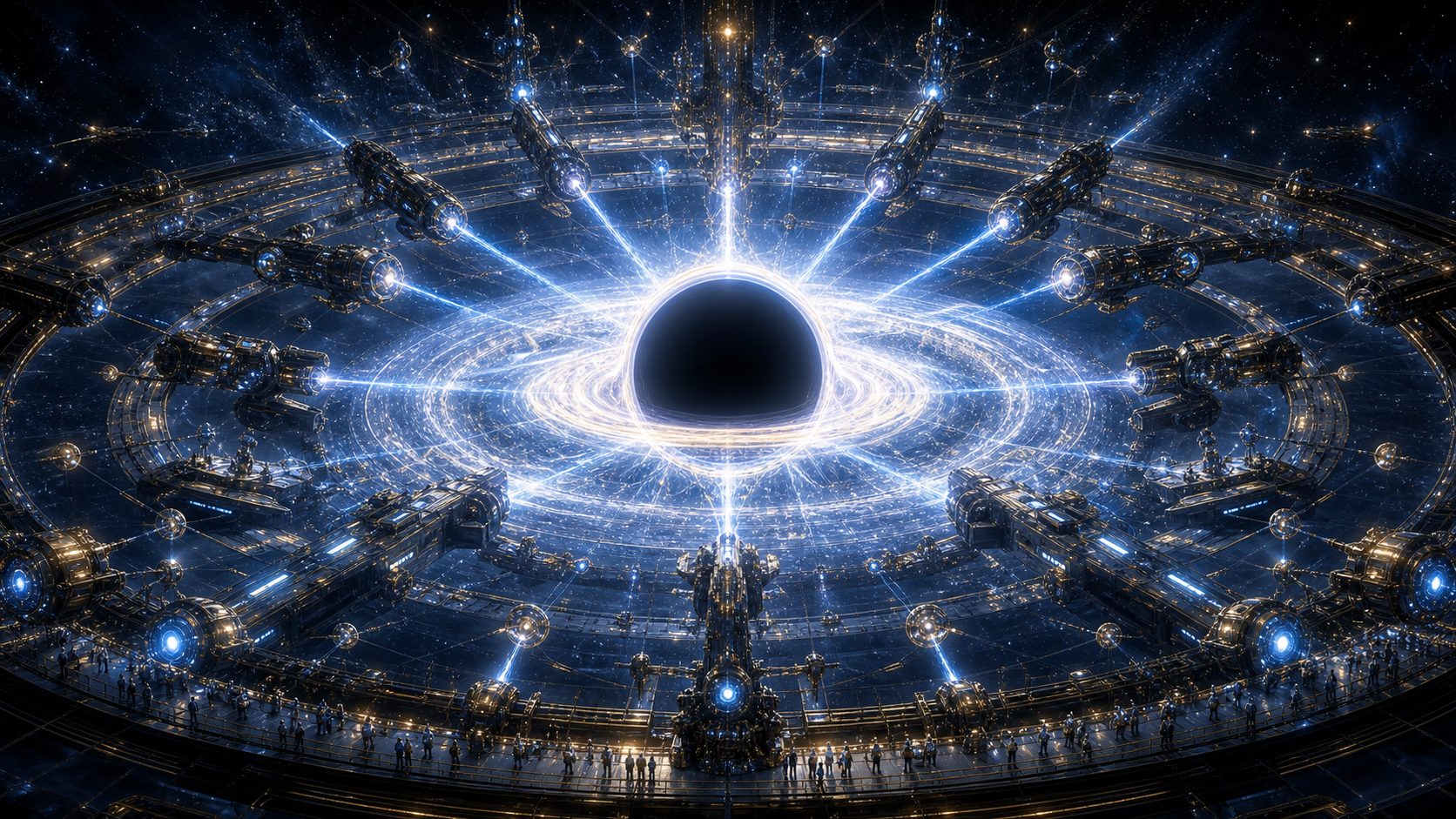
Beyond the disciplined near-term program lies the book's deep frontier: inquiries where the questions themselves are the achievement.
The core research program works where instruments already exist. Advanced Research works where they do not — yet. Its charter is the book's furthest material: the hidden architecture of the universe, "the informational web that links every particle, every mind, every possibility," explored through theory, simulation, and the patient construction of frameworks that future instruments could one day test.
This is not license for vagueness. The book's own standard applies with extra force at the frontier: every grand claim decomposed into systems, mechanisms, and failure modes; every conjecture stated so that it could, in principle, be wrong. The frontier topics below are organized exactly that way — as research questions with proposed architectures, not as promises.
Three inquiries anchor the portfolio: information access across spacetime, the scientific study of consciousness, and the engineering of designed realities. Around them orbit the cosmological summits — dark matter and dark energy, unified physics, and the Theory of Everything the book imagines the White Noise Computer finally formulating.
The central conjecture: entangled states inherently linked to the entirety of existence — across all points in space and moments in time — rather than to discrete local particles. The theoretical keystone of the entire ecosystem.
Interfacing with the quantum vacuum to reveal what the book calls the informational blueprint of the universe — treating spacetime itself as a readable record of cosmic history.
The W.N. Telescope concept: extending observation across distance and time, from reconstructed historical events to the dynamics of distant cosmic phenomena — pursued first in simulation.
The book treats consciousness not as a residue of computation but as a possible participant in the universe's informational structure. Its working hypothesis: the human brain — especially in trained individuals — may exhibit latent capacities to interface with entanglement fields, functioning as a biologically evolved conduit for non-local information exchange. If true, the brain of a remote viewer is a naturally occurring prototype of the very machine the company is named for.
Advanced Research extends this beyond the laboratory protocols of the core program: quantum theories of mind and their testability; the question of whether quantum-coherent structures such as microtubular arrays play any functional role in cognition; distributed sentience — the book's vision of a unified entangled awareness spanning many nodes; and the continuity problems raised by consciousness transfer and backup in the immortality framework. Each is pursued as philosophy with engineering ambitions: rigorous about what is known, explicit about what is conjectured.
"There remains a realm largely unexplored: the hidden architecture of the universe itself — the informational web that links every particle, every mind, every possibility."
Hyperreal simulated environments — the book's cosmic simulation spaces — used for research, ethical testing, and civilizational rehearsal long before any physical substrate exists.
Testing physical theories by building universes that embody them: the book's most audacious research method, in which a theory's consistency is demonstrated by inhabiting it.
The theoretical programmable medium — Blue Gue and its descendants — through which designed realities would be instantiated, stabilized, and maintained.
The ethics of authorship: stability obligations, the moral status of simulated minds, and the Law of Large Verses as a statistical frame for engineered realities.

The book's final scientific aspiration is total: a comprehensive, self-consistent framework explaining all physical phenomena across scales — uniting gravity, electromagnetism, and the nuclear forces, and integrating dark matter and dark energy naturally into the cosmic picture.
Advanced Research holds this summit as orientation rather than destination: the fixed point by which every lesser inquiry — from the Superformula to entanglement cosmology — takes its bearing.
Every claim carries its epistemic status — established, frontier, or visionary — using the calibration drawn on The Science. No claim borrows credibility from its neighbors.
Frontier visions are broken into mechanisms, dependencies, and failure modes — the book's own insistence that grand claims earn their grandeur through structure.
Inquiries touching minds, realities, and cosmic-scale power begin with their governance questions, not end with them — oversight is a design input, never an appendix.