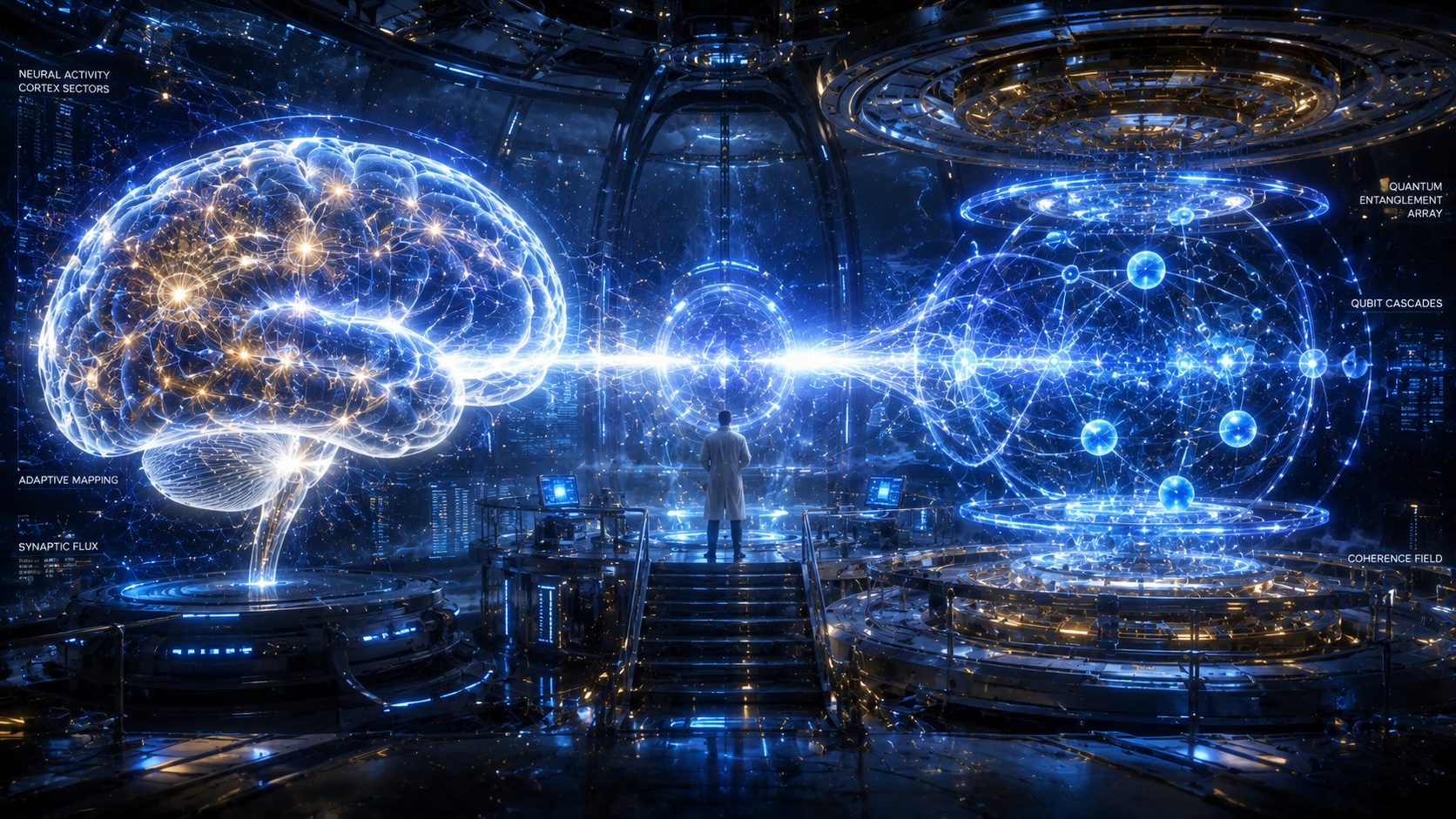
From injectable nanobots that listen to single neurons, to macrobots that raise megastructures — one robotics continuum, coordinated by a single entangled intelligence.
In White Noise Totality, robotics is not a product category but a continuum of embodiment. At one end: neurological nanobots, agents of 1 to 100 nanometers, small enough to cross the blood-brain barrier and navigate neural architecture without disruption or immune response. At the other: macrobots — megastructure-scale engineering organisms that shape galactic cities, deploy containment fields, and assemble entire settlements. Between them lies every working scale of a civilization.
What unifies the continuum is coordination. The book describes nanobots and macrobots as universally distributed, networked via quantum entanglement, and orchestrated by the White Noise Computer's superintelligence. Each W.N. Chip-equipped unit carries a quantum-integrated intelligence core — local autonomy for real-time response, global alignment with the overarching swarm logic. The result is less a fleet of machines than a single distributed organism with billions of bodies.
This is the embodiment layer of W.N. AI: the place where omnipresent cognition becomes omnipresent capability — healing, building, maintaining, and exploring, from the synapse to the star system.
Microscopic agents that monitor synaptic transmissions in real time and modulate neuronal firing with nanometric accuracy — the research instruments of remote viewing reverse-engineering and the repair crews of the Digital Medical System.
Cellular-scale maintenance at body and biosphere scale: continuous health monitoring, molecular repair, ecosystem stewardship — AI-guided companions embedded in the nanobot matrix.
The human-scale middle of the continuum: fabrication, logistics, agriculture, and exploration platforms running W.N. OS, sharing perception and skill across the entire network.
Infinitely scalable engineering organisms that construct, deconstruct, and reconfigure infrastructure anywhere — the builders of OSTSS settlements and, in the book's furthest chapters, megastructures around black holes.
A verified intent — a home to build, a wound to heal, a habitat to terraform — enters the network through the goal system, checked against embedded ethical constraints.
The superintelligence decomposes the goal across scales: nanobots manipulate matter, biology, and quantum fields locally, while macrobots deploy structural and energetic capacity.
Units synchronize through quantum-entangled communication — multi-scale action with no central choke point and no signal delay across the working volume.
The loop is self-correcting: outcomes are monitored continuously, drift is repaired, and the result is sustained — not merely built — in alignment with long-term wellbeing.
"These intelligent, adaptive swarms can instantaneously construct, deconstruct, reconfigure, or deliver any desired property, infrastructure, or resource anywhere in space and time."
The book describes massless topological transformer chips embedded throughout the nanobot and macrobot layers — "the nervous system of an omnipresent intelligence, the silent architects of a civilization no longer bound by classical limits."
Every robot in the continuum is, in this vision, a neuron of the same mind: locally capable, globally coherent, and answerable to the same macroethical cores that govern the Superintelligence itself.
The book itself keeps the ledger of difficulties. Technically: building nanobots that can record and influence neural activity is a formidable challenge, and the number required for meaningful coverage could be extremely large. Ethically: how do we guarantee alignment between human objectives and nanobot autonomy in unpredictable environments — and can ethical alignment be reliably maintained in a system so powerful that it may evolve beyond human supervision?
A self-replicating, omnipresent robotic substrate is simultaneously the book's most enabling and most dangerous idea. Its proposed safeguards — embedded macroethical cores, transparent coordination, and governance that treats replication itself as a licensed act — are explored across the Superintelligence and Singleton frameworks.