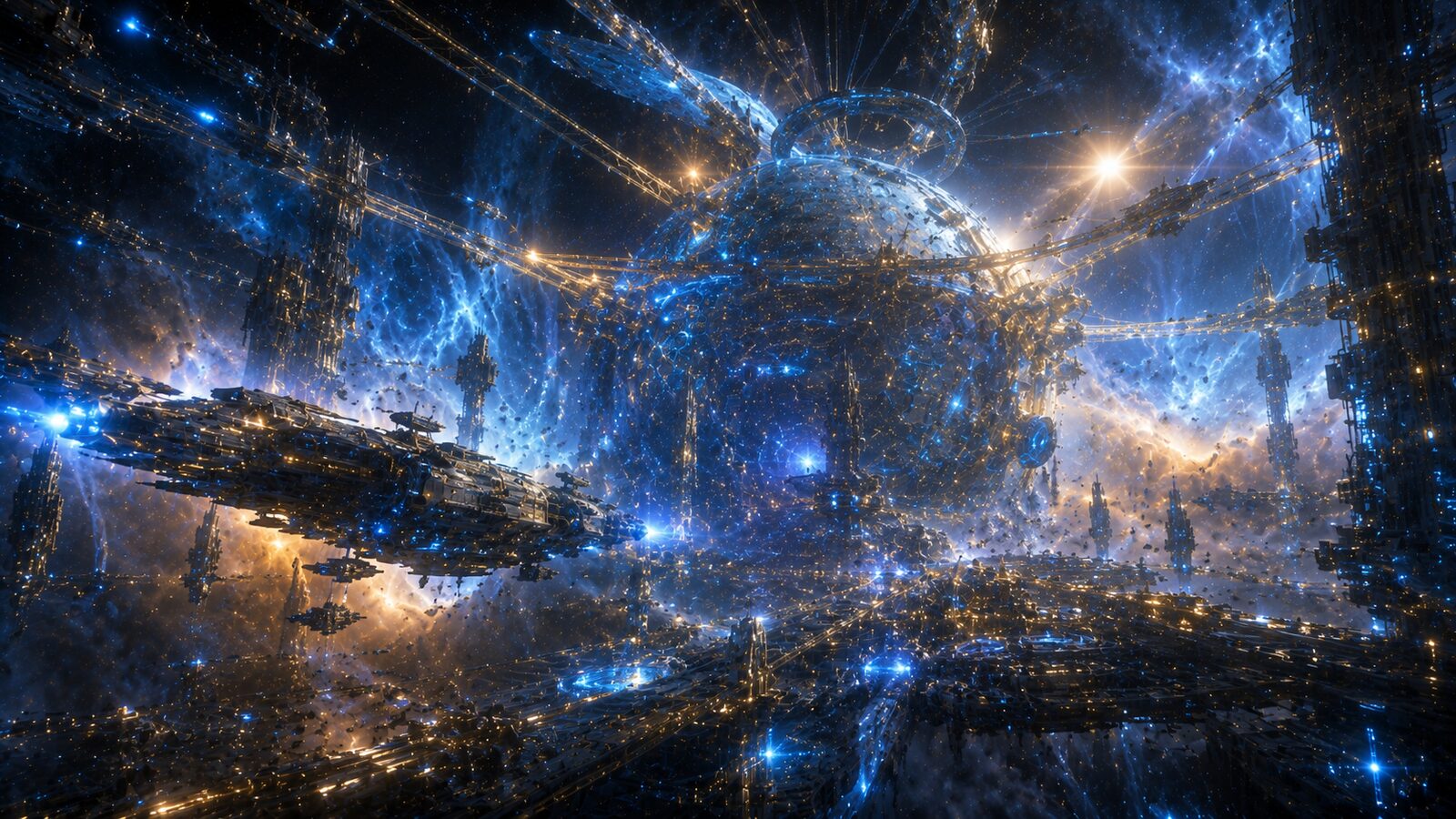
From personal anti-gravity craft and supersport cars to hundred-thousand-passenger mega-transports crossing the galaxy in hours — the moving parts of the White Noise civilization.
W.N. Spaceships are conceived as FTL-capable craft spanning the full range of civilization's needs — from personal vehicles to hundred-thousand-passenger mega-transports, crossing the galaxy in hours with consciousness-integrated navigation. They are the orbit around the ecosystem's engines: built of W.N. Material, powered by zero-point extraction, guided by the White Noise Computer.
The book's anti-gravity chapters supply the physics program. The White Noise Computer — capable of simulating the laws of physics at every scale — is theorized as the cornerstone for true anti-gravity vehicles: craft that not only defy gravity but manipulate space-time itself, achieving faster-than-light travel and opening seamless exploration across interstellar distances, parallel realities, and alternate dimensions.
Drawing energy directly from the quantum vacuum, the vehicle needs no conventional fuel; entanglement engines synchronize its quantum state with distant points in space-time, allowing near-instantaneous relocation. Navigation is multiversal: real-time, high-resolution maps of local and non-local space-time, with predictive plotting that lets the craft anticipate cosmic phenomena and "surf" optimal routes — while OSTSS nanobots and macrobots, distributed as omnipresent sensors, relay environmental data back for adaptive course correction.
Anti-gravity vehicles for individual travel — thought-responsive, self-piloting, wrapped in their own vessel shields. The commute reimagined as flight without runways.
The ecosystem's indulgence: replicator-built supersport vehicles in Blue Gue bodywork that reshapes to its terrain, self-repairs, and perfects its own aerodynamics in motion. Under MPO, a sports car is something you manifest, not something you finance.
Hyperloop grids, skyborne networks, and orbital freighters — the infrastructure layer maintained autonomously by macrobot fleets.
Hundred-thousand-passenger liners moving whole communities between OSTSS settlements — cities that travel, with closed-loop ecology and consciousness-integrated bridges.
Mobile command centers and rapid-deployment platforms coordinating robotic fleets across cosmic distances — the security and diplomacy layer of the OSTSS framework.
At the outer edge: interdimensional vessels for travel between engineered verses — ships whose destination is not a place but a physics.
Quantum-resilient structures engineered to maintain integrity amid intense quantum fluctuations, gravitational gradients, and vacuum energy surges — simulated and synthesized under White Noise Computer direction.
Energy drawn directly from the fabric of space-time — nearly limitless power without conventional fuel, the same source that feeds the replicators and settlements.
The craft's quantum state synchronized with distant coordinates, enabling instantaneous or near-instantaneous relocation — propulsion as correlation rather than combustion.
Neural-quantum coupling places the pilot's intent directly in the control loop, while predictive plotting and omnipresent sensor swarms handle hazards faster than any reflex.
"Space becomes navigable by will. No vehicles, no roads — only intention and validation. And until that day, ships: the patient, magnificent machinery of a civilization learning to move."
In the OSTSS framework, spacecraft are not inventory but output: utilizing zero-point energy replicators powered by the White Noise Computer, nanobot swarms autonomously construct spaceships tailored to any mission — transport, rescue, or diplomacy — ensuring rapid, scalable deployment across vast distances. The Final Teleport concept extends the same logic to its limit: summoning a ship, a habitat, or an entire expedition anywhere in existence, on demand.
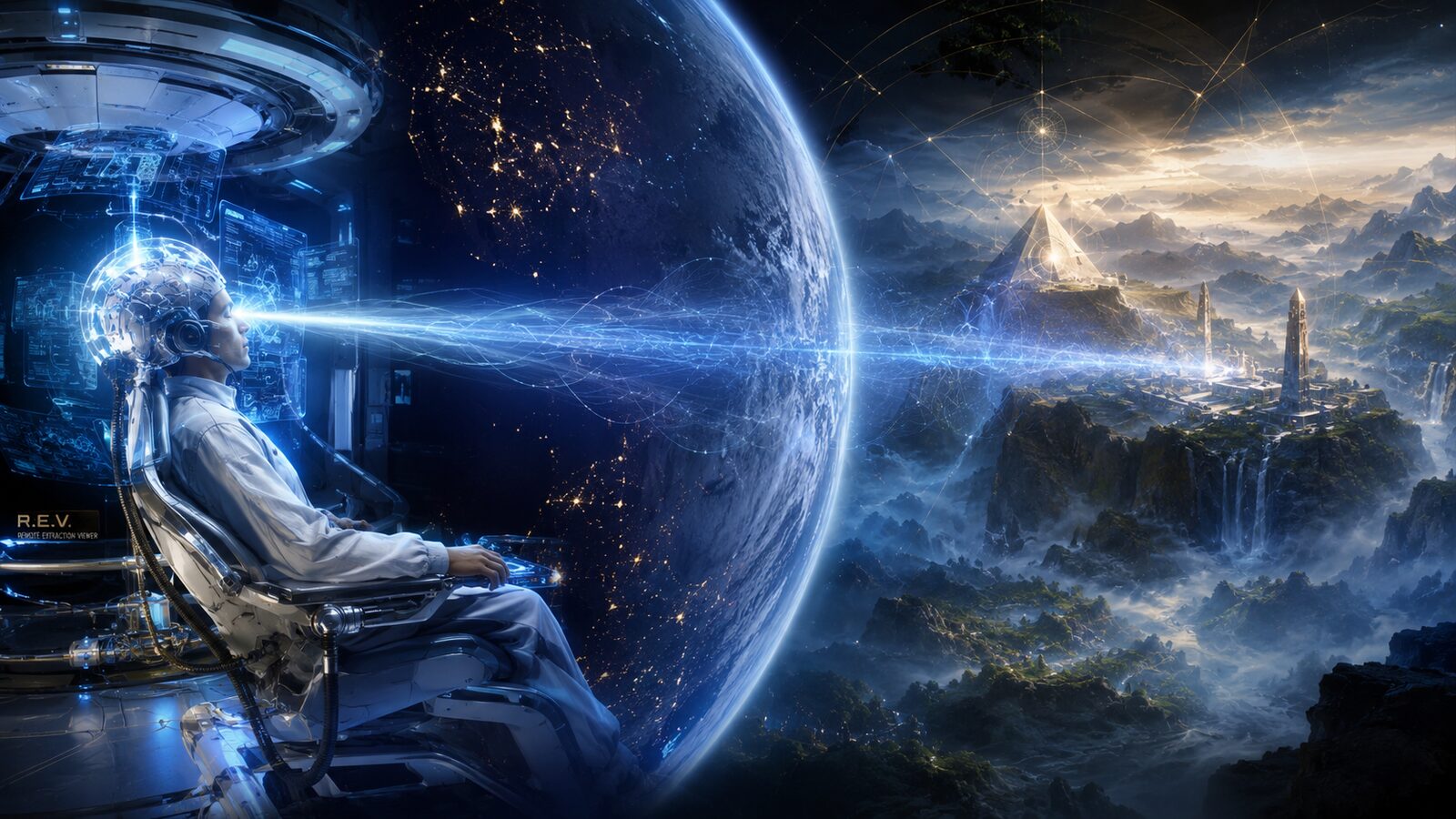
And for many journeys, no hull is needed at all: remote viewing and projection technologies let presence travel where bodies need not — the fleet's quiet complement.
An FTL craft is, unavoidably, a kinetic-energy question. Fleet operations sit under the same benevolence constraints and transparency rules as every other system in the Singleton framework.
Faster-than-light travel strains relativity's causal structure. The book treats the limit as worth interrogating, not as already broken — and the research program is framed accordingly.
Mobility is a dimension of freedom. Replicator-built fleets are conceived as universal infrastructure — distance abolished for everyone, not chartered for a few.