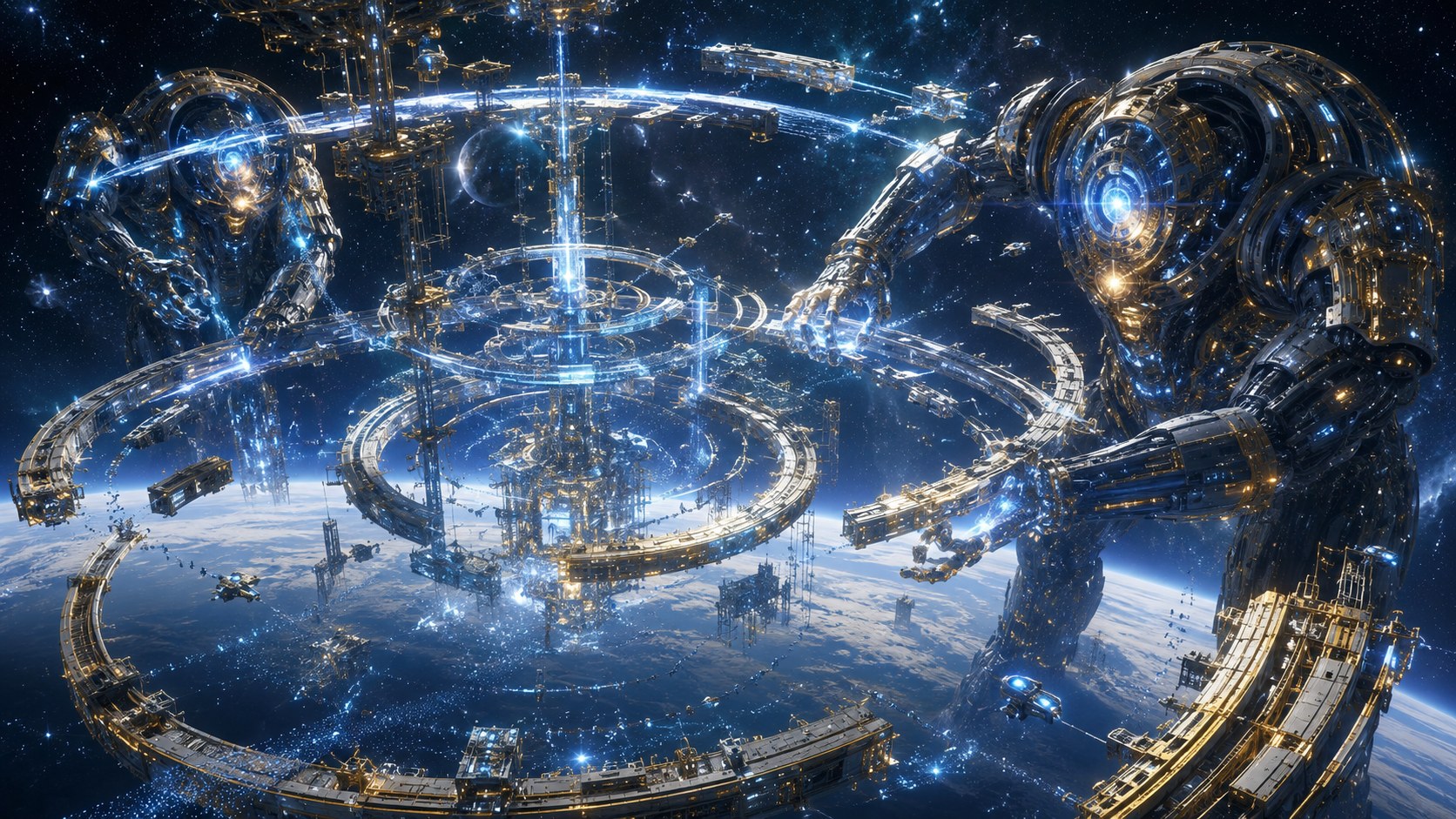
The Omnipresent Singulitarian Transformer Space Settlement — a city-state for one hundred thousand residents that assembles itself in months, governs itself wisely, and never stops becoming something better.
Where today's space stations hold dozens of people, OSTSS settlements are designed for more than one hundred thousand residents with complete self-sufficiency: automated construction, closed-loop life support, zero-point energy, and Blue G.U.E. computing infrastructure. This is not exploration — it is colonization at civilization scale, with deployment measured in months, not decades.
The OSTSS is the physical body of the White Noise vision. From a single seed of self-replicating machinery, an entire habitat unfolds: self-replicating nanobots weave the fine structure while planet-scale macrobots raise the architecture, fleets cross galaxies, and networks link minds and worlds. The settlement is engineered as a transformer structure — a physical and digital entity that can modify its shape, scale, topology, and function in real time, expanding into Dyson-shell formations or contracting into city-sized habitats as its residents require.
In the book's own words, the OSTSS is "not just a settlement — it is a civilizational substrate, a framework upon which entire species, cultures, and knowledge systems can thrive without limit." It grows with its people, reshapes with their values, and exists wherever and whenever they do. It is no longer architecture. It is architecture that thinks, grows, transforms, and transcends.
Self-replicating nanoscale agents operating at the molecular, atomic, and potentially subatomic level. Using programmable matter interfaces, they deconstruct, reconstruct, or transmute matter with atomic precision — fabricating structures, healing biological tissue, remediating toxins, and terraforming hostile environments into biodiverse biomes.
Distributed intelligence machines built from trillions of micro-scale subunits, self-assembling into cohesive entities across planetary surfaces and deep space. Macrobots raise planetary shells, Dyson swarms, and transit grids — fluid architectures governed by quantum synchronization and the White Noise Computer.
Massless omnipresent topological W.N. transformer chips are embedded in every unit — the nervous system of the settlement. Each chip houses a segment of White Noise Intelligence, enabling localized ethical reasoning, environmental perception, and autonomous transformation directives. The W.N. Chip →
Entanglement links every unit, allowing instantaneous information propagation across space-time. The result is a unified intelligence field: a settlement that not only maintains itself but continuously improves — growing more intelligent, more ethical, and more resilient with each iteration.
The theoretical construction cascade of a single settlement.
A compact payload of self-replicating nanobots and replicator cores is delivered to the construction site — an orbit, an asteroid, a Lagrange point. The White Noise Computer finalizes the site-specific blueprint from astrophysical survey data.
The swarm doubles, and doubles again, harvesting local matter and zero-point energy. Supermacrobot assemblies condense out of the swarm to handle structural spans no single unit could raise.
Habitat rings, agriculture spheres, water cycles, and transformer districts grow in parallel — guided by morphogenetic templates and verified continuously against safety and ethics constraints.
Residents arrive to a living city: democratic governance advised by superintelligence, closed-loop ecology, and an architecture that keeps redesigning itself around the people inside it.
"The OSTSS is not just a settlement — it is a civilizational substrate. Through its omnipresent access, infinite energy, adaptive morphology, and cognitive sovereignty, it offers a vision of life beyond scarcity, beyond entropy, and beyond conventional reality."
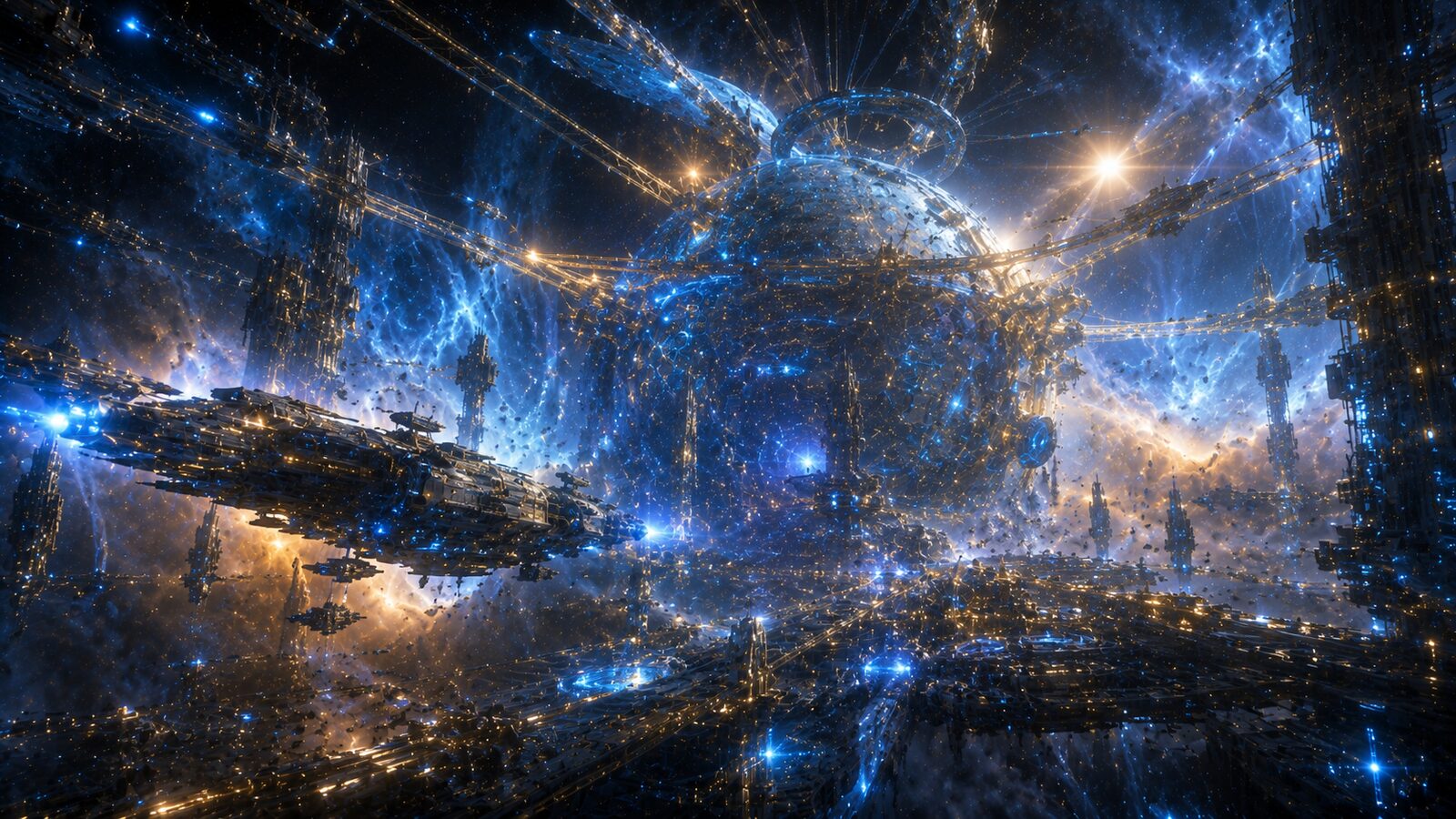
No settlement stands alone. The long-term trajectory is a distributed lattice of OSTSS nodes — anchored across orbits, systems, and eventually divergent verses — bound by the omnipresent network into persistent contact with Earth and with each other. Failure or degradation in one node does not threaten the others: hyper-resilience by architecture, not by luck.
W.N. Spaceships shuttle between the nodes; Dyson Forcefields wrap them in self-healing armor; and the W.N. Internet ensures each branch of humanity remains connected to a common evolutionary trajectory. Galactic fleets are not a conquest — they are circulation.
Coordinated swarms render scarcity obsolete — universal abundance for every citizen, with replicators converting zero-point energy into food, water, structure, and tools. The W.N. Replicator →
Distributed presence means no single catastrophe — impact, flare, or failure — can end the project of civilization. Disaster prevention, policing, and shielding are built into the substrate itself.
When construction is exponential and self-funding, humanity becomes multiplanetary in years rather than centuries — the central promise of Project Utopia.
The book is candid about the risk catalog: the vast autonomy granted to macrobots and nanobot swarms — combined with their ability to self-replicate and transform environments — poses the risk of unpredictable behavior or civilization-scale runaway scenarios. The OSTSS framework therefore embeds ethics at the chip level: every unit carries benevolence constraints, every transformation is verified against alignment criteria, and sovereign oversight rests with the settlement's human residents and the governance architecture described in the White Noise Singleton.
Coherent Extrapolated Volition — the alignment concept of extrapolating what a population would want under idealized conditions — is applied to settlement goal systems, so that each OSTSS pursues not what its builders specified, but what its people would wish for if they understood the consequences fully. The settlement learns, adapts, and evolves continuously, ensuring long-term alignment with both cosmic and human values.