White Noise can identify material dependency classes and pair them with current public claim boundaries.
Dependency governance
Vendor risk before infrastructure claims.
This public register gives enterprise buyers, strategic partners, sponsors, investors, and board reviewers a first-pass view of White Noise dependency classes, current public use state, stronger-use gates, owner-state caveats, and review triggers.
Use boundary
This register is for general information only. It is not a vendor audit, procurement policy, SOC 2 or ISO 27001 evidence, PCI evidence, legal advice, data-processing agreement, service-level dependency register, completed vendor security review, or proof of enterprise vendor-management maturity.
Visual boundary
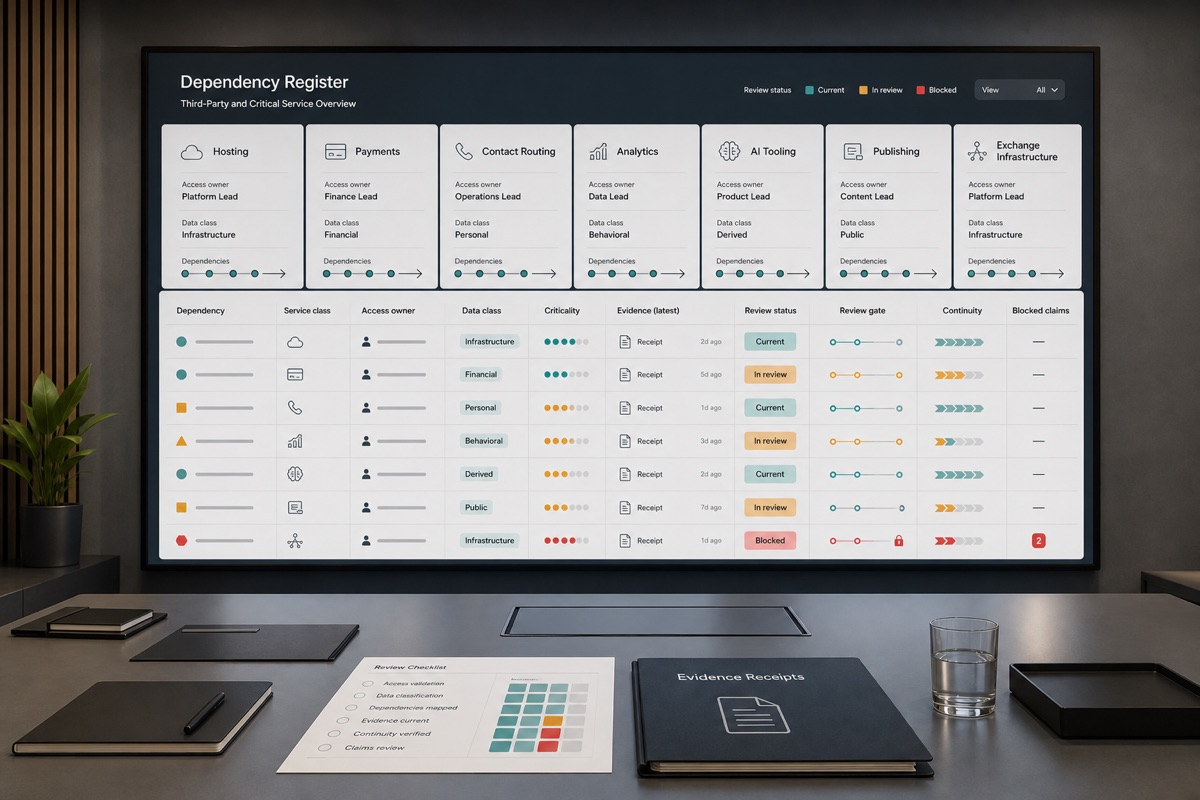
The hero image is a reused GPT-generated conceptual governance visual. It is not proof of vendor review completion, audited controls, procurement maturity, enterprise security, payment compliance, production CRM, live Exchange operations, or operational speculative technology. Review the image provenance record.
Board view
Public availability is not vendor readiness.
The register is meant to prevent inference drift. White Noise can show that dependency-class review has begun, but it should not imply production resilience, payment compliance, enterprise procurement maturity, live CRM operations, or Exchange infrastructure readiness until service-level records exist.
Uptime, payments, CRM, analytics, prototype workflow, publishing, account, and Exchange claims need private service records.
AI-generated dependency imagery may support narrative when provenance and non-proof boundaries are visible.
Public materials must not be read as vendor audit, procurement maturity, SOC 2, ISO 27001, PCI, or DPA proof.
Hosting, domains, and deployment
Static site files, local asset references, and public materials integrity checks.
- Public state
- Publishing and reference hygiene are supportable when local references resolve and no uptime claim is made.
- Stronger gate
- Uptime, disaster recovery, SLA, reliability, backup, monitoring, or continuity claims require service-level records.
Payments and checkout handoff
Processor configuration, store pages, membership routes, and purchase handoff surfaces.
- Public state
- Processor-handoff language is supportable when White Noise does not claim direct card custody.
- Stronger gate
- PCI, refunds, subscriptions, tax, chargeback, revenue-recognition, or billing-data claims require reviewed records.
Contact, inquiry, and response routing
Contact page, diligence request guide, first-response standard, and inquiry triage protocol.
- Public state
- Routing and response-shape language is supportable when missing workflow proof remains explicit.
- Stronger gate
- Production CRM, staffed queue, SLA, response metrics, or confidential exchange requires owner, access, logging, retention, and escalation records.
Analytics and operating measurement
Model context, planning assumptions, and future KPI or conversion references.
- Public state
- No audited metric claim is supportable without source records and definitions.
- Stronger gate
- Traffic, conversion, retention, revenue, or capital-grade reporting requires source-of-truth records, exclusions, and review owner.
AI tooling and generated visuals
Published governance, investor, privacy, proof-pack, and technical visuals with provenance records.
- Public state
- Editorial and conceptual use is allowed when provenance, alt text, prompt intent, and non-proof boundaries are visible.
- Stronger gate
- Treating AI outputs as operating proof, legal evidence, customer proof, product proof, or automated-control evidence requires separate evidence and review.
Publishing, corpus, and curriculum tooling
Book, Academy, Library, encyclopedia, corpus, dataset registry, and source-rights surfaces.
- Public state
- Public exploration and bounded company-authored publishing are supportable when source-rights boundaries remain visible.
- Stronger gate
- Institutional publishing, LMS, model training, commercial datasets, licensing, or syndication require source-specific records.
Account, member, CMS, and portal surfaces
Portal, CMS, Club, WN Plus, browser, and demo account surfaces.
- Public state
- Demo or static-surface language is supportable when production account custody is not implied.
- Stronger gate
- Production identity, admin access, retention, deletion, support, or enterprise authorization claims require system-owner and data-handling records.
Exchange, marketplace, custody, and WN Coin infrastructure
Exchange launch-status note, WN Coin routes, and marketplace-adjacent pages.
- Public state
- Preview, boundary, and launch-gate language are supportable while market activity remains blocked.
- Stronger gate
- Sale, custody, liquidity, market operations, creator payouts, payment rails, or compliance claims require launch, legal, dependency, and source-rights review.
The register supports bounded diligence routing.
- State that third-party dependency review has begun at the dependency-class level.
- Pair this register with the security/data baseline, source-rights register, risk register, and operating cadence memo.
- Describe payment posture as specialized processor handoff when no direct billing credential custody is claimed.
- Describe generated images as editorial or conceptual only when provenance and usage boundaries are visible.
- Route serious counterparties to ask for one service-specific record when vendor, payment, CRM, analytics, AI, publishing, or Exchange readiness matters.
The private register should be service-specific.
The next maturity step is a private service-level dependency register for material services used in hosting, domains, deployment, payments, contact routing, CRM, analytics, AI tooling, publishing or corpus workflows, account surfaces, Exchange, marketplace, custody, or creator-payment infrastructure.
- Service name, business purpose, data or asset classes handled, and access owner.
- Credential-storage rule, admin-review state, contract or terms source, privacy relevance, and continuity plan.
- Offboarding route, public claim boundary, review owner, and event trigger.
Reading ruleDependency discipline protects enterprise value.
Source gateService-Level Dependency GateAcceptance record before stronger vendor, continuity, or procurement claims.
BaselineThird-Party Dependency BaselineMinimum fields and public-language rules before stronger dependency claims.
SecuritySecurity/Data BaselineCurrent static-site data posture, payment handoff, and security non-claims.
RightsSource-Rights RegisterSource classes and stronger-use gates before reuse, licensing, or corpus claims.
The register makes diligence easier by saying where White Noise is bounded now and which dependency records must exist before stronger claims.