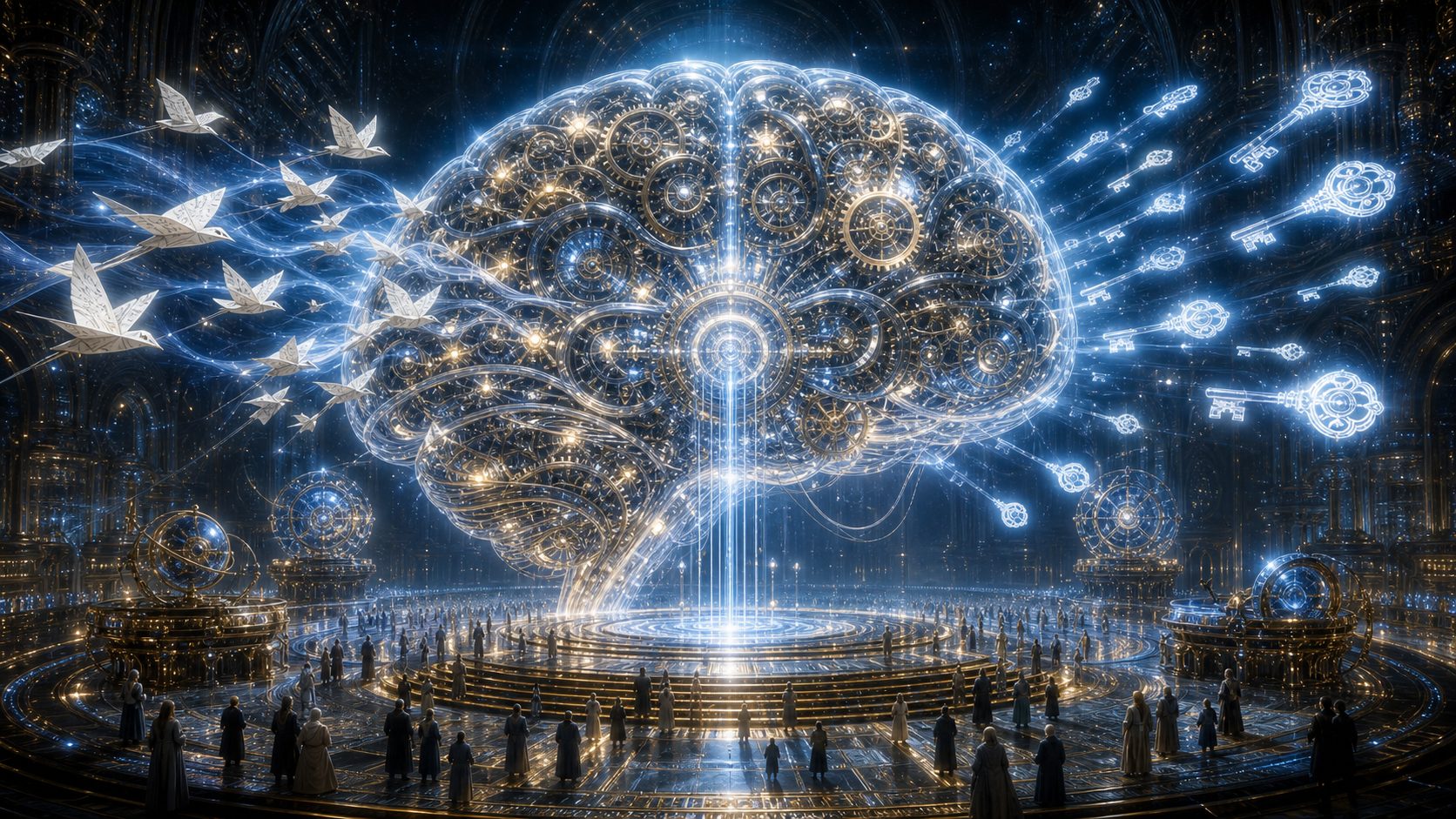
In the book's framework, food ceases to be something grown and shipped — it becomes pure information, compiled molecule by molecule for the person about to eat it.
"Among all the applications of the White Noise Replicator," the book writes, "none touches daily life more intimately than food." W.N. Food is the framework's answer to the oldest human anxiety: the White Noise Replicator and Computer together "promise the end of agriculture as a survival activity — and the beginning of food as pure information."
The envisioned mechanism follows the replicator's zero-point energy principles, tuned to the demands of biology. Drawing on the vacuum's latent energy, the system would assemble edible matter molecule by molecule: "proteins folded to order, vitamins in precise ratios, flavors and textures rendered with atomic fidelity." The White Noise Computer would hold the master library — every dish ever cooked, every cuisine ever invented, and every dish that could be invented within the space of human taste.
Because synthesis is informational, every meal could be personal. Coupled to the Digital Medical System, the replicator would read the diner's current biology — metabolic state, micronutrient gaps, allergies, training load, even mood — and compile the meal accordingly. Two people sharing the same table might eat what appears to be the same dish while receiving entirely different molecular compositions, each optimized for its eater. In the book's phrase: "the dish adapts to the person, never the reverse."
"Famine becomes structurally impossible wherever a replicator stands." Hunger, in the framework, is reclassified from tragedy to infrastructure failure — and infrastructure can be replicated.
A civilization that synthesizes food from energy no longer farms at planetary scale or ships produce across oceans. The book imagines agricultural land rewilding — a pillar of its ecological restoration program.
"Meat, in this framework, is compiled rather than raised — indistinguishable at the molecular level from its biological original, with no nervous system ever involved."
"Unconsumed matter is simply decompiled back into energy." The supply chain collapses into a single step, and the concept of food waste loses its referent.
The diner chooses — or describes, or merely imagines — a dish from the master library: any cuisine, any era, any invention not yet tasted by anyone.
The Digital Medical System would supply the diner's live nutritional profile: what this body, today, actually needs.
The replicator would assemble the dish from zero-point energy, atom by atom — flavor and texture exact, composition silently personalized.
What remains is the part no machine replaces: people eating together — "the oldest human ritual," as the book calls it, finally freed from every constraint except imagination.
"Eating together remains what it has always been — the oldest human ritual — now freed from every constraint except imagination."
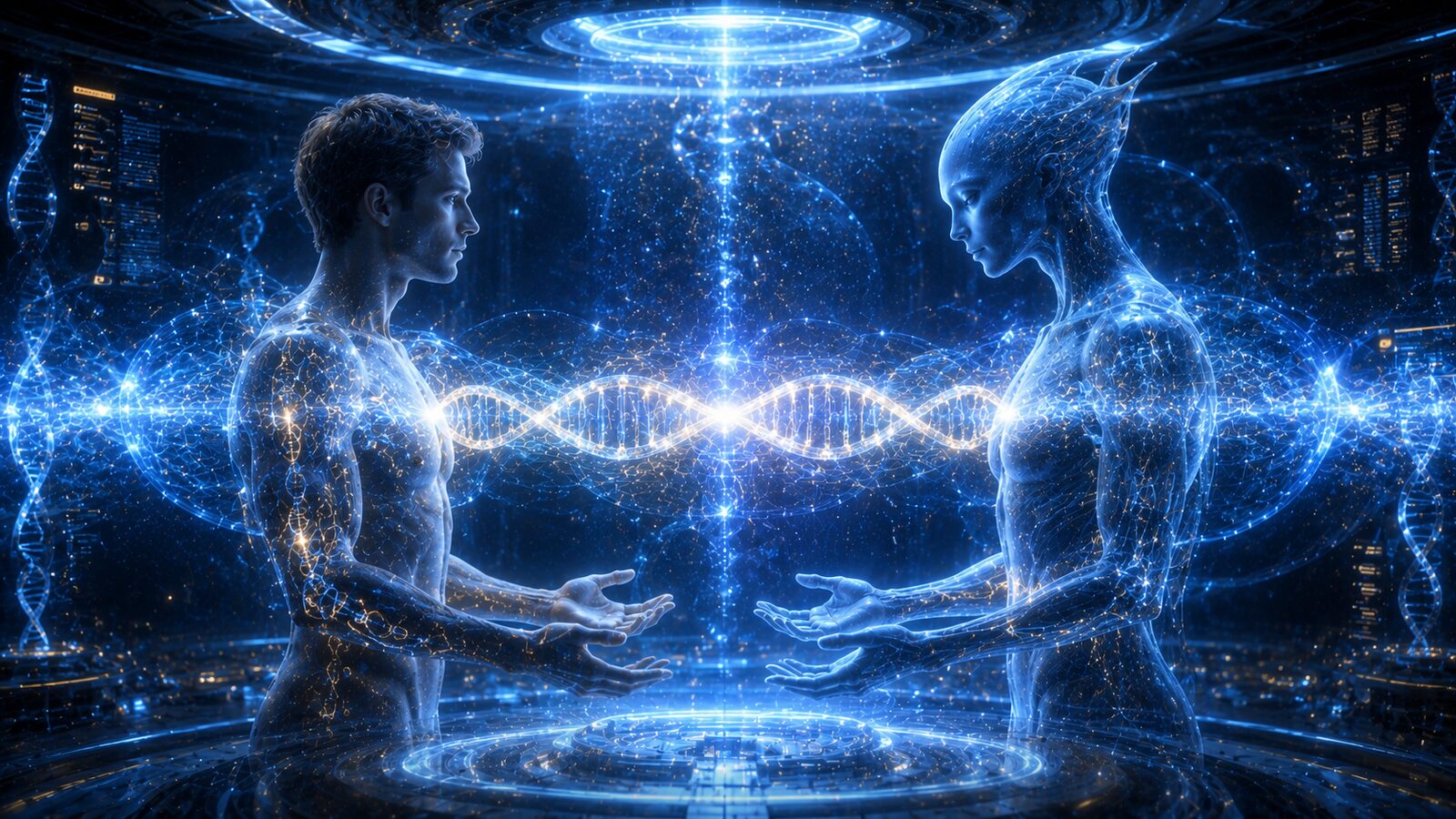
In the envisioned coupling of replicator and medical system, "disease-driven dietary restriction disappears as a category." Allergies are compiled around; deficiencies are corrected silently inside dessert; the constellation entry for White Noise Food and White Noise Water reads simply: "nutrient-perfect, quantum-optimized sustenance."
The book treats this as the quiet half of its health program: cures for what goes wrong, and food engineered so that far less ever does.
The book anticipates the obvious objection — that infinite synthesis would make food meaningless — and argues the reverse. "Far from flattening cuisine, infinite synthesis is imagined here as a renaissance. Chefs become composers working in an unlimited medium; family recipes become heirloom files passed between generations; the cuisines of distant OSTSS settlements propagate across the omnipresent network at the speed of entanglement." Scarcity, it suggests, was never what made a meal matter.
Read against the rest of the framework, W.N. Food is the most domestic face of the post-scarcity thesis that runs through the whole book: that once matter becomes software, the foundations of want dissolve — beginning, fittingly, at the dinner table.