Use this before contact when the real blocker is shaping the inquiry, not the absence of a form.
Inquiry prep
Best use
Turn a vague lead into one reviewable ask.
Expected first return
One artifact, one boundary, one next room.
Do not infer
No secure diligence room or staffed CRM implied.
Package one serious note before you ask for a bigger room.
This checklist exists to improve enterprise trust, lead quality, partner fit, and investor signal without implying infrastructure that does not exist yet. Use it when the question is real but the note is still too vague. The goal is simple: name one decision, one reviewed surface, one expected first-return artifact, and one boundary so White Noise can answer with something concrete.
Use boundary
This checklist is for general information only. It is not investment advice, not an offer to sell or solicit securities, not a dataroom, not audited reporting, and not proof that speculative White Noise technologies are commercially deployed.
Visual decision
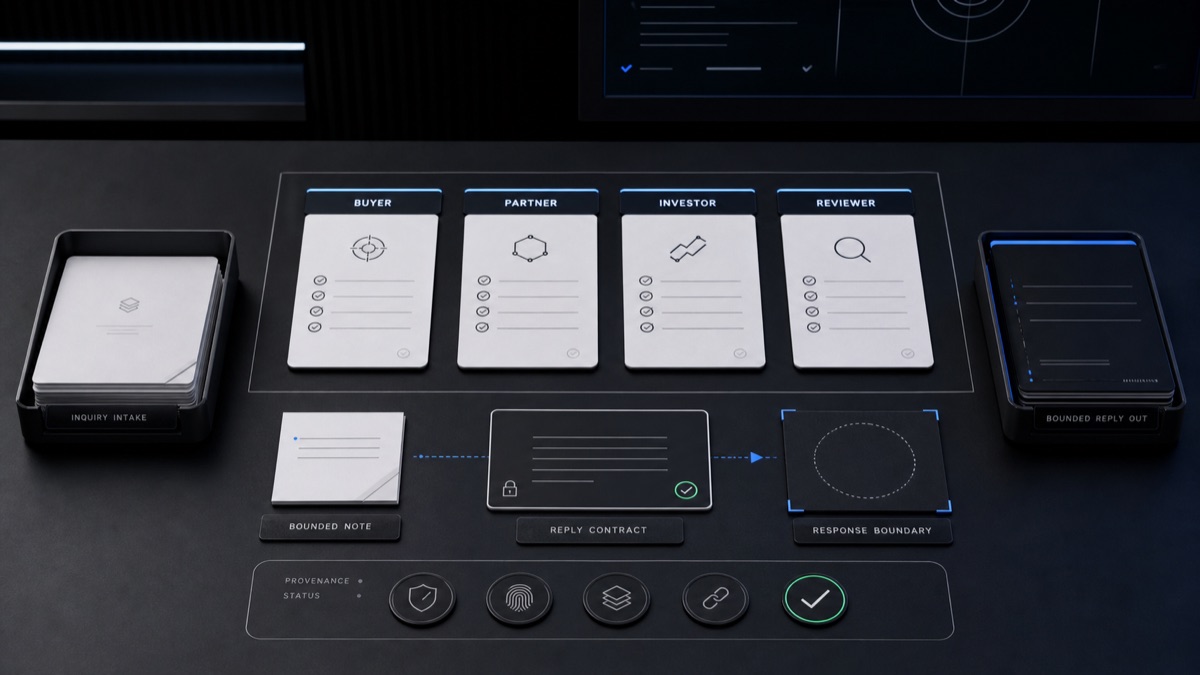
Hero image: GPT-generated serious-inquiry checklist concept created on 2026-07-02 for this route. Prompt intent: show buyer, partner, investor, and reviewer lanes with a bounded note, reply contract, response boundary, and provenance/status tokens in one disciplined review surface. Asset:
assets/contact/white-noise-serious-inquiry-checklist-20260702.jpg. Review the provenance record. Usage boundary: editorial orientation only, not proof of a staffed inquiry desk, production CRM, live customer records, secure diligence room, formal financing process, response SLA, audited controls, legal review, or operational speculative technology.
The first reply should return a memo, walkthrough, packet, scope path, redirect, or plain not-ready answer.
This page prepares a public first-pass note only. It does not create a private process by itself.
Before You Send
The note should answer six questions before it leaves your browser.
The fastest way to lower reply quality is to ask for a broad introduction, broad diligence, or broad partnership conversation. The best first note is narrower: it gives White Noise one concrete decision to answer and one boundary to keep visible.
Name the decision, not the topic.
Examples: first capital posture review, scoped services fit, program sponsorship fit, procurement-boundary check, or claim-boundary review.
If the decision is unclear, open the reviewer cockpit or investor quickstart first.Name who is making that decision.
Investor, board observer, enterprise buyer, strategic partner, sponsor, operator, analyst, or research lead changes the right first artifact and the right route.
One role is better than a blended “investor-partner-buyer” request.Cite one page or packet already reviewed.
Use one named public surface such as the company snapshot, scorecard, partner-fit memo, starter brief, Trust Center, or capital-readiness note.
The reply gets stronger when it can continue an inspected route instead of starting from zero.Ask for one artifact back.
Examples: capital-response memo, partner-fit walkthrough, procurement-boundary memo, scoped services path, methods note, or plain not-ready answer.
Do not ask for “everything available” or an undefined dataroom.Name the main risk or non-claim up front.
Examples: missing formal-process materials, delivery maturity, security-review boundary, source-rights boundary, or launch-state honesty.
The first reply should answer the boundary directly instead of warming around it.Say whether the note is exploratory or time-bound.
A near-term procurement screen, a July board discussion, or a first internal circulate are different from general long-horizon interest.
Timing should scope urgency, not imply a response SLA.Fast ruleOne decision, one reviewed surface, one expected return.
SendOpen the routed formThat is the smallest trust-preserving contact shape White Noise can route responsibly today.
Use the contact route after the note is specific enough to survive first review.
MapMatch the decision to the right artifactUse the request guide when the expected first return still feels fuzzy.
ReplyInspect the response contractConfirm what a credible first reply should contain before you send the note.
Role Map
Use the route that matches the real room.
This page is not a universal inbox. The role determines the smallest defensible next artifact and which warmer assumptions must stay out of scope.
Ask for current posture, not a broad story.
Best first surfaces: company snapshot, counterparty scorecard, investor quickstart, capital-readiness note, or board action snapshot.
Best first return: capital-response memo or claim-boundary note. Open investor quickstartAsk for delivery shape and procurement truth.
Best first surfaces: enterprise starter brief, enterprise procurement boundary, pilot gate, commercial surface register, or Trust Center.
Best first return: scoped services path or procurement-boundary memo. Open starter briefAsk for program fit before deeper assumptions.
Best first surfaces: partner-fit memo, enterprise starter brief, diligence request guide, or first-meeting packet.
Best first return: partner-fit walkthrough or support-level boundary memo. Open partner-fit memoAsk for a bounded methods path.
Best first surfaces: Custom R&D route, Trust Center, or the relevant bounded research surface already reviewed.
Best first return: scoping memo, benchmark plan, or explicit not-ready boundary. Open Custom R&D routeReply Contract
A serious first reply should feel smaller and truer, not warmer.
The improvement here is not only better outbound notes. It is better inbound conditions for the first White Noise answer: cleaner routing, fewer implied promises, and a higher chance of returning something useful on the first pass.
Say what room is true.
The reply should confirm live route, fallback mode, or unconfirmed routing instead of implying a staffed monitored desk.
Do not infer production CRM, support coverage, or a response SLA.Return one useful object.
The first answer should carry one memo, walkthrough, scope path, packet, redirect, or plain not-ready answer tied to the named decision.
Generic warmth is lower quality than one bounded artifact.Name the missing proof directly.
If the request depends on auditeds, security-reviewed controls, customer proof, financing documents, or stronger enterprise workflow evidence, the answer should say so plainly.
Missing materials are cleaner to name than to simulate.Tell the sender where the second move belongs.
The reply should route services, partner, investor, privacy, procurement, or credibility work to the correct public room instead of collapsing everything into one thread.
One honest redirect improves trust more than one overbroad intake.Keep public contact public.
This checklist improves first-pass routing only. It does not create a secure handling environment.
- Do not send confidential diligence records, personal data, credentials, or regulated records through a public first-pass route.
- Do not ask a public route to prove audited reporting, formal financing documents, security-reviewed controls, or live dataroom readiness if those materials are not represented as ready.
- Do not book time until the note is narrow enough to justify one bounded answer.
Next stepUse the checklist to improve signal, not to inflate expectation.
ContactOpen the routed formThe strongest first note still keeps the room smaller than the ambition.
Move into the contact route once the note is specific enough to survive first review.
InvestorOpen investor quickstartUse this when the inquiry is still mostly about first-pass capital or diligence posture.
EnterpriseOpen starter briefUse this when the inquiry is really about buyer-side delivery and procurement fit.
ResponseInspect the reply standardRead how White Noise should answer before you decide whether the route is worth using.