A public page can route diligence, but it cannot substitute for production evidence.
Home / Investor Relations / Source Record Priority Queue
Public source-record queue
Collect the records before warming the claim.
This board-level queue names the next source records White Noise should collect before KPI, CRM, customer, dependency, source-rights, security, Exchange, or investor-materials claims move out of pending.
Use boundary
This queue is a public board-priority artifact only. It is not audited reporting, not a KPI report, not a CRM proof packet, not legal advice, not investment advice, and not proof that speculative White Noise systems are commercially deployed.
Visual boundary
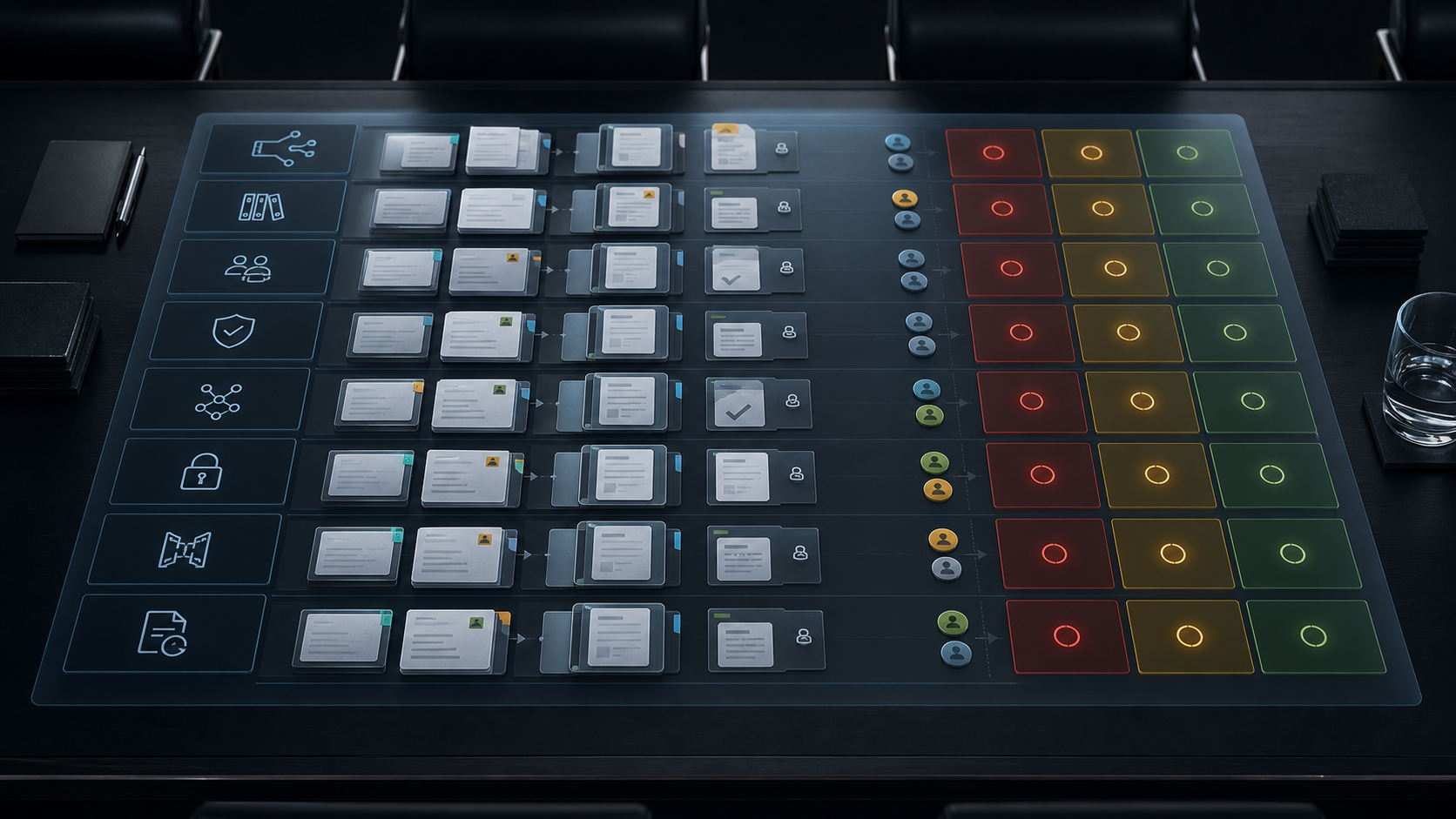
This GPT-generated image is conceptual governance art only. It is not proof of a staffed control room, live CRM, audited KPI system, live dataroom, legal review, customer traction, production security system, Exchange activity, operational speculative technology, trained model, or web-scale source ingestion. Review the image provenance record.
Production CRM and response-workflow language stays blocked until a provider record passes review.
These records would support more concrete commercial language without requiring named-customer proof.
The queue shows what would move each claim, and what remains blocked until then.
Priority queue
The next records to collect are operational, not rhetorical.
The public trust stack is now broad enough. The next board job is to collect the source records that let White Noise update claims without relying on estimates, demos, local state, or planning assumptions.
Each row names the record, acceptance evidence, blocked claim, and current state.
Priority 1 is deliberately unchanged from the previous board run: configure one production contact-routing provider mode, run the guarded test, and preserve source evidence before changing public routing language.
| Priority | Source record | Acceptance evidence | Blocked public claim | Current state |
|---|---|---|---|---|
| 1 | Production contact routing delivery record | Exactly one configured provider mode, redacted ready preflight, production health check, confirmed synthetic delivery test, provider receipt, owner review, fallback rule, privacy boundary, and dated test window. | Production CRM, monitored enterprise workflow, staffed support, or response SLA. | blocked no delivery mode ready |
| 2 | Payment and account source reconciliation | Payment processor source, account state source, cohort window, refunds/test transaction exclusions, reconciliation note, and source owner. | Free-to-paid conversion, paid member retention, revenue quality, or audited member actuals. | pending source evidence |
| 3 | Inquiry and scoped-work log | Inquiry route, qualification definition, scoped-work stage, date window, duplicate/test exclusions, privacy treatment, and owner review. | Qualified R&D pipeline, consulting pipeline, enterprise demand, or repeatable commercial workflow. | pending source evidence |
| 4 | Evidence artifact shipment ledger | Artifact title, delivery date, recipient class, permission state, evidence level, claim boundary, and private/public availability state. | Delivery velocity, customer outcome proof, named case-study strength, or services maturity. | pending source evidence |
| 5 | Customer, partner, sponsor, logo, quote, or case-study permission record | Written permission, source context, approved usage channel, revocation/contact route, evidence level, and claim boundary. | Named customer proof, endorsed partner proof, customer outcome proof, or permissioned logo/quote use. | pending source evidence |
| 6 | Source-rights and corpus-use clearance record | Source-specific rights basis, permitted usage, attribution rule, model-training/corpus/marketplace restrictions, takedown route, and review date. | Institutional clearance, complete licensing, model-training permission, or stronger corpus reuse. | pending source evidence |
| 7 | Service-level dependency record | Vendor/service name, data class, access owner, terms source, continuity/offboarding plan, security relevance, and review trigger. | Vendor maturity, procurement readiness, service-level assurance, SOC 2/ISO evidence, or audited dependency controls. | pending source evidence |
| 8 | Security and data-handling control evidence | Data-flow record, access route, retention/deletion rule, production collection state, vendor relevance, privacy policy review, and owner review. | Security-reviewed enterprise controls, compliance certification, legal-reviewed privacy packet, or production access review. | pending source evidence |
| 9 | Exchange launch evidence file | Launch gate checklist, legal/compliance route where applicable, custody/provenance state, payment/settlement owner, incident/rollback plan, support owner, and dated board decision. | Live Exchange market operations, token sale, custody, liquidity, creator payout, or launch readiness. | pending source evidence |
| 10 | Investor materials freshness receipt | Manifest update, materials index update, integrity check, claim-language guard where relevant, search/sitemap update, and dated board memo. | The public investor stack is current without dated review evidence. | active monthly control |
The first record to source is still production contact routing.
If the provider remains unconfigured, the board should not treat that as a copy problem. It is an execution blocker that keeps CRM, response-SLA, staffed-support, and enterprise-workflow claims blocked.
- Configure exactly one production delivery mode.
- Rerun the redacted preflight until it is ready.
- Run production health and the confirmed synthetic delivery test.
- Preserve the provider receipt, owner review, fallback rule, and privacy boundary.
Priority 1Contact Routing Evidence PackSource-record checklist for provider preflight, synthetic delivery, receipt, owner review, fallback, and privacy boundary.
Acceptance barSource Record Acceptance StandardRequired fields, disallowed substitutes, status labels, and validator checks before a source record can warm a claim.
RunbookProduction Test RunbookGuarded local commands and activation packet path for delivery-mode setup.
KPI controlKPI Evidence RegisterMetric source status, evidence floor, owner review, and blocked KPI claims.
Owner gateDecision Ownership RegisterOwner type, evidence floor, escalation trigger, allowed first action, and blocked claim.
DiscoveryMaterials IndexCurrent public materials, routed-next artifacts, and absent formal-process evidence.