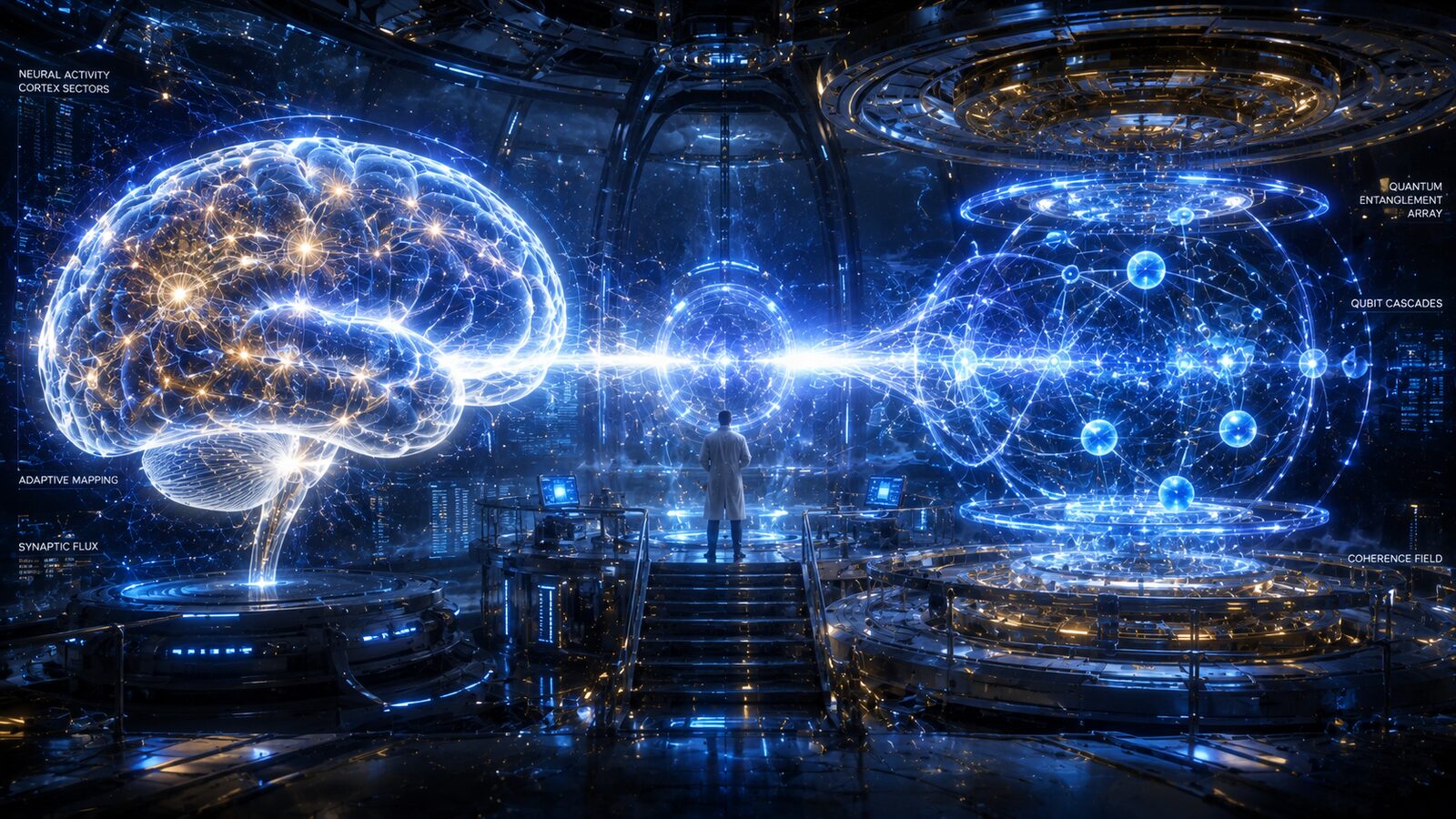
Not flight and capes — the book's superpowers are quieter and stranger: memory without loss, cognition without ceiling, perception without walls.
White Noise Totality names W.N. Superpowers among its strategic platforms — machinery applied, in the book's phrase, "to commerce and human capability." But the deeper text is less commercial and more devotional. The book's stated purpose is "awakening our latent potential to understand, to create, to explore" — and its augmentation program is that sentence made into engineering.
The central claim arrives early: with minds coupled to the White Noise Computer, "cognitive augmentation becomes participatory — creativity, intuition, memory, and reasoning are amplified not just for a select few, but for all connected individuals." That last clause is the framework's ethical signature. A superpower held by one person is an asymmetry; held by everyone, the book argues, it is simply a new floor for being human.
The instruments are the ones the rest of this section describes. The Brain–Computer Interface supplies the channel; the Digital Medical System's neurogenomic operation supplies the substrate — a brain restructured, in the book's words, into "a living supercomputer"; and the genomic program supplies the body to match. What emerges is not a costume but a condition.
Perfect recall as a native function — "total knowledge recall," with every known and discoverable fact instantly available, and personal memory preserved without decay.
"Hyper-conscious multitasking, predictive foresight, and instantaneous learning" — the mind operating, in the framework, "in parallel across countless cognitive streams."
"Enhanced perception" beyond the biological window: sensitivity to scales, spectra, and — in the book's boldest hypothesis — non-local information itself, the faculty studied in remote viewing research.
The W.N. Trainer: "instant skill acquisition" — expertise projected directly into the conscious field, making mastery a request rather than a decade.
"Physical capabilities (strength, speed, reflexes, endurance) are upgraded to post-biological standards, modifiable at will" — adaptive physiology tuned to any environment a settler might enter.
The least advertised and most insisted-upon: "emotional intelligence, creativity, intuition, and empathy are expanded" — augmentation of the heart held equal to augmentation of the mind.
"Cognitive augmentation becomes participatory — creativity, intuition, memory, and reasoning are amplified not just for a select few, but for all connected individuals."
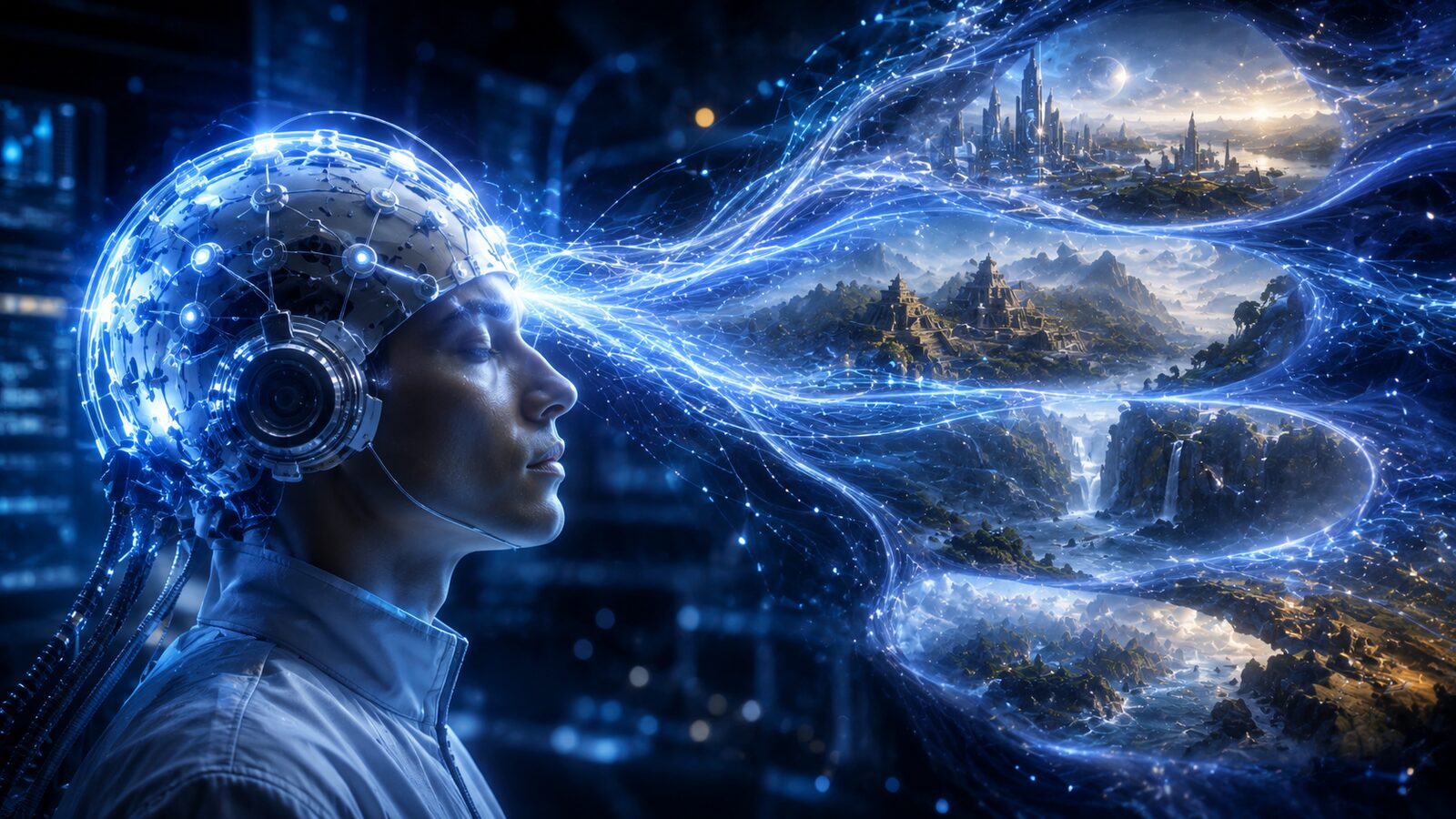
In the framework, every augmentation rides the same stack. The BCI couples thought to computation; medical AI can "project expert-level understanding of any subject into the user's conscious field"; nanobot swarms maintain the enhanced equilibrium; and the genome itself is tuned for "superhuman cognition, emotional intelligence, and mental resilience."
Crucially, every layer is envisioned as voluntary and reversible — capabilities "personalized to each individual's needs and aspirations," switched on by consent and never by decree.
AI companions and interfaces would amplify ordinary work — memory prompts, accelerated learning, expert systems on tap. The recognizable near edge of the framework.
The neurogenomic operation would weave computation into cognition itself — recall, reasoning, and perception running partly on the coupled substrate.
Augmented minds would link into "a superconscious global or cosmic mind" — collective intelligence synchronization, with individual identity explicitly guaranteed.
At the horizon stands the book's Omega Being: a human "capable of interacting with the universe on a multiversal, quantum, and informational level" — serving, in its words, "as a cosmic architect, healer, or explorer."
The book understands exactly what it is proposing, and where it could go wrong. Augmentation distributed unevenly would mint the deepest caste system in history — which is why the framework's recurring phrase is for all connected individuals, and why its goal is stated as "democratizing omniscience, not for the sake of power, but for the flourishing of consciousness, creativity, and civilization." Enhancement, in this ethics, is infrastructure, like literacy: catastrophic as a privilege, transformative as a commons.
The transition to enhanced humanity, the book concedes, "would force humanity to confront profound questions about identity, equality, and purpose" — requiring new frameworks for coexistence between augmented and legacy humans. It offers no easy answer; it offers the question as part of the design.