
A theoretical training system in which the network does not replace human ability — it accelerates its acquisition, from languages to athletics to entirely new modes of perception.
Mastery, in every era, has been rationed by the decade: ten thousand hours for the violinist, the surgeon, the pilot. White Noise Totality lists the W.N. Trainer in its product constellation with a two-word specification — "instant skill acquisition" — and beneath that compression sits one of the book's most human ideas: that the same machinery imagined for computing and medicine could collapse the distance between wanting an ability and having it.
The mechanism is already sketched in the book's research chapters. Brain-computer interfaces paired with neurofeedback let a learner receive live feedback on their own neural activity and entrain their cognition to the precise states most conducive to a task — what the book observes produces "faster skill acquisition, greater reliability, and an increasingly refined dataset linking subjective experience to neural signatures." The Trainer generalizes that closed loop from laboratory protocol to a universal discipline of growth.
Layered above it are the network's other gifts: superintelligent tutors that shape curricula to each learner's cognitive profile, immersive training worlds generated on demand, and — at the speculative summit — learning environments inside engineered verses with modified time flow for accelerated training.
Real-time neural metrics guide the learner into optimal cognitive states — theta-gamma balance, cortical synchrony — turning focus itself into a trainable, measurable skill.
Tailored educational and training games, each fitted to the learner's profile, interests, and objectives — surgery rehearsed without patients, languages lived rather than memorized.
Coupled to the Digital Medical System, training load, recovery, and even nutrition are personalized continuously — the body coached at molecular resolution.
The frontier modality: through the W.N. BCI, validated skill architectures are imprinted directly — the book's "instant acquisition," held inside strict consent and safety frameworks.
The Trainer builds a high-resolution model of the learner — current ability, neural signatures, goals — in privacy-sovereign partnership with the W.N. Assistant.
Neurofeedback guides the mind into the states where the target skill consolidates fastest; simulation supplies deliberate practice at exactly the edge of ability.
AI analysis identifies which neural patterns predict durable mastery, scheduling rest, repetition, and variation with superhuman precision.
The whole system adapts over time — in the book's phrase, "improving training protocols and experimental designs with each cycle": a living laboratory for cognitive engineering.
"Whether mastering a new language, exploring the history of ancient civilizations, or training for specialized professions, learners will have access to personalized, hands-on experiences tailored by advanced AI and community wisdom."
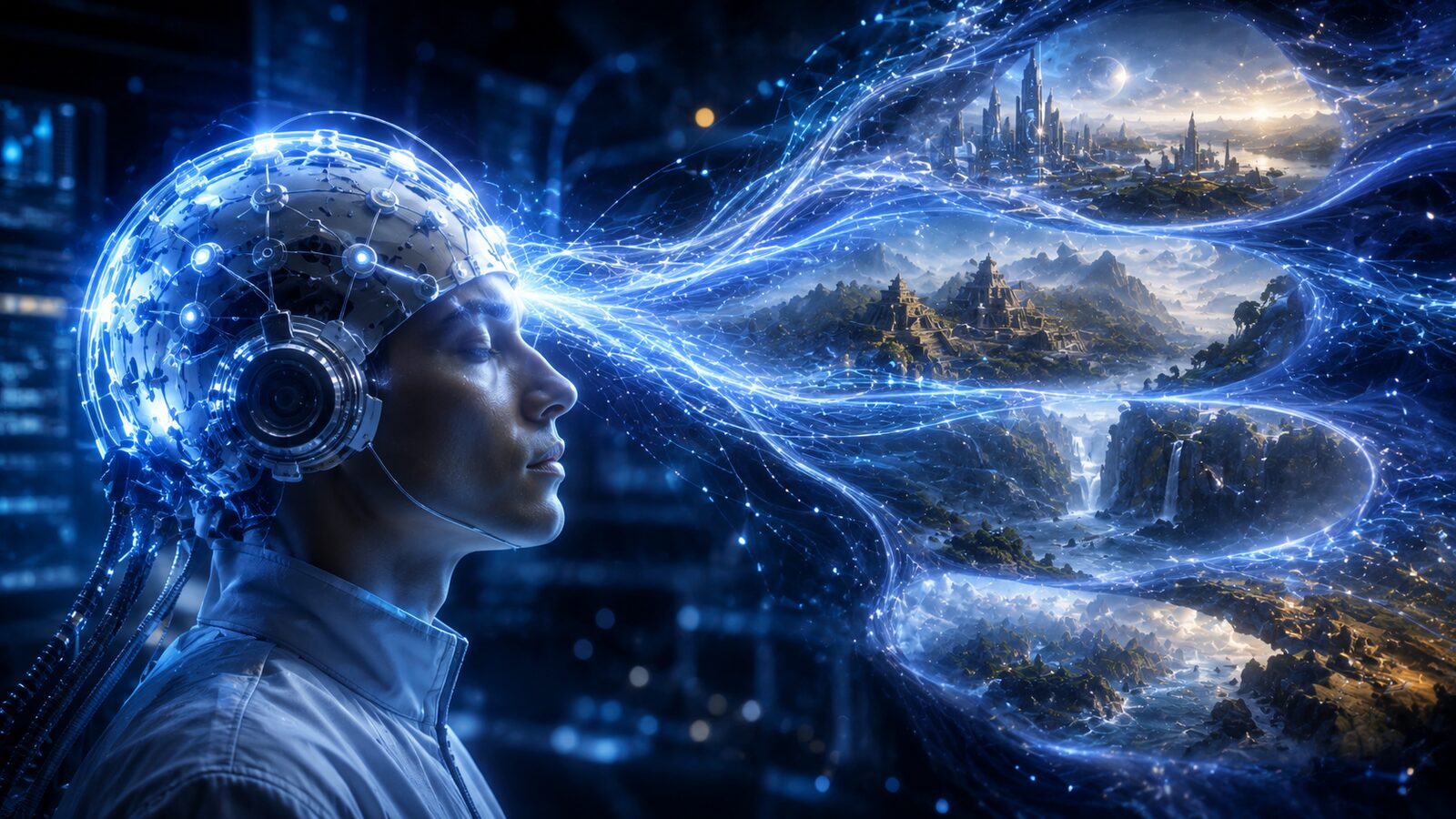
The book's most distinctive training program is perceptual. Its remote viewing research treats anomalous cognition as a trainable discipline — observable as neuroplastic adaptations, structural and functional brain changes in trained individuals.
In the mature vision, the Trainer becomes the gymnasium of W.N. Superpowers: the place where enhanced perception, memory, and cognition are not implanted but cultivated — capability earned through guided practice, amplified by the network.
Project Utopia names the education revolution as one of its pillars: consciousness-integrated learning with superintelligent tutors, immersive experience, and hundred-fold accelerated knowledge acquisition — "every human a genius." The Trainer is the instrument of that pillar. Its promise is not a world of identical experts but a world where the ceiling on any life is curiosity rather than circumstance.
The framework is equally clear about boundaries: training data of the mind is the most intimate data there is. The Trainer inherits the ecosystem's hard rules — locally sovereign neural records, consent as a continuous process, and absolute protection of private mental space — because a system that can shape minds must answer to the minds it shapes.