White Noise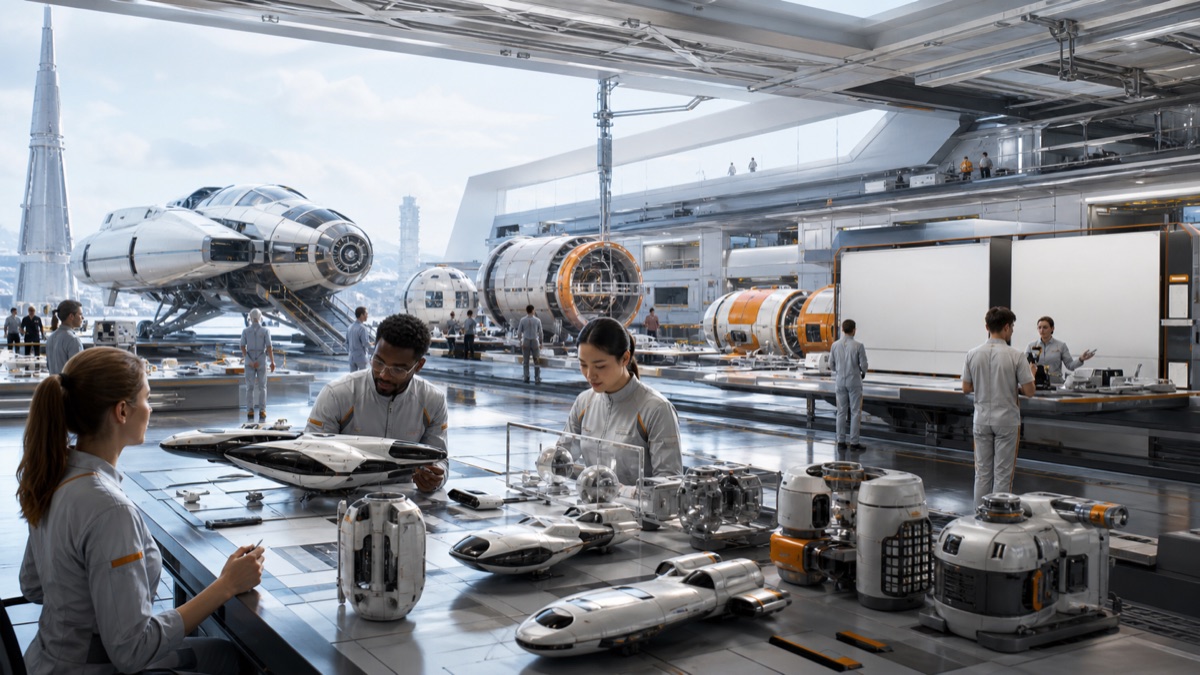
Nonmilitary Grammar for Deep-Space Fleets begins with a White Noise habit that matters more than spectacle: name the claim, name the present boundary, and name the test that could make the claim smaller. The source text invites civilization-scale imagination, but the public site also states the current reality clearly. White Noise Inc. offers education, media, community, marketplace, consulting, Custom R&D, reservation tooling, and roadmap work. The finished speculative technologies remain concepts unless a page explicitly says otherwise.
That distinction does not weaken the idea. It gives the idea a place to work. For this topic, the working object is nonmilitary grammar for deep-space fleets. It is not a prop for a miracle story. It is a surface where energy, time, consent, uncertainty, maintenance, and public consequence can be inspected together. The useful thesis is modest and practical: White Noise needs a nonmilitary grammar that makes exploration answer to care before capability.
The Source-World Horizon
White Noise Totality asks what a civilization might build if computation, matter, medicine, settlement, economics, education, and governance were treated as one connected architecture. That horizon includes the White Noise Computer, Library, Replicator, OSTSS, Spaceships, Superfactories, engineered verses, and Project Utopia. The horizon is large by design. It is meant to provoke research imagination, not to erase the gap between a book-world premise and present capability.
The best editorial use of that horizon is translation. A source-world claim becomes useful when it forces a sharper question about Exploration & Frontier Ops: what exists now, what remains only speculative, what can be tested, and who would be affected if the work scaled. Without that translation, White Noise vocabulary becomes decorative. With it, the vocabulary becomes a map of responsibilities.
The Present Boundary
The present boundary for this article is mission taxonomy, rescue plans, maintenance systems, research payloads, radiation review, licensing paths, and public purpose language. These constraints are not embarrassments to hide. They are the first materials of serious design. A page that names them lets the reader feel the ambition without being asked to mistake ambition for delivery.
The boundary also protects White Noise's commercial surfaces. Memberships, Academy courses, Exchange art, WN Labs engagements, WN Coin reservation tooling, product concepts, and service pages should be understood as current or proposed surfaces in their own categories. They do not imply working omnipresent computation, autonomous replicators, accredited degrees, guaranteed medical outcomes, shipping spacecraft, or investment returns. Careful language is part of the product because trust is part of the product.
The Failure Mode
The main failure mode is letting fleet imagery inherit military assumptions because the design grammar is not explicit. That failure usually arrives before anyone means harm. A metaphor gets repeated as a mechanism. A roadmap gets photographed like a product. A beautiful image gets treated as evidence. A word like infinite, omnipresent, utility, fleet, or university carries more authority than the underlying proof can support.
White Noise writing should resist that drift. It should say when it is speculating, when it is teaching, when it is inviting a client into a scoped research question, when it is describing a digital collectible or community benefit, and when it is naming a long-range civilizational horizon. The article's job is not to lower the ceiling. It is to keep the floor visible.
A Responsible First Artifact
The responsible first artifact is not the whole dream. It is the smallest durable object that helps a reader, member, lab client, or collaborator think better. For Nonmilitary Grammar for Deep-Space Fleets, that artifact could be a protocol, review note, prototype card, design brief, consent map, or boundary statement. It should be valuable even if the largest White Noise premise never becomes buildable.
A good artifact answers five questions. What is the claim? What present capability constrains it? What would count as a negative result? Who can inspect or refuse the next step? What language should be avoided until stronger evidence exists? Those questions turn cosmic ambition into practical translation.
Governance as Design Material
Governance is often described as a later approval step. At White Noise scale, that is too late. Governance shapes the interface, the course, the claim, the marketplace surface, the research scope, and the community norm from the beginning. It decides what the system is allowed to know, who benefits, who carries risk, and how the work stops when evidence changes.
The refusal sentence for this piece is direct: do not imply weapons use, operational fleet capability, passenger-ready spacecraft, or launch service. This is not a legal afterthought. It is editorial infrastructure, and it lets an enthusiastic reader and a skeptical reader leave with the same map.
What to Read Next
The closest search vocabulary for this piece is deep-space fleet nonmilitary grammar, with secondary terms including WN Spaceships, fleet taxonomy, rescue readiness, nonmilitary design, frontier operations. Continue with the nearby pages below to see the same White Noise discipline from adjacent angles.