White Noise
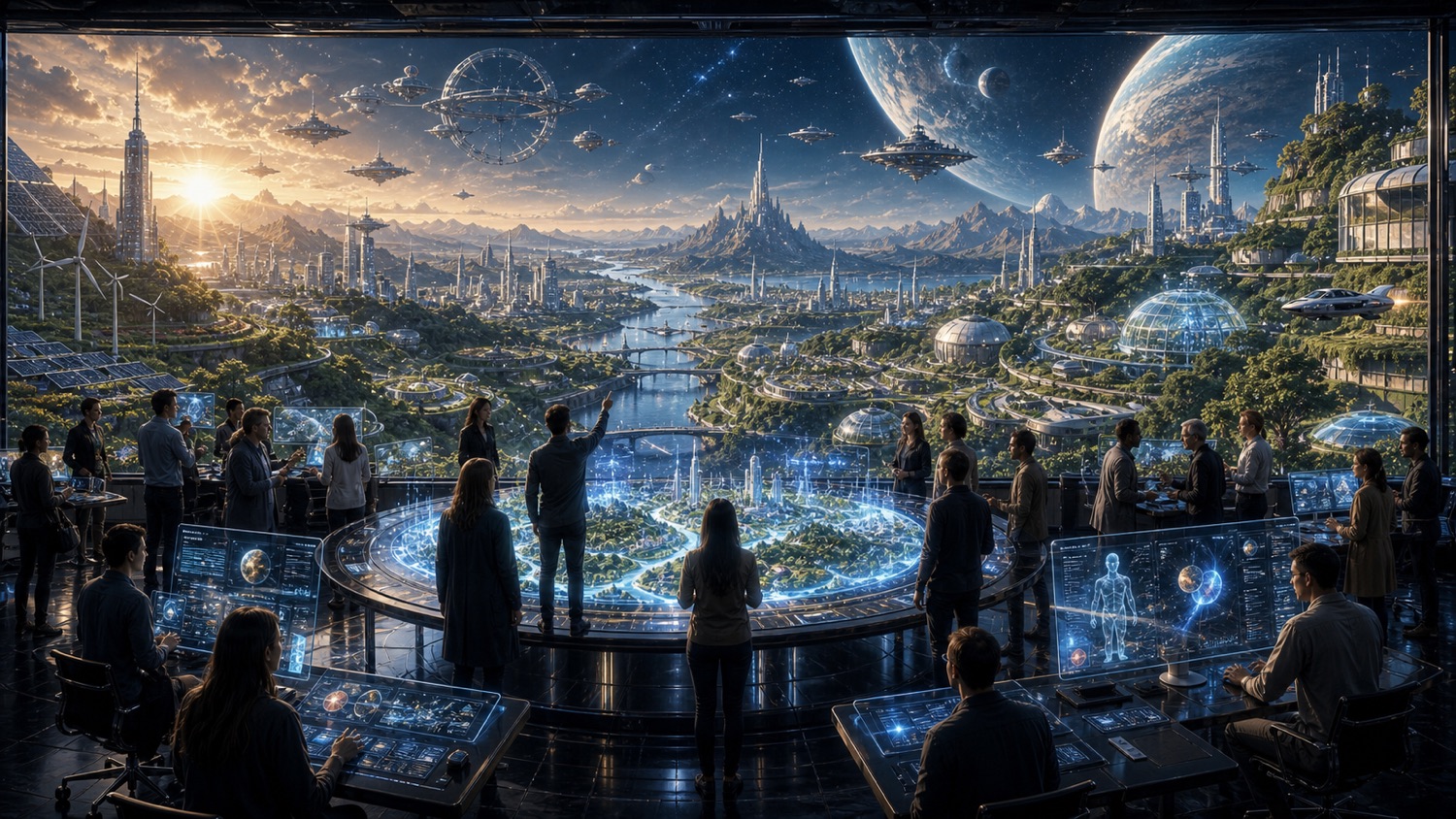
The Quiet Index of Possible Worlds begins with a White Noise premise that is easy to admire and hard to practice: ambition becomes more valuable when its boundary is easier to inspect. White Noise Totality gives the project a source-world horizon large enough to include omnipresent computation, the White Noise Library, matter compilation, digital medicine, engineered worlds, settlement systems, markets, education, and Project Utopia. The public site translates that horizon into current media, courses, community, Exchange culture, consulting, Custom R&D, Labs language, reservation tooling, and roadmap pages. Those layers have to remain distinct.
The working object for this feature is possible-world index. It is not evidence that a finished speculative system exists. It is a thinking instrument: a way to place a beautiful concept under questions of measurement, consent, cost, evidence, maintenance, and public consequence. The article's thesis is practical: a possible-world index that makes quiet governance as important as spectacular variety.
The Horizon and the Boundary
The White Noise horizon is useful because it refuses to keep disciplines in small rooms. Computation changes medicine. Matter systems change economics. Libraries change rights. Education changes who can critique the machine. Governance changes the architecture of every tool. The danger is that the same integrative language can make a reader feel that a future system has already been delivered simply because all the vocabulary sits in one grand map.
For White Noise Library Sciences, the boundary is the editorial and technical work that keeps the map usable. It asks what present disciplines constrain the idea, what would count as negative evidence, what assumptions are still borrowed from source-world imagination, and who has authority to pause the next step. A boundary is not an apology for ambition. It is the infrastructure that lets ambition travel without becoming hype.
The Present Materials
The present materials are semantic indexing, provenance records, rights review, retrieval safety, and model-world governance. These are not placeholders for the real future; they are the real work available now. A White Noise page can be cinematic, but it should still separate a course from an accredited degree, a reservation interface from a financial promise, a medical horizon from regulated care, a spaceship study from a shipping vehicle, and a laboratory question from a demonstrated capability.
This matters commercially as well as ethically. WN Academy, WN Club, WN Exchange, consulting, Custom R&D, and Labs-facing pages should invite serious participation without implying that the largest technologies have already crossed their evidence thresholds. Trust is not created by lowering the vision. Trust is created by letting readers see exactly which layer they are standing on.
The Main Failure Mode
The main failure mode is treating every possible world as equally retrievable, inhabitable, or ethically available. It can happen without bad intent. A rendering becomes shorthand for a system. A phrase like infinite or omnipresent carries more certainty than the proof can bear. A roadmap begins to sound like authorization. A community norm becomes social pressure to agree. A public-good concept forgets to show who maintains, refuses, or pays for the system when the first excitement has passed.
White Noise writing should be disciplined enough to hold the excitement and the audit in the same paragraph. The best feature does not drain wonder from the source material. It teaches the reader how to keep wonder answerable to evidence. That is why the strongest claim in this essay is not that the far horizon will arrive. It is that the first useful artifact can improve how people think before the horizon arrives.
The First Useful Artifact
The first useful artifact should work even if the grandest premise never becomes buildable. It might be a protocol, a course exercise, a risk register, a refusal log, a calibration practice, a public map, a consulting ledger, or a repair plan. It should help a reader distinguish source-world possibility from present service; help a member ask a better question; help a client inspect a scope; or help a researcher publish a smaller, more honest result.
A good artifact answers five questions. What exact claim is being made? What present field constrains it? What evidence would reduce or overturn it? Who can inspect, refuse, appeal, or maintain the next step? What words should stay off the page until stronger proof exists? Those questions turn White Noise from an atmosphere into a method.
Governance as Part of the Object
Governance is not paperwork that arrives after the machine is built. At White Noise scale, governance is part of the object. The interface, the course, the member norm, the service scope, the encyclopedia term, the marketplace record, and the lab note all decide what is visible and what is allowed to grow. They also decide how the system remembers a correction.
This is why the nearby WN Encyclopedia terms matter. They give the site a controlled vocabulary for calibration, uncertainty, refusal, public risk, repair, licensing, and last-mile translation. Internal links should not merely move traffic around the site. They should help the reader find the next boundary.
Editorial Test
The editorial test for The Quiet Index of Possible Worlds is whether the skeptical reader and the enthusiastic reader leave with the same map. Both should see the ambition. Both should see the current boundary. Both should understand that White Noise Inc. currently presents media, education, community, marketplace, consulting, and research-facing surfaces while treating the largest technologies as speculative unless a page explicitly proves otherwise.
The primary search phrase is possible-world index. Related vocabulary includes White Noise Library, engineered verses, provenance, retrieval safety, knowledge governance. The best next reading is the closest term that makes the idea more accountable.