Canon Fluency
Start with the source text, Academy routes, and reference pages so a future crew shares language before it shares risk.
- Artifact
- Learning path, notes, certificate trail
- Next room
- Academy paths
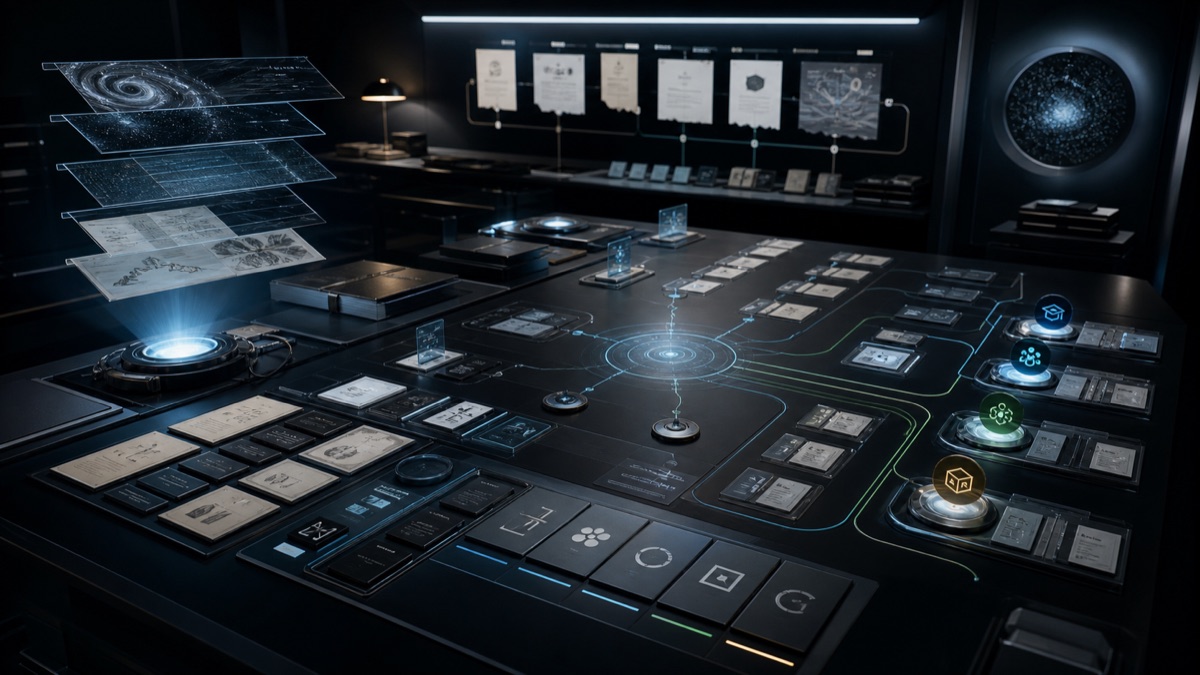
WN Club is where members stop building alone. Build canon fluency, combine time, skills, credits, and sourced questions with others who share a thesis, then charter collaborative research across the 14 core technologies of White Noise Totality with evidence rules and non-investment boundaries visible from the start.
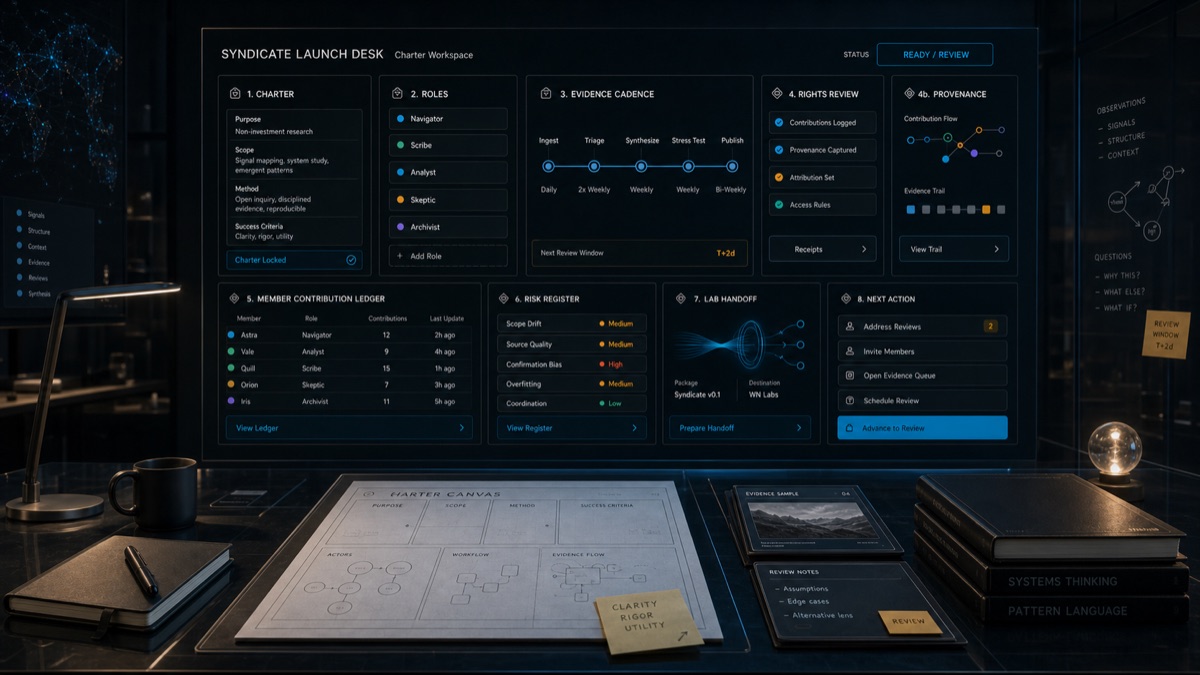
Image provenance: GPT-generated WN Club member workspace created on 2026-06-28 for member-experience positioning. Prompt intent: depict saved contributions, charter receipts, provenance trails, status rails, and routed handoffs across Academy, Syndicates, Labs, Exchange, and Contact. Asset: assets/club/wn-club-member-workspace-20260628.jpg. Review the provenance record. Usage boundary: conceptual editorial image only, not proof of a live member workspace, staffed operating room, production community platform, audited ledger, investment vehicle, or operational syndicate workflow.
WN Club should feel like a serious creative and research membership, not a vague social room. The proof desk gives visitors the same pattern used by strong product and collective platforms: visible status, explicit roles, inspectable records, and a clear route from interest to action.
Each crew starts with a thesis, owner, role map, resource band, first decision point, and the reason the work belongs inside White Noise.
Prospective members can tell whether a track is open, forming, scoped, running, paused, archived, or ready for a public handoff.
Runs, negative results, source notes, contribution records, and claim limits stay attached to the project instead of disappearing into chat.
Readers can study first, join the Club, charter a syndicate, sponsor a scope, or route mature output toward Labs, Exchange, or Contact.
A world-class member surface reduces uncertainty before the join. These tracks translate the White Noise universe into visible states: what is ready to study, what is forming, what needs a crew, and where a sponsor or builder should route next.
Start with the source text, Academy routes, and reference pages so a future crew shares language before it shares risk.
Post a buildable question, name the first constraint, and gather three members around roles instead of enthusiasm alone.
Translate the thesis into a bounded protocol with controls, budget band, evidence threshold, and a planned stopping rule.
Move mature outputs into a Library note, Exchange drop, follow-on R&D scope, or contact route with the claim limit attached.
The Club is strongest when the rules are boring and visible. Each member crew should be able to show what it is studying, who is responsible, what evidence would change the plan, and which claims are off limits before any budget, Lab access, Exchange asset, or public handoff is discussed.
Charters do not sell securities, pooled funds, guaranteed returns, token upside, profit participation, or liquidity rights.
Time, skills, Academy credits, sourced notes, tools, and approved sponsored budgets are logged as project contributions, not return-bearing stakes.
Each crew names the hypothesis, method, risk, negative-result rule, claim boundary, and next decision date before public language warms up.
Outputs move as learning records, Labs briefs, Exchange provenance, creative works, or contact scopes with the limitation attached.
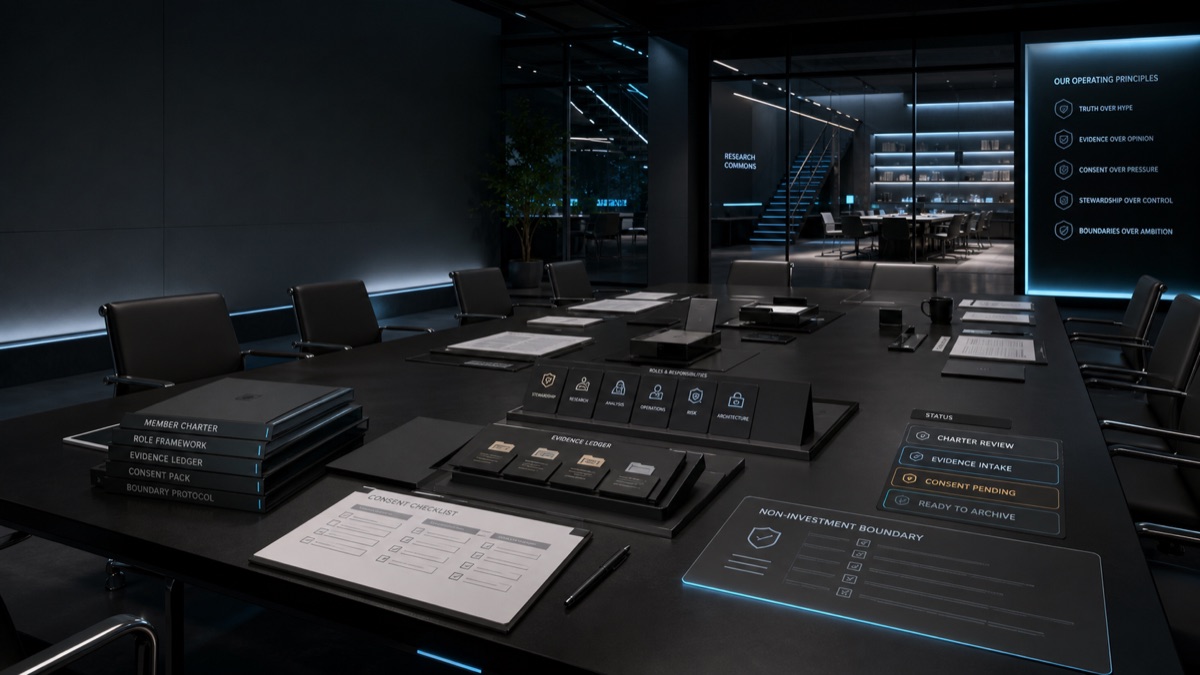
Image provenance: GPT-generated conceptual governance asset created on 2026-06-27. Prompt intent: show a member charter room with role cards, evidence ledgers, consent checks, status tags, and a non-investment boundary panel. Asset: assets/club/member-charter-governance-room.jpg. Review the provenance record. Usage boundary: editorial and conceptual only; not evidence of a staffed diligence room, audited control system, investment vehicle, or live syndicate operations.
Frontier R&D is too big for one person and too speculative for one budget. A WN Club syndicate is a small, member-formed crew — three or more — that coordinates resources behind a single research thesis and runs it like an experiment, not a company or investment pool.
Each syndicate writes a charter: the question it's chasing, who contributes what, how compute and Academy credits are shared, which claims are allowed, and how any resulting works, notes, or venture concepts may be attributed and routed. White Noise Inc. provides the tooling, the Library, and the rails; the charter keeps expectations inside a non-investment boundary.
Float a research question in the Club — "room-temperature W.N. Chip coherence," "replicator food chemistry," "verse physics sandboxes." Find your crew.
Three or more members sign a charter defining contributions, roles, review cadence, decision rights, and permitted handoffs.
Combine time, Academy credits, approved tools, research notes, and any sponsored budget explicitly documented in the charter.
Work the brief using the Library, the Generators, and Consulting's Infinite Strategy layer. Log findings as you go.
Turn findings into Exchange works, patent-idea notes, or a follow-on research scope with the claim limit and contribution record attached.
Versioned charters, transparent contribution ledgers, and member review keep every syndicate fair and legible.
Every part of White Noise Totality opens its own research front. Below are the domains members charter syndicates around — each a buildable thesis you can take into the standardized WN Labs. Pick one, then join free and submit a quote.
Coherence, error correction, and the omnipresent computational substrate behind the White Noise Computer.
Topological chip integration and the path to room-temperature quantum coherence — where the architecture becomes engineering.
Quantum entanglement-based sensors, filtering, and data generation for pattern recognition at scale.
Entanglement-based neural-network training, memory, and decision-making systems.
Programmable materials and vacuum-to-matter synthesis toward atomic-precision fabrication.
Self-assembling materials, matter compression, and the nanoscale builders the replicator depends on.
Vacuum-energy, contained singularity cores, fusion, and antimatter toward limitless power.
Modeling stellar, galactic, and Kardashev-scale energy production and infrastructure.
Molecular monitoring, neurological nanobots, and cures computed before disease takes hold.
Regenerative medicine and cellular-repair research toward biological longevity.
Brain–computer interfaces, neural-activity manipulation, and human–nanobot symbiosis.
Self-replicating builder swarms, OSTSS nanobots and macrobots, and swarm logistics.
Habitat-growth models and the replication-and-evolution engine that raises settlements in months.
Space systems, propulsion, and microdimensional teleportation infrastructure.
Indexing and retrieval for a catalog of all things that can possibly exist.
Zero-latency routing and entanglement-relay protocols for boundaryless communication.
Sandbox physics, tunable constants, and ownership frameworks for created universes.
AI-augmented decision systems and value-alignment frameworks for civilization-scale choices.
Existential-risk management, robust security, and fault-tolerant system design.
Civilization-scale simulation and high-accuracy forecasting for planning and stewardship.
A syndicate is a creative venture, not a guarantee. Here is how the basics work before you sign a charter.
Joining the Club is free. You charter a syndicate and commit only the resources the crew names: time, Academy credits, approved tools, notes, or a clearly scoped sponsored budget. There is no default pooled fund.
The charter sets attribution, license, publication, and handoff rules before work begins. Contribution ledgers track member input, but the Club does not promise equity, profit share, token upside, liquidity, or financial return.
Findings are logged either way. A negative result still becomes a reusable, reproducible record the next crew can build on, and the charter limits work before attention, budget, or public claims expand.
A charter names roles, not just members. These are the hats a crew fills as it moves a thesis through the five-move lifecycle — from posting the question to publishing an evidence-bounded handoff.
The member who floated the question. Owns the brief, keeps the charter's success criterion in view, and convenes the crew at each decision point — doubling down, narrowing, or winding the work down on what the findings actually show.
The members who run the experiments — working the brief in the standardized WN Labs with the Library, the Generators, and Consulting's Infinite Strategy layer, and logging findings as they go so every run stays reproducible.
Pressure-tests methods and results before anything ships. Separates a real signal from noise, holds claims to what the evidence supports, and makes sure a negative result is logged as cleanly as a positive one.
Keeps the crew legible: maintains the versioned charter and contribution ledger, tracks who put in what, runs member review, and makes sure attribution and handoff rules match the terms everyone signed.
Roles overlap by design — a three-member crew might wear all four hats. The charter names who holds each responsibility, not how many people fill it.
Coordinating resources is the easy part. Durable syndicates need transparent responsibility, useful information, fair rules, and a way to steer together when nobody can see the whole future.

Shared capacity still needs legitimate decisions and boundaries.

Accountability works best when it is designed into the process.

Long horizons require plural judgment, not one heroic captain.

Who can see the system often determines who can change it.
The Club charter turns these ideas into practical defaults for contribution records, review rights, attribution, claim limits, and reproducibility.
Explore syndicates →
"The future is not discovered by lone geniuses but assembled by crews — combining minds, machines, and nerve until the impossible becomes a working prototype." White Noise Totality — Part X

Join the club for free to charter or join a syndicate, commission scoped custom R&D, and route mature outputs to the right public or private handoff.