The request should start from an inspected route, memo, manifest, proof pack, or control page.
Home / Investor Relations / First Meeting Readiness
Public meeting gate
Book the first meeting only after the agenda survives the proof state.
This route helps investors, enterprise buyers, strategic partners, institutions, sponsors, and board reviewers decide whether a first White Noise conversation is narrow enough to book from current public materials.
Use boundary
This checklist is for general information only. It is not investment advice, not an offer to sell or solicit securities, not a secure diligence room, and not proof of audited reporting, enterprise workflow maturity, or commercially deployed speculative technology.
Visual boundary
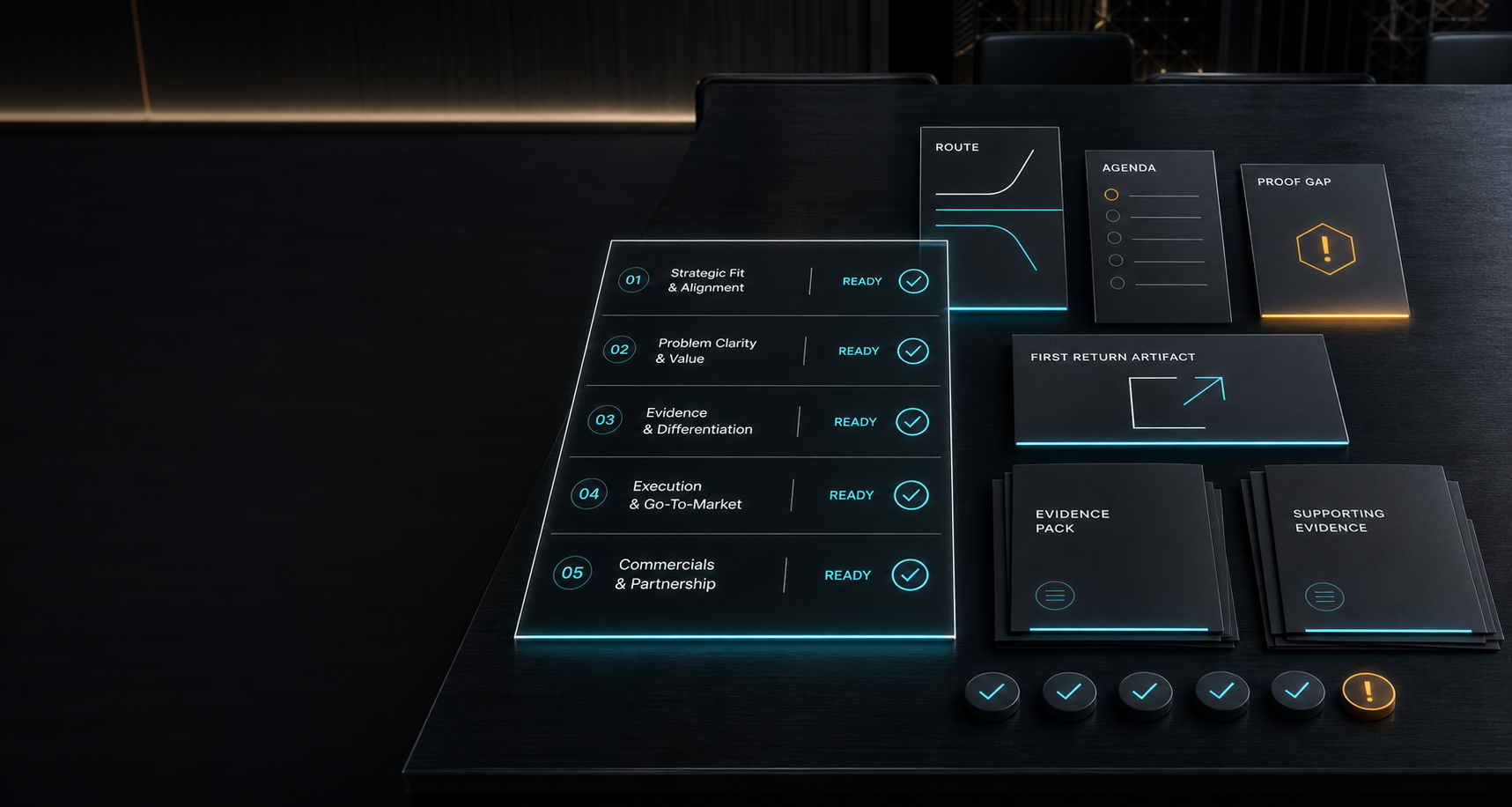
The hero image is a GPT-generated editorial first-meeting gate visual. It is not proof of a staffed first-meeting workflow, production CRM, audited reporting, formal financing process, named counterparties, customer traction, or operational speculative technology. Review the image provenance record.
Board view
The first call should be a decision tool, not a substitute for missing proof.
The meeting is ready only when the counterparty can name the reviewed public artifact, the decision behind the call, the proof gap that matters, the first-return artifact requested, and the safe public route for the note.
Capital, buyer, partner, sponsor, institution, or board-review intent should be visible before scheduling.
The note should name the main risk or boundary, not ask for a broad narrative reset.
The best first return is a walkthrough, boundary memo, capital-readiness response, or formal-process note.
No confidential, personal, credential, regulated, or unpublished material should enter the first public route.
Use the right first packet before asking for time.
- Strategic capital or board review: start with Latest Public Investor Update, then review Public Capital Readiness Note and the Materials Manifest.
- Enterprise buyer or operator: start with Enterprise Starter Brief, then review Security and Data-Handling Baseline and Public Proof Pack.
- Institution, sponsor, or strategic partner: start with Partner-Fit Memo, then review Diligence Request Guide and the public proof floor.
Good first asks are narrow enough to answer honestly.
- A public-surface walkthrough.
- A claim-boundary memo.
- A capital-readiness response.
- A scoped services or research path.
- A formal-process note saying the requested material is not represented as ready yet.
Do not book the call as if missing gates are already satisfied.
If one of these is the real gating issue, the cleaner answer is a boundary note or a statement that the material is not represented as ready:
- Audited financial statements or audited KPI reporting.
- Production CRM, secure enterprise intake workflow, or enterprise controls proof.
- Formal financing documents or an active securities process.
- Live Exchange market-operations proof.
- Proof that speculative White Noise technologies are commercially deployed.
Meeting ruleInvestor First Meeting ContractUse the public investor page rule before routing a meeting note.
Request routeDiligence Request GuideMatch the decision to the smallest responsible first-return artifact.
Reply ruleFirst-Response StandardKeep the first response bounded and route-state honest.