Buyer, partner, sponsor, investor, and reviewer asks start by naming the one surface or risk being evaluated.
Home / Investor Relations / Public First-Return Artifact Menu
Public first-return route
Choose the smallest credible artifact the proof state can support.
This route defines the first artifact White Noise should return after a bounded request. It keeps enterprise buyers, partners, sponsors, investors, and board reviewers from receiving a broader packet than the public evidence can justify.
Use boundary
This menu is for general information only. It is not investment advice, not an offer to sell or solicit securities, not a confidential dataroom, not a service-level agreement, and not proof of a staffed enterprise workflow.
Visual boundary
This page reuses the existing GPT-generated first-return routing image in the hero and adds a separate GPT-generated artifact-selection workbench below. Both images are editorial support only, not proof of a staffed diligence desk, audited controls, production CRM, enterprise support workflow, formal financing process, or operational speculative technology. Review the hero provenance or review the workbench provenance.

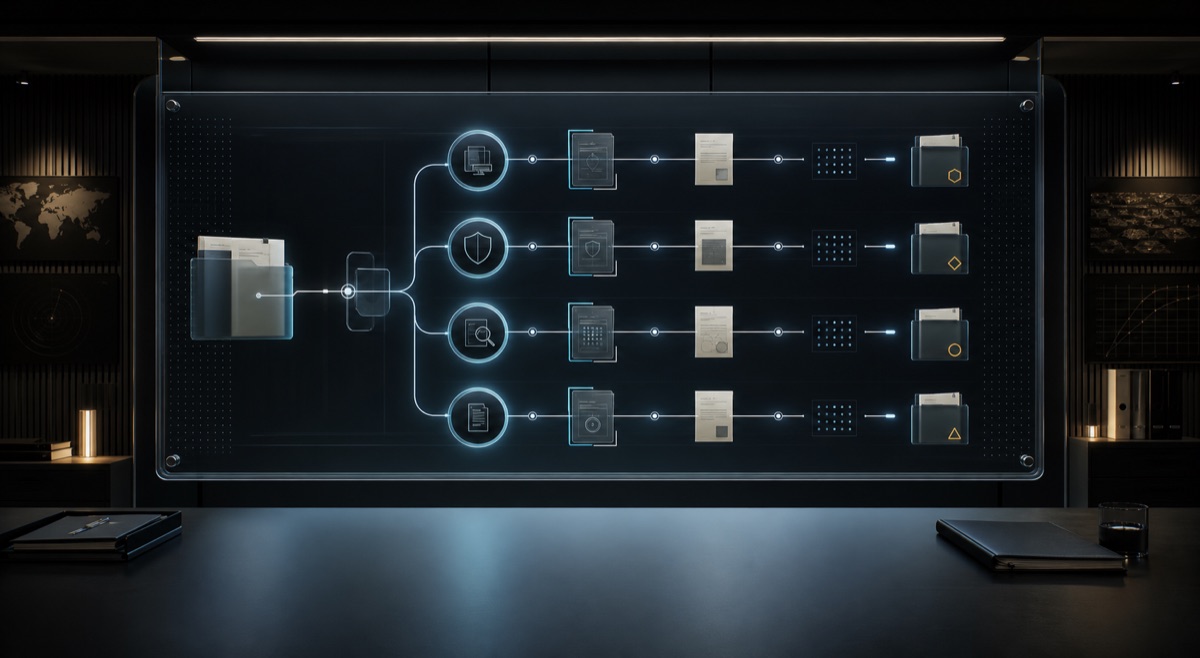
The visual shows the page’s operating idea: one inquiry, four possible artifact shapes, one responsible handoff, and a provenance boundary that travels with the answer.
Artifact decision surface
Make the first-return choice visible before the contact push.
World-class product pages reduce anxiety by showing the object a user is about to evaluate. For this route, the object is a small decision: choose the lowest-risk artifact that can answer one serious ask without pretending a deeper operation exists.
The return cannot outrun current pages, source records, permission state, or explicit gaps.
Walkthrough, boundary memo, scoped services route, or formal-process note should be selected before response copy gets warmer.
The reply should state what it does not prove: CRM, support, customer proof, audited controls, legal review, or financing process.
Generated visual disclosure
Original GPT-generated editorial image, published with provenance.
Asset: assets/governance/white-noise-first-return-artifact-workbench-20260702.png. It is not evidence of monitored inbox coverage, production CRM, staffed support, audited response metrics, customer traction, legal review, procurement readiness, formal financing activity, or deployed speculative technology. Review provenance.
Routing rules
Answer the decision, keep the boundary, refuse unearned maturity.
The safest first return is not the biggest packet. It is the smallest response that answers the real question without pretending missing process, proof, or operating infrastructure already exists.
Match the artifact to the decision.
Do not send a broad narrative packet when the counterparty asked one gating question. The first return should stay proportionate to the single decision being tested.
Preserve public-state truth.
If the answer depends only on public materials, say so. If it would require private records, signed permission, legal review, audited reporting, or a later formal process, say that plainly.
Use the lowest-risk sufficient artifact.
Prefer a walkthrough or boundary memo before implying deeper diligence. Move to a scoped route only when the work can be framed and constrained responsibly.
Refuse unearned maturity.
If the request depends on audited KPIs, audited financials, enterprise controls, named customer proof, production CRM evidence, or formal financing documents, the correct answer may be a formal-process note.
Request triage matrix
Map the ask to the first responsible return.
These examples keep the response shape tied to the real question instead of defaulting to a generic “send more information” flow.
“Show how your public route supports this buying decision.”
Return firstPublic-surface walkthrough.
WhyThe question can be answered from current public pages, route state, and one bounded interpretation.
“Is this product or market claim operational today?”
Return firstBoundary memo.
WhyThe real risk is claim maturity and proof state, not broader sales or investor routing.
“Can you scope a research or services engagement around this thesis?”
Return firstScoped services or Custom R&D route.
WhyThe request names work to be evaluated, constrained, and priced rather than only read.
“Send audited financials, KPI proof, legal-reviewed materials, or a dataroom.”
Return firstFormal-process note.
WhyThe public build does not represent those materials as ready and should not simulate them.
“Can we use your logo, quote, case study, or metrics publicly?”
Return firstBoundary memo plus customer-evidence permission route.
WhyPublication requires source context, written permission, approved channel, and claim-boundary review.
“Can you prove inquiry-response or conversion performance?”
Return firstBoundary memo plus evidence-log route.
WhyA log template exists, but source-backed records must exist before warmer metrics can be claimed.
Every first-return artifact should include six things.
- The role and decision being answered.
- The public surface or material used.
- The current route state or evidence state.
- One direct answer or recommended next step.
- One explicit boundary.
- The next route if stronger material is required.
Use a first return shaped like this.
The first artifact we can return is[walkthrough / boundary memo / scoped route / formal-process note].
It answers[single decision]using[public surface or source category].
The current evidence state is[public / limited / not represented as ready].
The main boundary is[risk or missing proof].
The next appropriate route is[page, memo, scope path, or later formal process].
Related routes
Use the menu as part of the trust stack, not by itself.
The first-return menu works best when it sits between the question map, the first-response standard, and the actual routing note. That combination improves lead quality without claiming a larger enterprise process than exists.
Question mapMatch the actual concern to the right route.
Choose the first public artifact, explicit non-claim, and best next ask for the diligence issue.
Request guideAsk for one bounded artifact.Carry the role, decision, risk boundary, and requested first return into a clean note.
Reply ruleDefine what the first serious reply should say.Keep route-state truth, artifact availability, and missing-proof honesty visible in the response.
TriageClassify the inquiry before responding.Check route class, owner state, escalation, and source-record linkage before any warmer handling claim appears.