The first decision is where the ask belongs, not how warmly to reply.
Home / Investor Relations / Inquiry Triage Protocol
Public pre-reply control
Classify the request before the company warms the answer.
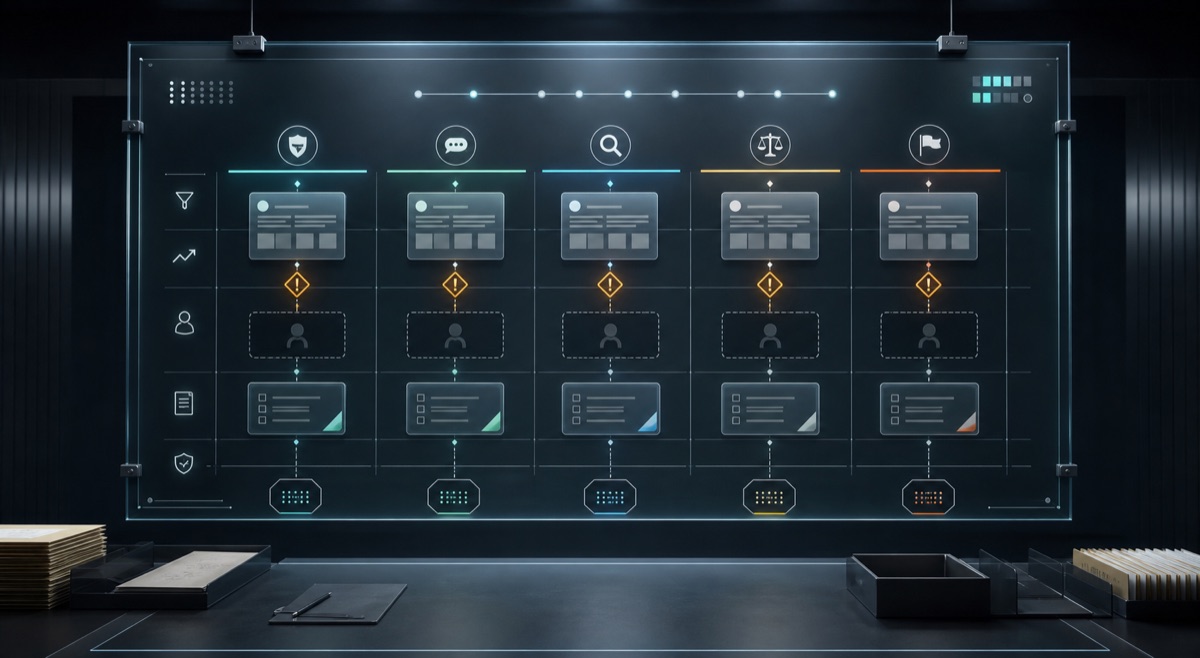
This public protocol tells White Noise how to classify a serious inbound request before sending the first response: which route the inquiry belongs in, what owner state exists, which first-return artifact is appropriate, and what must escalate before stronger proof is implied.
Use boundary
This protocol is for general information only. It is not investment advice, not an offer to sell or solicit securities, not a service-level agreement, not a production support policy, and not proof of a staffed investor-relations, enterprise support, or CRM operation.
Visual boundary
This route reuses the GPT-generated editorial governance image already attached to the source protocol. It is not proof of a staffed support desk, audited control room, production CRM, enterprise support workflow, active financing process, customer traction, or operational speculative technology. Review the provenance record.
Board view
The governance value is preventing the wrong room from answering.
White Noise already has public routing surfaces, first-response standards, a first-return artifact menu, and an inquiry-response evidence log template. This protocol fills the pre-reply gap: classify the request, name owner state, check escalation gates, and keep the first answer bounded.
Name whether a real owner, founder-led owner, owner gap, or formal-process owner is required.
Financials, securities language, security controls, customer proof, and regulated interpretations require stricter handling.
Do not publish triage summaries until source records and permission standards support them.
Buyer or services request
Ask whether the sender is evaluating a concrete learning, consulting, or Custom R&D decision.
- First route: public-surface walkthrough or scoped services route.
- Escalate if the reply would imply guaranteed feasibility, production capacity, regulated advice, security-reviewed controls, or customer outcomes.
Strategic partner or institution
Ask whether the sender is proposing distribution, program, sponsorship, curriculum, institution, or channel fit.
- First route: partner-fit memo, program walkthrough, or boundary memo.
- Escalate for exclusivity, logo use, signed operations, shared metrics, or production support workflow.
Investor or board reviewer
Ask whether the sender is testing capital readiness, proof depth, operating maturity, or claim boundaries.
- First route: capital-readiness response, public-surface walkthrough, boundary memo, or formal-process note.
- Escalate for audited financials, KPI proof, valuation support, securities activity, dataroom access, or legal-reviewed financing materials.
Media, credibility, or regulated subject
Ask whether the request would shape public description, legal interpretation, privacy, security, token, payment, custody, personal data, health, or compliance posture.
- First route: boundary memo, public-materials route, formal-process note, or statement that the material is not represented as ready.
- Escalate before any jurisdiction-specific advice, certification, launch permission, security assurance, or regulated interpretation.
Every serious inquiry should carry one internal owner-state tag before the first reply is sent.
- Named internal owner: a person or function is accountable for the response; do not publish the owner unless approved.
- Founder-led owner: the founder is accountable because no delegated function exists; summarize only through founder-continuity materials.
- Owner gap: no accountable owner or function is established; state that stronger workflow proof is not represented as ready.
- Formal-process owner needed: counsel, finance, security, privacy, or another formal review function must handle the reply before stronger claims are made.
An owner tag is not a public proof point. It is a control that prevents replies from implying deeper operating maturity than exists.
Escalate before sending a stronger response when the inquiry asks for proof the public stack does not yet earn.
- Audited financials, audited KPI reporting, valuation support, formal financing materials, securities language, token sale language, custody, payments, or market operations.
- Named customer, logo, quote, case-study, partner, sponsor, or metric publication.
- Security controls, privacy compliance, legal conclusions, regulated clinical or health interpretation, tax, sanctions, production access, credentials, personal data, CRM exports, API keys, or enterprise workflow proof.
- Any claim that speculative White Noise technologies are complete, deployed, validated, or commercially operational.
Required linkage
The protocol only works inside the public trust stack.
The triage protocol classifies the inquiry. The first-response standard shapes the reply. The first-return menu selects the smallest credible artifact. The evidence-log template preserves the source trail before public summaries or response claims exist.
Reply ruleFirst-Response StandardDefine what the first serious reply should say and what it must not imply.
Artifact choiceFirst-Return Artifact MenuSelect the smallest credible route, memo, walkthrough, or formal-process note.
Source trailResponse Evidence LogPreserve inquiry class, route state, boundary, and source records before any summary is published.
PermissionCustomer Evidence StandardGate logos, names, quotes, case studies, and customer or partner proof before publication.
RiskPublic Risk RegisterDecide whether the inquiry creates a public trust-stack update trigger.
SecuritySecurity and Data BaselinePrevent first replies from implying stronger privacy, security, or enterprise controls than exist.
ExchangeExchange Launch Status NoteKeep token, marketplace, custody, and market-operation language within the current public boundary.
ContinuityFounder Continuity NoteUse founder-led owner state honestly when delegated functions are not yet established.