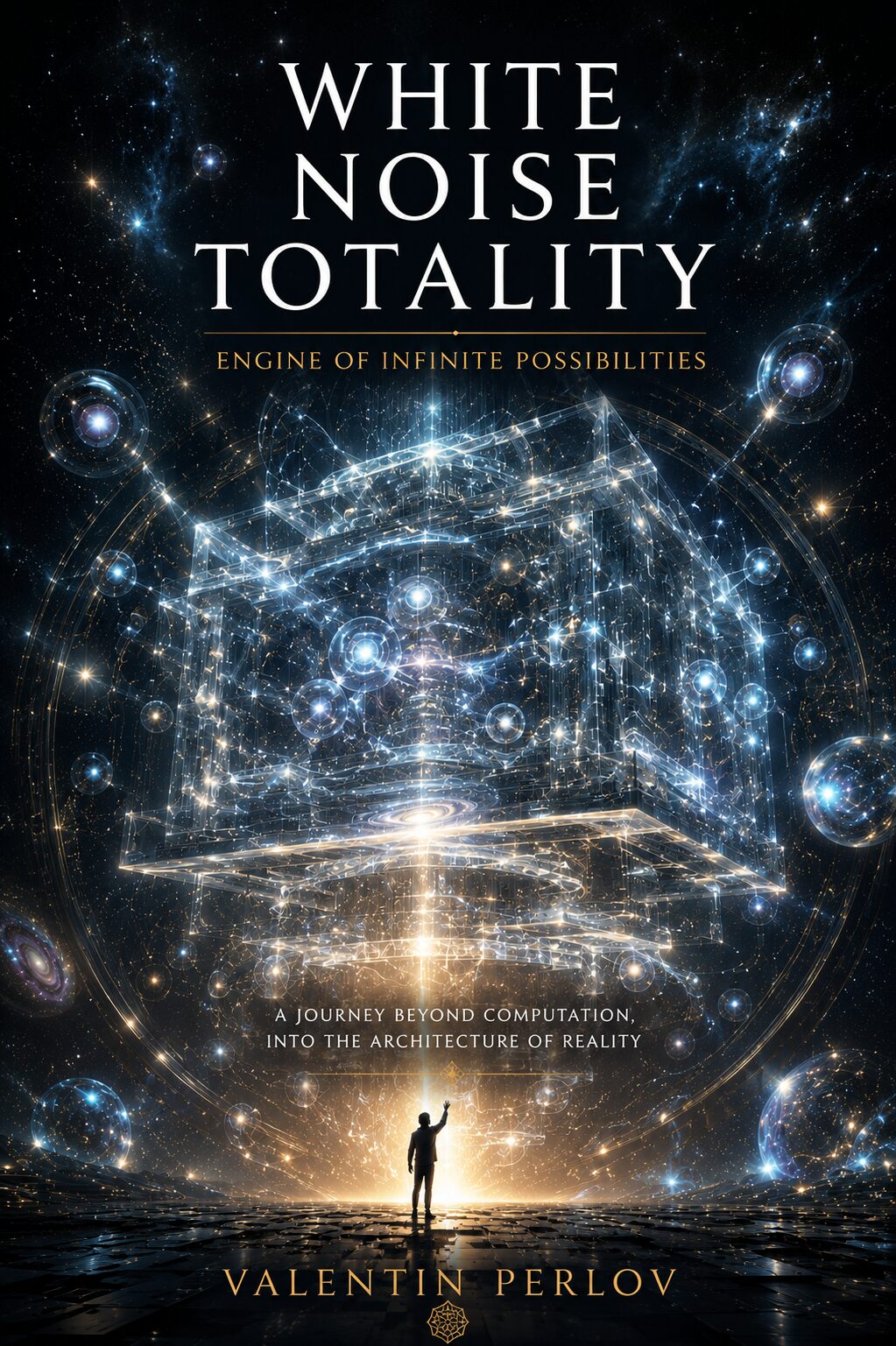
The complete manuscript in eleven parts — a systematic answer to the question: if the deepest possibilities of physics were fully unlocked, what would a flourishing civilization build with them?
At the heart of White Noise Totality sits a single, audacious idea: that the universe itself — every particle, every field, every point in space and time — can be treated as one vast, entangled informational fabric, and that a sufficiently advanced civilization could learn to compute with that fabric directly. The instrument of that leap is the White Noise Computer: a hypothetical machine that does not sit in a data center but lives in the entanglement structure of reality itself.
From that one seed, an entire civilization unfolds across the pages. The OSTSS grows from it as the physical body of the vision — self-replicating nanobots and planet-scale macrobots, settlements that assemble themselves in months, fleets that cross galaxies. Around them gather the supporting pillars: the Digital Medical System and its promise of indefinite health; the White Noise Library and its archive of all possible knowledge; replicators that turn vacuum energy into matter; and verses — entire engineered universes — created and owned the way earlier generations owned land.
This unified edition gathers the complete original manuscript, reorganized into eleven parts, and extends it with the newest layer of the project: the White Noise Inc. ecosystem, with its W.N. Chip, W.N. Material, Blue Gue, the Superformula, and Project Utopia. Each chapter now opens with an AI image prompt, so the book's imagery can be generated and regenerated as freely as its ideas.
The five "Why" sections, the core vision of White Noise Totality as a civilizational threshold, the first complete portrait of the White Noise Computer — and the shadows mapped alongside the light, with the architecture of stewardship intended to meet them.
The engineer's question: how do we get there from here? Three converging routes — reverse engineering remote viewing, the quantum engineering campaign, and the exotic hardware of the mature vision.
The physical body of the vision: self-replicating nanobot and macrobot swarms, settlements at civilization scale, private OSTSS habitats, and the first personalized verses.
The infrastructure comes home — the Omnipresent City, the Omnipresent Home, and the settlement as a system for preventing war, crime, and disaster. The hinge between building the machine and living inside it.
Eight movements on a single life: total perception, Max Experience, the medical system and immortality, infinite memory, parallel thinking, personal omnipresence, the Omega Genome, and WNIOS. Not a tool humanity uses — a new kind of human.
A toolbox for operating a universe: the Library, libraries of all possible media and software, Final Teleport, replicators, and the Omnipresent Cosmological Simulator.
The book's longest sustained argument: optimal legal codes, disaster prevention, cybersecurity, hyperconnected government, Max Property Ownership, the White Noise DAO, and Blue Foam. Omnipotence without institutions is catastrophe; with them, stewardship.
Megastructures in infinite number, theoretical time travel, black hole and white hole generation, anti-gravity and faster-than-light travel — the framework tested against the hardest limits physics offers.
Every thread pulled tight: superintelligence formalized, Star Councils of cosmic federation, eternal continuity frameworks, and the reach for the Theory of Everything.
The vision acquires an address: the ecosystem's mission and roadmap, the five pillars of its science, the chip and material at its core, verses at its creative frontier, and the full product constellation as a hundred-year roadmap.
Every journey of this scale must end by returning home — to the question of what it was all for. The conclusion gathers the threads, and a glossary offers the reader a map of the book's language.
"Read it as speculation, as manifesto, as science fiction in the form of an engineering brief — but read it on its own terms: as one sustained answer to the question of what 'everything' might actually mean."
The reader will encounter claims that strain belief — and that is precisely the point. Read it the way one reads Tsiolkovsky's rocket equations from 1903 or Bernal's space habitats from 1929: not as a product catalog, but as a map of ambition.
The book was written as a manifesto for a new era, born of an urgent belief that humanity stands at the threshold of its greatest opportunity — and its greatest risk. Its insistence on stewardship and ethical foresight is not an afterthought; it is the moral spine of the work.
Every grand claim is decomposed into systems, phases, and feedback loops. The tone is deliberate: theoretical, stepwise, plausibility-focused — engineering problems rather than miracles, with assumptions stated openly.

Valentin Perlov writes at the confluence of quantum information, consciousness studies, and civilizational design — the territory where physics ends and ambition begins. White Noise Totality is his sustained act of cartography: a decade of frameworks, drawn into one internally consistent map of what a post-scarcity, post-locality civilization could be.
His method is visible on every page: take an impossible claim, refuse to flinch, and decompose it until it becomes a sequence of merely very hard problems. The result is a body of work that is equal parts provocation and blueprint — and an open invitation to the pioneers, visionaries, skeptics, and builders it was written for.
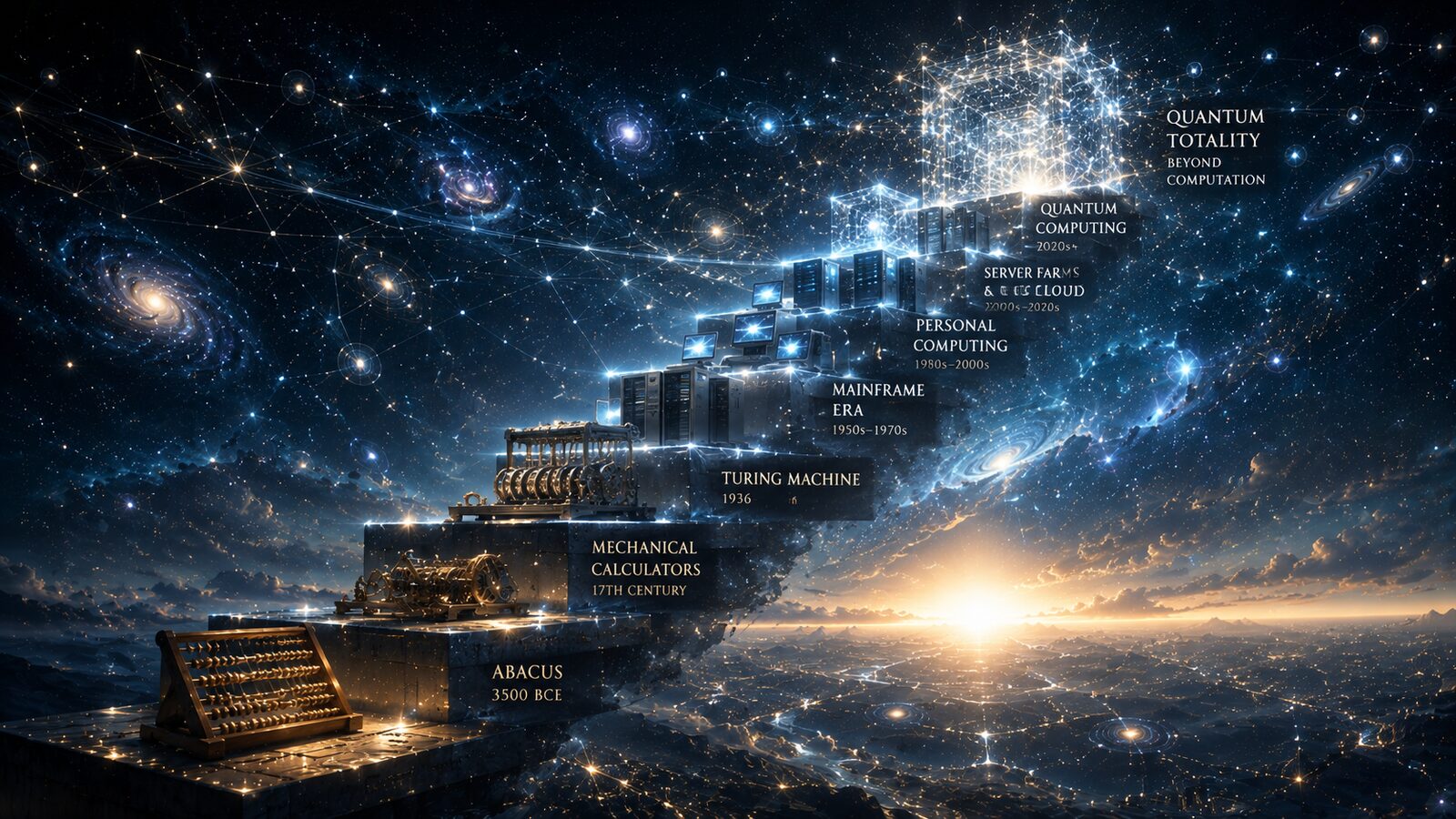
The book is the trunk; this site is its canopy. Every major chapter has grown into a page of the ecosystem — from the W.N. Chip and Law of Large Verses to Project Utopia. The Academy teaches its frameworks; the magazines extend its inquiries; the blog carries its conversation forward.
For enquiries about the book — editions, press, or speaking — visit the contact page.