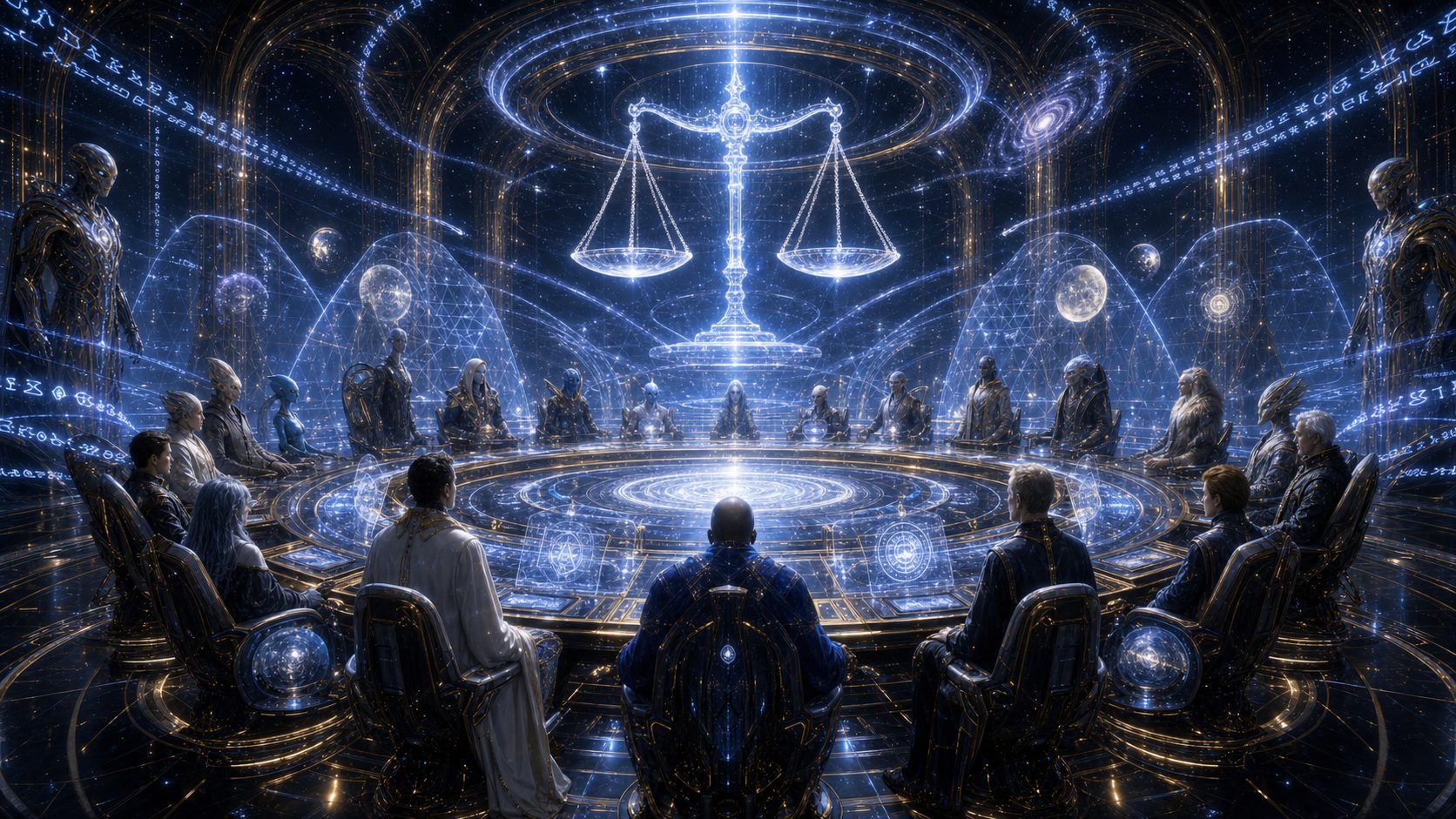
The Totality universe as a place to inhabit — storyworlds, simulations, and games built from the same internally consistent map the book draws.
Most fictional universes are painted backdrops; the Totality universe is load-bearing. Because White Noise Totality was written as an engineering brief — every technology decomposed, every dependency named — its world holds up under the two hardest audiences there are: critics and players. W.N. Media and W.N. Gaming are the ecosystem's envisioned studios for turning that rigor into experience: films and serials set along the hundred-year roadmap, simulations that let you operate the machinery, and games whose rules are the book's physics.
The source material is famously generous. The OSTSS gives the universe its cities and politics; verses give it infinite stages with custom physical laws; the Singleton debate gives it moral stakes; and the Law of Large Verses gives it the most vertiginous cosmology in fiction — civilizations trillions of times beyond us, for whom our cosmos is an object of study. Each chapter of the book even opens with an AI image prompt, so the universe's visual language is, by design, endlessly regenerable.
A near-future serial about the laboratory race for room-temperature coherence — ambition, doubt, and the first chip that refuses to decohere. Drama at the scale of a desk, with stakes at the scale of a civilization.
An ensemble saga aboard the first OSTSS settlement: governance by superintelligent advice, a city that builds its own successor, and the question of what home means when home can copy itself.
An anthology set under the Law of Large Verses — first contact not as a meeting of peers, but as an introduction across a staggering gradient of capability.
A creation sandbox built on W.N. Verses: dial gravity, time, and thermodynamics like studio controls, ignite a cosmos, and live with the consequences. The tutorial is physics; the endgame is stewardship.
A grand-strategy simulation of the OSTSS doctrine — one settlement builds two, two build four — where the limiting resource is never matter but governance, and every shortcut you take is waiting for you ten generations later.
A narrative strategy game about the Singleton transition: you hold the override, the system holds the future, and every dialogue is a trolley problem wearing better clothes.
A post-scarcity economy sim built on the replicator chapters: when matter is free, you compete on pattern, reputation, and taste — the book's reputation economy, made playable.
"Every conceivable form of interactive entertainment can be designed, from single-player adventures and massive shared universes to games that evolve with the player's imagination — blurring the lines between play, art, and discovery."
There is a pleasing recursion here. Within the book's own fiction, the White Noise Computer can generate all possible media and games — every story, every world, every interactive form, tuned in real time to each player's imagination. W.N. Media and W.N. Gaming are the present-day, human-scale shadow of that capability: finite studios sketching the first rooms of an infinite gallery.
The shared social fabric for these worlds is Metaland — the ecosystem's envisioned network where players, readers, and builders inhabit the same map. Creators interested in the universe — writers, designers, studios — are welcome via the contact page.