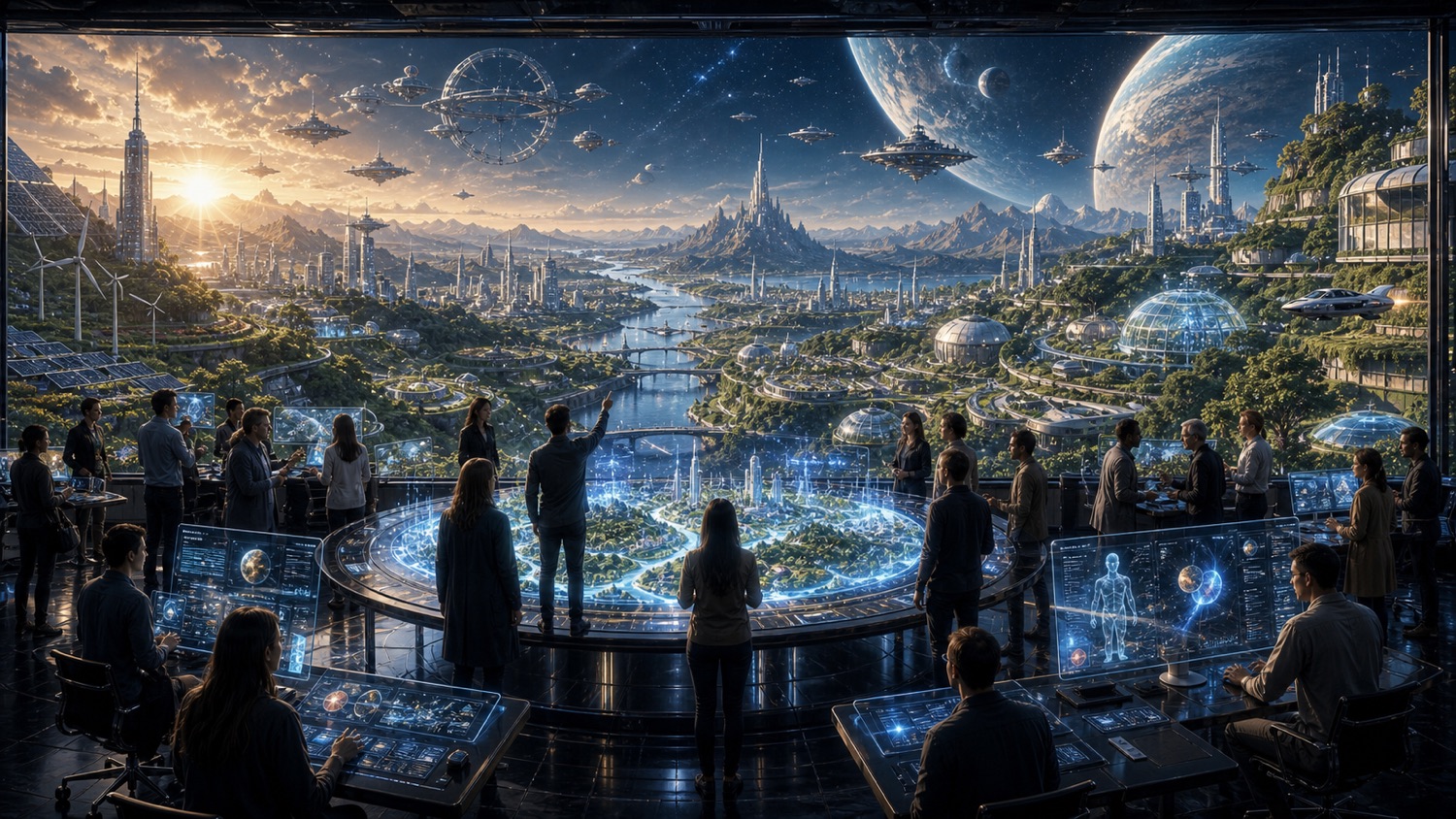
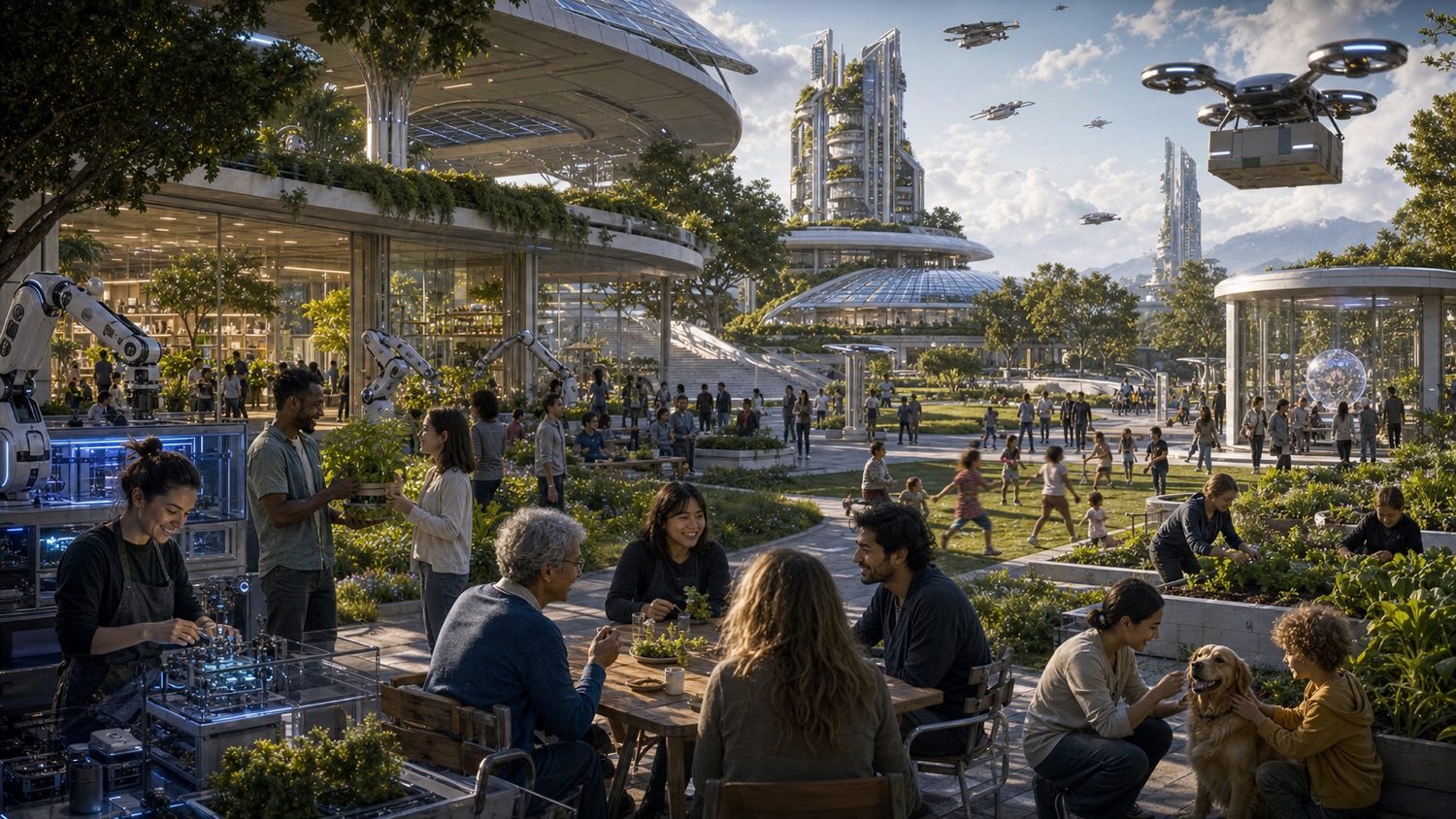
An original long-form WN Magazine essay translating abundance coordination from the far edge of White Noise Totality into tests, limits, interfaces, and stewardship.
This feature treats White Noise Totality as a generative source text rather than a literal product catalogue. The book supplies the far horizon: the White Noise Computer, the W.N. Chip, the Replicator, the Library of possible things, OSTSS habitats, the Digital Medical System, immortality research, Project Utopia, and a civilization trying to keep its ethics large enough for its tools. The article then walks back from that horizon to the questions a serious lab, studio, institution, or reader could actually use.
The public White Noise Inc. site turns the book into an ecosystem: products, Academy courses, Labs, the Exchange, Club, Syndicates, University planning, and the Grand Challenge all orbit the same premise. A magazine essay is strongest when it keeps those connections visible, because the technical claim, the educational path, the market layer, and the stewardship problem are never separate for long.
The central question is simple: if abundance coordination were the north star, what would count as honest progress today? The answer is never a single breakthrough. It is a stack of measurements, interfaces, incentives, safeguards, and cultural choices that either make the vision more coherent or expose the place where it breaks.
The Claim Worth Testing
The ordinary sciences under the extraordinary claim are markets, institutions, labor, status, and allocation, which is why the first step is careful translation. Seen from the prototype level, the section on the claim worth testing is less about spectacle than about how abundance coordination behaves under constraint. A reader can treat the abundance exchange as a sketch of desire: what function should exist, and what would it cost to make honest? The useful move is to keep the ambition visible while refusing to hide the constraint. Tracking maintenance burden keeps the work connected to use, maintenance, and public trust. The risk worth naming is assuming material plenty removes social scarcity, so evidence has to remain more important than atmosphere.
If material throughput is hidden, the prototype teaches the wrong lesson no matter how elegant it looks. Without a visible account of reversibility, the system would turn ambition into opacity. A field that cannot describe its own failure modes is not ready for scale. In Post-Scarcity Economics, progress has to pass through markets, institutions, labor, status, and allocation; otherwise the language becomes detached from the world it wants to change. The abundance exchange matters here because it turns an abstract promise into something with edges, interfaces, and possible failure. A Manual for the Edge Case in Post-Scarcity Economics therefore reads the book's horizon as a design brief with missing pages, not as a finished manual.
White Noise Totality is most productive when read as a pressure gradient between dream and mechanism. The practical system would include human review, provenance, rollback, and a way to say no. A weak version of the field would slide into assuming material plenty removes social scarcity; a serious version designs against that slide. The book offers the dramatic object, the abundance exchange, while the practical version asks for sensors, protocols, people, and stop rules. WN Academy, WN Labs, the Exchange, Club, and Syndicates make the speculative corpus operational as education, research, markets, community, and funding paths rather than only a book of far horizons. The article treats interpretability as a design material, because invisible costs become political facts later.
Where the Book Leaps
No architecture deserves trust merely because it is mathematically beautiful. This essay keeps the name of the dream intact while asking what the name obligates a builder to prove. Project Utopia is the human-facing interpretation of the stack: post-scarcity economics, reputation, education, governance, and shared flourishing are treated as design problems rather than slogans. The useful milestone would make public legitimacy visible to operators before it tried to claim total reach. The boundary matters because it protects both wonder and credibility. The imagined abundance exchange gives the essay a concrete object to test instead of leaving the idea as atmosphere.
The article's wager is that a precise translation can preserve wonder without laundering uncertainty. The ordinary sciences under the extraordinary claim are markets, institutions, labor, status, and allocation, which is why the first step is careful translation. Tracking consent keeps the work connected to use, maintenance, and public trust. The strongest research culture would welcome a result that narrows abundance coordination, because narrowed dreams are easier to build responsibly. The phrase sounds cosmic, but the first useful version would look like a bench, a dataset, and an audit. The article's job is to unfold the leap without sneering at why the leap was attractive in the first place.
If material throughput is hidden, the prototype teaches the wrong lesson no matter how elegant it looks. In Post-Scarcity Economics, progress has to pass through markets, institutions, labor, status, and allocation; otherwise the language becomes detached from the world it wants to change. The abundance exchange matters here because it turns an abstract promise into something with edges, interfaces, and possible failure. Without a visible account of public legitimacy, the system would turn ambition into opacity. A Manual for the Edge Case in Post-Scarcity Economics therefore reads the book's horizon as a design brief with missing pages, not as a finished manual. WN Academy, WN Labs, the Exchange, Club, and Syndicates make the speculative corpus operational as education, research, markets, community, and funding paths rather than only a book of far horizons.
The Grounded Version
The title's promise is useful only if it leads back to the blank pages a builder would have to fill. The nearby disciplines are markets, institutions, labor, status, and allocation, and they give the speculation both vocabulary and resistance. The book offers the dramatic object, the abundance exchange, while the practical version asks for sensors, protocols, people, and stop rules. Project Utopia is the human-facing interpretation of the stack: post-scarcity economics, reputation, education, governance, and shared flourishing are treated as design problems rather than slogans. Scale makes the problem more interesting, not easier. For a laboratory team, the section on the grounded version would begin as a protocol rather than as a declaration.
The useful milestone would make public legitimacy visible to operators before it tried to claim total reach. Because assuming material plenty removes social scarcity is plausible, the work needs published limits as much as it needs demonstrations. The same roadmap also needs a threshold for failure recovery, or the promise will outrun accountability. A grounded program in Post-Scarcity Economics would borrow from markets, institutions, labor, status, and allocation before claiming any White Noise-scale capability. A practical translation should still feel connected to the dream, otherwise it becomes ordinary incrementalism. At the policy scale, the section on the grounded version turns abundance coordination from a luminous phrase into an operation that can be observed.
Seen from the cultural level, the section on the grounded version is less about spectacle than about how abundance coordination behaves under constraint. One honest dashboard would expose error rate early, while the system is still small enough to correct. A reader can treat the abundance exchange as a sketch of desire: what function should exist, and what would it cost to make honest? A miracle is not a plan, but a miracle can still point toward a plan if it is interrogated carefully. Tracking error rate keeps the work connected to use, maintenance, and public trust. The ordinary sciences under the extraordinary claim are markets, institutions, labor, status, and allocation, which is why the first step is careful translation.
Prototype Discipline
The W.N. Chip and Replicator translate that premise into matter, where zero-point ambition has to answer to energy ledgers, thermodynamics, materials, maintenance, and atomic error rates. In Post-Scarcity Economics, progress has to pass through markets, institutions, labor, status, and allocation; otherwise the language becomes detached from the world it wants to change. Without a visible account of resilience, the system would turn ambition into opacity. The abundance exchange matters here because it turns an abstract promise into something with edges, interfaces, and possible failure. If material throughput is hidden, the prototype teaches the wrong lesson no matter how elegant it looks. A Manual for the Edge Case in Post-Scarcity Economics therefore reads the book's horizon as a design brief with missing pages, not as a finished manual.
For an interface team, the section on prototype discipline would begin as a protocol rather than as a declaration. OSTSS and the self-building settlement vision make the Totality program spatial: habitats, robotics, closed ecology, shielding, spin gravity, and construction loops become tests of whether abundance can maintain itself. The nearby disciplines are markets, institutions, labor, status, and allocation, and they give the speculation both vocabulary and resistance. A second milestone would track energy cost, because hidden cost is where speculative systems become socially expensive. White Noise Totality is most productive when read as a pressure gradient between dream and mechanism. The article treats interpretability as a design material, because invisible costs become political facts later.
The same roadmap also needs a threshold for material throughput, or the promise will outrun accountability. The imagined abundance exchange gives the essay a concrete object to test instead of leaving the idea as atmosphere. Because assuming material plenty removes social scarcity is plausible, the work needs published limits as much as it needs demonstrations. OSTSS and the self-building settlement vision make the Totality program spatial: habitats, robotics, closed ecology, shielding, spin gravity, and construction loops become tests of whether abundance can maintain itself. This essay keeps the name of the dream intact while asking what the name obligates a builder to prove. A grounded program in Post-Scarcity Economics would borrow from markets, institutions, labor, status, and allocation before claiming any White Noise-scale capability.
The Measurement Layer
The article's wager is that a precise translation can preserve wonder without laundering uncertainty. The first dashboard should show confidence, cost, uncertainty, and the boundary of the instrument. The ordinary sciences under the extraordinary claim are markets, institutions, labor, status, and allocation, which is why the first step is careful translation. The phrase sounds cosmic, but the first useful version would look like a bench, a dataset, and an audit. WN Academy, WN Labs, the Exchange, Club, and Syndicates make the speculative corpus operational as education, research, markets, community, and funding paths rather than only a book of far horizons. The risk worth naming is assuming material plenty removes social scarcity, so evidence has to remain more important than atmosphere.
The article treats the book as a map of questions, not as a catalogue of existing machines. Project Utopia is the human-facing interpretation of the stack: post-scarcity economics, reputation, education, governance, and shared flourishing are treated as design problems rather than slogans. The abundance exchange matters here because it turns an abstract promise into something with edges, interfaces, and possible failure. The field version of the problem asks whether abundance coordination can survive contact with instruments, operators, and review. A system that cannot report what it failed to sense is already overstating itself. Without a visible account of reversibility, the system would turn ambition into opacity.
A second milestone would track interpretability, because hidden cost is where speculative systems become socially expensive. The book offers the dramatic object, the abundance exchange, while the practical version asks for sensors, protocols, people, and stop rules. A weak version of the field would slide into assuming material plenty removes social scarcity; a serious version designs against that slide. For an institutional team, the section on the measurement layer would begin as a protocol rather than as a declaration. The W.N. Chip and Replicator translate that premise into matter, where zero-point ambition has to answer to energy ledgers, thermodynamics, materials, maintenance, and atomic error rates. The title's promise is useful only if it leads back to the blank pages a builder would have to fill.
Energy, Latency, and Material Cost
This essay keeps the name of the dream intact while asking what the name obligates a builder to prove. The same roadmap also needs a threshold for latency, or the promise will outrun accountability. A serious reader does not need to choose between imagination and discipline. WN Academy, WN Labs, the Exchange, Club, and Syndicates make the speculative corpus operational as education, research, markets, community, and funding paths rather than only a book of far horizons. The imagined abundance exchange gives the essay a concrete object to test instead of leaving the idea as atmosphere. The useful milestone would make public legitimacy visible to operators before it tried to claim total reach.
The article's wager is that a precise translation can preserve wonder without laundering uncertainty. The risk worth naming is assuming material plenty removes social scarcity, so evidence has to remain more important than atmosphere. Tracking consent keeps the work connected to use, maintenance, and public trust. A miracle is not a plan, but a miracle can still point toward a plan if it is interrogated carefully. Seen from the reader level, the section on energy, latency, and material cost is less about spectacle than about how abundance coordination behaves under constraint. Project Utopia is the human-facing interpretation of the stack: post-scarcity economics, reputation, education, governance, and shared flourishing are treated as design problems rather than slogans.
Every grand capability has a physical ledger, even when the interface hides it. A Manual for the Edge Case in Post-Scarcity Economics therefore reads the book's horizon as a design brief with missing pages, not as a finished manual. The operator version of the problem asks whether abundance coordination can survive contact with instruments, operators, and review. In Post-Scarcity Economics, progress has to pass through markets, institutions, labor, status, and allocation; otherwise the language becomes detached from the world it wants to change. A miracle is not a plan, but a miracle can still point toward a plan if it is interrogated carefully. The failure pattern to watch is assuming material plenty removes social scarcity, especially when a beautiful interface makes the system feel inevitable.
Human Interfaces
The book offers the dramatic object, the abundance exchange, while the practical version asks for sensors, protocols, people, and stop rules. For a laboratory team, the section on human interfaces would begin as a protocol rather than as a declaration. A second milestone would track auditability, because hidden cost is where speculative systems become socially expensive. A good interface slows the user down exactly where power would otherwise become too easy. The article treats interpretability as a design material, because invisible costs become political facts later. A weak version of the field would slide into assuming material plenty removes social scarcity; a serious version designs against that slide.
The same roadmap also needs a threshold for failure recovery, or the promise will outrun accountability. At the policy scale, the section on human interfaces turns abundance coordination from a luminous phrase into an operation that can be observed. Because assuming material plenty removes social scarcity is plausible, the work needs published limits as much as it needs demonstrations. Abundance without stewardship can become a faster way to make old mistakes. The strongest research culture would welcome a result that narrows abundance coordination, because narrowed dreams are easier to build responsibly. The imagined abundance exchange gives the essay a concrete object to test instead of leaving the idea as atmosphere.
The interface is where cosmic leverage becomes a human decision. In that sense the speculation behaves like a stress test for ordinary research assumptions. A reader can treat the abundance exchange as a sketch of desire: what function should exist, and what would it cost to make honest? OSTSS and the self-building settlement vision make the Totality program spatial: habitats, robotics, closed ecology, shielding, spin gravity, and construction loops become tests of whether abundance can maintain itself. Tracking error rate keeps the work connected to use, maintenance, and public trust. The ordinary sciences under the extraordinary claim are markets, institutions, labor, status, and allocation, which is why the first step is careful translation.
Failure Modes
The economic version of the problem asks whether abundance coordination can survive contact with instruments, operators, and review. In Post-Scarcity Economics, progress has to pass through markets, institutions, labor, status, and allocation; otherwise the language becomes detached from the world it wants to change. White Noise Totality is most productive when read as a pressure gradient between dream and mechanism. OSTSS and the self-building settlement vision make the Totality program spatial: habitats, robotics, closed ecology, shielding, spin gravity, and construction loops become tests of whether abundance can maintain itself. The abundance exchange matters here because it turns an abstract promise into something with edges, interfaces, and possible failure. A civilization should not outsource judgment simply because the interface feels omniscient.
The title's promise is useful only if it leads back to the blank pages a builder would have to fill. The book offers the dramatic object, the abundance exchange, while the practical version asks for sensors, protocols, people, and stop rules. A weak version of the field would slide into assuming material plenty removes social scarcity; a serious version designs against that slide. WN Academy, WN Labs, the Exchange, Club, and Syndicates make the speculative corpus operational as education, research, markets, community, and funding paths rather than only a book of far horizons. The article treats interpretability as a design material, because invisible costs become political facts later. For an interface team, the section on failure modes would begin as a protocol rather than as a declaration.
The imagined abundance exchange gives the essay a concrete object to test instead of leaving the idea as atmosphere. Project Utopia is the human-facing interpretation of the stack: post-scarcity economics, reputation, education, governance, and shared flourishing are treated as design problems rather than slogans. The same roadmap also needs a threshold for material throughput, or the promise will outrun accountability. A grounded program in Post-Scarcity Economics would borrow from markets, institutions, labor, status, and allocation before claiming any White Noise-scale capability. At the bench scale, the section on failure modes turns abundance coordination from a luminous phrase into an operation that can be observed. If the tool removes friction, governance must add the right friction back.
Governance Before Scale
Seen from the prototype level, the section on governance before scale is less about spectacle than about how abundance coordination behaves under constraint. The W.N. Chip and Replicator translate that premise into matter, where zero-point ambition has to answer to energy ledgers, thermodynamics, materials, maintenance, and atomic error rates. The ordinary sciences under the extraordinary claim are markets, institutions, labor, status, and allocation, which is why the first step is careful translation. Tracking maintenance burden keeps the work connected to use, maintenance, and public trust. Access rules, appeal paths, and public oversight are technical components at this level of leverage. One honest dashboard would expose error rate early, while the system is still small enough to correct.
In Post-Scarcity Economics, progress has to pass through markets, institutions, labor, status, and allocation; otherwise the language becomes detached from the world it wants to change. Without a visible account of reversibility, the system would turn ambition into opacity. If a system changes shared reality, private preference cannot be its only steering mechanism. The failure pattern to watch is assuming material plenty removes social scarcity, especially when a beautiful interface makes the system feel inevitable. If material throughput is hidden, the prototype teaches the wrong lesson no matter how elegant it looks. A Manual for the Edge Case in Post-Scarcity Economics therefore reads the book's horizon as a design brief with missing pages, not as a finished manual.
Governance before scale is not bureaucracy for its own sake; it is how a civilization buys time to think. A second milestone would track interpretability, because hidden cost is where speculative systems become socially expensive. The article treats interpretability as a design material, because invisible costs become political facts later. The title's promise is useful only if it leads back to the blank pages a builder would have to fill. For an institutional team, the section on governance before scale would begin as a protocol rather than as a declaration. The question is not whether the premise is dazzling; the question is what research, governance, or learning path the premise can organize.
What a Serious Lab Would Build
The boundary matters because it protects both wonder and credibility. A grounded program in Post-Scarcity Economics would borrow from markets, institutions, labor, status, and allocation before claiming any White Noise-scale capability. The first build should be useful even if the grand theory never matures. From the book side, the recurring pattern is entanglement first, then computation, then matter, then medicine, then habitats, then governance; each layer inherits the risk of the layer before it. The imagined abundance exchange gives the essay a concrete object to test instead of leaving the idea as atmosphere. The same roadmap also needs a threshold for latency, or the promise will outrun accountability.
The risk worth naming is assuming material plenty removes social scarcity, so evidence has to remain more important than atmosphere. A reader can treat the abundance exchange as a sketch of desire: what function should exist, and what would it cost to make honest? A lab worthy of the premise would treat safety cases as part of the prototype, not as paperwork after the fact. The ordinary sciences under the extraordinary claim are markets, institutions, labor, status, and allocation, which is why the first step is careful translation. One honest dashboard would expose error rate early, while the system is still small enough to correct. Tracking consent keeps the work connected to use, maintenance, and public trust.
The strongest research culture would welcome a result that narrows abundance coordination, because narrowed dreams are easier to build responsibly. No architecture deserves trust merely because it is mathematically beautiful. The W.N. Chip and Replicator translate that premise into matter, where zero-point ambition has to answer to energy ledgers, thermodynamics, materials, maintenance, and atomic error rates. The research program should reward negative results because negative results draw the map. The abundance exchange matters here because it turns an abstract promise into something with edges, interfaces, and possible failure. In Post-Scarcity Economics, progress has to pass through markets, institutions, labor, status, and allocation; otherwise the language becomes detached from the world it wants to change.
What Survives Translation
The article treats interpretability as a design material, because invisible costs become political facts later. For a laboratory team, the section on what survives translation would begin as a protocol rather than as a declaration. The book offers the dramatic object, the abundance exchange, while the practical version asks for sensors, protocols, people, and stop rules. The nearby disciplines are markets, institutions, labor, status, and allocation, and they give the speculation both vocabulary and resistance. White Noise Totality is most productive when read as a pressure gradient between dream and mechanism. A weak version of the field would slide into assuming material plenty removes social scarcity; a serious version designs against that slide.
The danger is not only technical failure; it is social overbelief. The imagined abundance exchange gives the essay a concrete object to test instead of leaving the idea as atmosphere. Because assuming material plenty removes social scarcity is plausible, the work needs published limits as much as it needs demonstrations. At the policy scale, the section on what survives translation turns abundance coordination from a luminous phrase into an operation that can be observed. The phrase sounds cosmic, but the first useful version would look like a bench, a dataset, and an audit. OSTSS and the self-building settlement vision make the Totality program spatial: habitats, robotics, closed ecology, shielding, spin gravity, and construction loops become tests of whether abundance can maintain itself.
The ordinary sciences under the extraordinary claim are markets, institutions, labor, status, and allocation, which is why the first step is careful translation. Tracking error rate keeps the work connected to use, maintenance, and public trust. The article's wager is that a precise translation can preserve wonder without laundering uncertainty. What survives translation is often smaller, stranger, and more fundable than the original premise. The research program should reward negative results because negative results draw the map. Seen from the cultural level, the section on what survives translation is less about spectacle than about how abundance coordination behaves under constraint.