Your White Noise account
Manage your profile and plan, open the W.N. Plus members area, prepare review-gated Exchange drops, track Custom R&D requests, and review member report ledgers.
Account-state note: this public portal surface is still a browser-local demo. Explorer signups, saved drafts, and member-state examples persist in this browser unless a production delivery route is explicitly confirmed on-page.
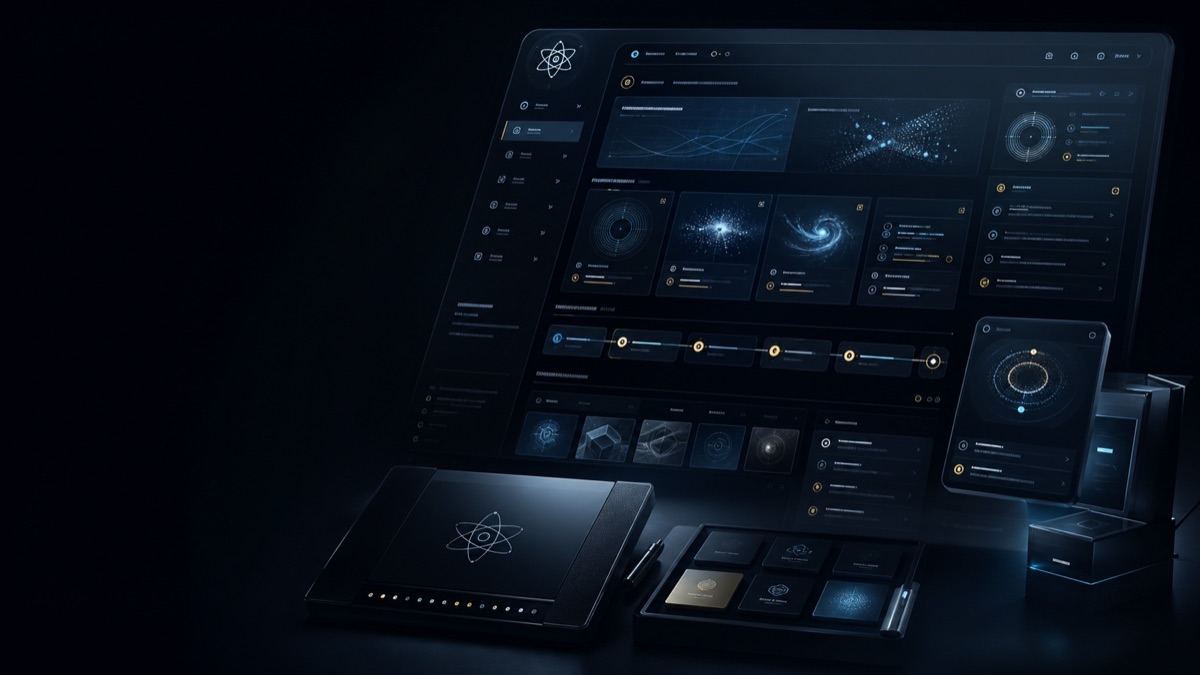
Image provenance: original GPT-generated concept art for portal orientation only. Prompt intent: depict account controls, member workspace access, Academy progress, Exchange readiness, provenance panels, and R&D report surfaces without implying a literal live dashboard. Asset: assets/portal/wn-member-portal-command-surface-20260628.jpg. Review the provenance record. Usage boundary: conceptual editorial image only, not a literal account screen, live exchange, live minting interface, operational lab, or production report.
Make membership feel like an operating system, not a login screen.
The portal now opens with the same clarity as the strongest frontier product experiences: what is live, who it is for, what proof it produces, and which action comes next. Members use W.N. Plus for Totality text, source retrieval, and generated visual tools, then carry outputs into the library, Academy, Exchange readiness, or R&D.
Account and plan
Create a profile, choose Explorer, Member, or Club Syndicate, and see the modules unlocked by each access level.
02 · CreateBlueprint Exchange studio
Prepare batches of up to 100 speculative blueprint artworks, open-model job manifests, metadata, and purchase-time Solana mint vouchers in the dedicated Exchange.
03 · ReadW.N. Plus members area
Generate Totality text and generated visual tools from the 194-book library, manuscript corpus, and website.
04 · LearnAcademy inside the portal
Browse the 1,000-course catalog, enroll locally, and carry your learning path beside membership and creation tools.
05 · ProveR&D report ledger
Club Syndicate work is framed as ledgers, methods, briefs, risks, provenance, and handoff artifacts.
Speculative economics inside White Noise Totality
This section summarizes fictional and long-range economic ideas described in White Noise Totality. It is worldview context for the book, not a statement of current White Noise Inc. product benefits, member earnings, ownership rights, or expected financial outcomes.
Collaborative R&D participation
The book imagines members backing research programs together and sharing in the learning, governance, and creative direction around those efforts. In the current public White Noise build, Club Syndicates are coordination and scoping structures for collaborative creative R&D, not ownership interests or return-bearing instruments.
Creator tooling and resale rules
The WN Exchange thesis includes creator-set usage and resale terms for eligible digital works. Any resale royalties depend on platform behavior, market activity, and the rules attached to the specific collectible, so the surface should be read as creator tooling and media rights framing, not as a promised income stream.
Long-range civic distribution ideas
White Noise Totality also explores how a future abundance economy might distribute benefits more broadly if frontier systems ever became real. That is speculative book context only. White Noise Inc. does not represent a current dividend, payout program, or member yield.
These concepts are part of the speculative economic framework explored in White Noise Totality. White Noise Inc. is an educational and creative venture; this section is not financial advice, not an offer, not a security or investment solicitation, and not a promise of royalties, dividends, or returns.
Inside your live R&D reports
For Club Syndicate members, every Custom R&D engagement keeps a live report in this portal. Each one is built from the same three standardized deliverables, so a fuzzy idea becomes something you can read, re-run, and act on.
Open results ledger
A comparable, open-by-default record of every run as it happens — positive, negative, or inconclusive. You watch the work progress live rather than waiting for a final memo, and each run stays on the ledger so the next question starts from what was already learned.
Reproducible methods bundle
The data, code, parameters, and protocols behind the findings, packaged to re-run on the same standardized WN Lab stack. If a result matters, you can reproduce it — a dead end can be ruled out with confidence, not just taken on faith.
Plain-language findings brief
A non-technical write-up of what the work found, what it means, and what it does not claim. You can act on the answer without parsing the raw runs, and steer the next decision point from a clear summary.
Decision-point log
A timestamped record of every fork the engagement took — each decision point, the evidence on the table at that moment, the option chosen, and the paths set aside. You can see exactly why the work went the way it did, reopen an abandoned branch later, and resume a follow-on engagement from any earlier fork without re-deriving the reasoning.
Standardized stack manifest
An exact record of the WN Lab stack your engagement ran on — which of the 20 AI models, brain-computer interfaces, quantum backends, and sensing & metrology rigs were provisioned, and at what settings. Because the provisioning is captured, your runs stay comparable to each other and a follow-on engagement re-stands the same bench rather than starting from zero.
Budget-burn ledger
A running tally of what the engagement has actually cost against the band you approved at the gate — compute hours, bench time, and model runs drawn down line by line as the work proceeds. You always know how much of the budget is left before the next fork, nothing is charged past the approved band without a fresh go-ahead, and a follow-on engagement is scoped from real figures rather than a guess.
Independent reproduction log
A record of every time another crew re-ran your methods bundle on the same standardized stack — who reproduced it, when, and whether the result held, shifted, or failed to repeat. A finding that has been independently reproduced is flagged on the ledger, so you can tell the results that have only run once from the ones that stand up when someone else turns the same crank.
Assumptions & risk register
A living list of the assumptions every finding rests on and the known limits around it — the conditions taken as given, the ranges a result was tested across, and where it has not been checked. Each entry travels with the finding so you read it inside its boundary conditions: you know exactly when a result applies, when it stops, and which open risks a follow-on engagement would need to close before leaning on it.
Scope & ethics attestation
A standing record that the engagement stayed inside the lines agreed at scope — the questions were research questions, not weapons or mass-harm work; any human-in-the-loop interfaces ran on consent, not control; data carried provenance and permission; and nothing was claimed beyond what the runs support. Each entry is dated against the work it covers, so you can see at a glance that the findings were produced within the boundaries you signed off on, and exactly where a request was narrowed or declined to stay there.
Schedule-vs-plan log
A running view of the engagement's schedule — the timeline agreed at scope set against what has actually happened, milestone by milestone, with each date stamped as it lands. Where the work runs ahead, slips, or pauses at a decision point, the log shows it and why, so the budget-burn figures read against real elapsed time rather than a guess. You always know where the work stands against the plan, what is still ahead, and a follow-on engagement is timed from real durations instead of an estimate.
Success-criteria scorecard
A plain verdict of the findings against the written success criteria you set at scope — each criterion marked met, partially met, or not met, with the run on the ledger that settles it. Where a target was only partly reached or missed, the card says by how much and what would have to change to close the gap. You see at a glance whether the work cleared the bar you agreed to, instead of inferring it from the brief, and a follow-on engagement starts from a clear picture of what is still open.
Closeout transfer manifest
A single checklist of everything the engagement hands back to you when it closes — the ledger entries, the methods bundle, the findings brief, the stack manifest, and any datasets, models, or prototypes produced — each line marked delivered, with where it lives and how to open it. Nothing is left implicit: you can confirm at a glance that every asset the other reports describe has actually been transferred and is reproducible on your side, so a follow-on engagement, or your own crew, can pick the work up from a complete package rather than chasing loose ends.
Open-questions backlog
A prioritized, forward-looking list of what the engagement left unanswered — the questions a run raised but did not settle, the branches set aside at a fork, and the leads a finding pointed to but ran out of scope to chase. Each item is ranked by what it would unlock and what it would take to answer, and linked back to the ledger run that surfaced it. Distinct from the success-criteria scorecard, which judges what you already asked, this is the research agenda for what comes next — so a follow-on engagement is scoped straight from a ready, evidence-backed shortlist rather than a blank page.
Input & data lineage
A traced record of where every input the engagement drew on came from — each dataset, model, and reference, with its source, license, and the permission it was used under — followed forward to the findings it fed. Distinct from the stack manifest, which captures the compute the runs stood on, this follows the material that went into them: you can see exactly which input shaped which result, confirm each one was used inside its license, and re-source or swap any of them in a follow-on engagement without re-tracing the chain by hand.
Peer-review critique log
A record of every independent review a finding passed through before it was signed off — who read the methods and the brief, what they challenged, and how the crew answered or revised. Distinct from the reproduction log, which re-runs the same methods to see if the numbers hold, this checks the reasoning around them: whether the question was framed fairly, the right baseline was used, and the conclusion is supported by what the runs actually show. Each critique stays attached to the finding with its resolution, so you can see which results were stress-tested by a second set of eyes and which still rest on a single read — and a follow-on engagement inherits the open objections instead of rediscovering them.
Steering-decision record
A dated log of every call that changed the engagement's direction — each fork taken at a decision point, the options that were on the table, the evidence that settled it, and who signed off. Distinct from the timeline, which tracks when things happened, and the backlog, which lists what was set aside, this captures why the work bent the way it did: the trade-offs weighed, the branches closed, and the reasoning behind each pivot. Every entry links back to the ledger run that prompted it, so months later you can reconstruct not just what the engagement found but how it got there — and a follow-on engagement reopens an old fork with the original reasoning in hand rather than guessing why a path was abandoned.
Candidate scoreboard
A head-to-head ranking of the approaches your engagement put in the running — every candidate method, design, or architecture scored against the same baseline on the same standardized stack, ordered by how it actually performed. Distinct from the open results ledger, which is the raw run-by-run record, and from the success-criteria scorecard, which judges the chosen result against the targets you set, this is the comparison itself: which option led, by how much, where each one held its edge, and the first condition that flipped the order. Every row links back to the ledger runs behind it, so you can see not just the winner but the full field — and a follow-on engagement re-opens the scoreboard to retest the leaders or promote a runner-up as the field, the data, or the hardware moves.
Robustness & sensitivity analysis
A measured view of how far each finding actually moves when the assumptions under it are pushed — every key input swept across the range it could plausibly take, with the resulting swing in the answer recorded. Distinct from the assumptions & risk register, which lists what a result rests on, this quantifies what those assumptions are worth: which parameters the conclusion is fragile to and which it shrugs off, how wide each was varied, and the point at which the answer flips or stops holding. Every entry links back to the ledger runs that produced it, so you can tell a result that survives hard pressure from one that only holds at a single convenient setting — and a follow-on engagement knows exactly which inputs to pin down first rather than re-probing the whole field.
Source & dataset register
A complete accounting of every input the engagement actually drew on — each dataset, corpus, measurement set, or external feed listed with where it came from, the version or snapshot used, the licence or permission it runs under, and how it was obtained or generated. Distinct from the stack manifest, which records the tools, models, and hardware the work ran on, and from the provenance trail, which links each finding back to the run that produced it, this register is the inventory of what went in: the raw material every result was built from. It flags which sources are proprietary inputs you brought, which are open or licensed third-party data, and which were generated on the standardized stack, so a reviewer can judge a finding by the quality of what fed it and a follow-on engagement can re-pull the exact same sources — or swap one cleanly — without reconstructing the supply chain from memory.
Plain-language term sheet
A definitions page that travels with every engagement — each piece of jargon, acronym, unit, and named method used anywhere across the other reports written out once in plain language, with the place it appears linked back so you can jump to the term in context. Distinct from the findings brief, which states what the engagement concluded in plain language, and from the methods bundle, which is the technical record of how, this sheet exists so a non-specialist member can actually read the rest: it turns "the baseline drifted past the success threshold under the swept parameter" into words anyone on your syndicate can follow. Terms are pulled from the reports themselves rather than a generic dictionary, so the sheet only ever defines what your engagement actually used — and a follow-on engagement inherits the vocabulary already settled instead of renaming the same idea three different ways.
Library-promotion record
A running record of which findings from your engagement were recognized as milestones and promoted into the White Noise Library — each promoted result listed with the ledger run that earned it, the success criterion it cleared, and the reproduction and review that backed it before it went in. Distinct from the success-criteria scorecard, which judges every result against the targets you set, and from the open results ledger, which holds the raw run-by-run record, this card tracks only the subset that crossed the bar to outlive the engagement: a confirmed result that becomes a standing reference future work can build on rather than re-derive. It also flags the candidates still short of promotion and what each would need to clear it, so you can see exactly what your engagement contributed to the shared body of knowledge — and a follow-on engagement starts from confirmed Library entries instead of re-proving settled ground.
Live R&D reports are a Club Syndicate benefit. Not yet a member with an active engagement? Submit a Custom R&D request →