
Home / Investor Relations
Investor Relations
Review the current proof state before you open a capital, partner, or buyer conversation.
This route is built for serious first-pass diligence: exact review dates, explicit missing materials, compact packet selection, and a bounded next note before anyone assumes audited, formal-process, or enterprise-grade proof that is not yet represented as ready.
Review before outreach
Reviewed2026-06-29
Public artifacts58
Earliest due2026-07-27
Explicit gaps10
Pick the smallest serious packet by reviewer type.
Send people to one bounded packet first, not the whole site. These three routes cover the highest-probability first conversations without implying a dataroom, audited KPI set, staffed IR desk, or secure diligence room.
Capital
Current posture, explicit absences, and what still belongs only in a later formal process.
Open the capital-readiness note BuyerDelivery shape, first artifact selection, and services-path fit before enterprise assumptions get warmer.
Open the enterprise starter brief PartnerProgram fit, current commercial surfaces, and the cleanest first collaboration packet.
Open the partner-fit memoChecking manifest freshness.
Using the downloadable materials manifest to confirm the latest review date, next due date, and explicit gaps.
Checking inquiry handoff state.
Inspecting whether this environment reports configured delivery or demo fallback only.
2026-06-29Reviewed
58Public Artifacts
2026-07-27Earliest Monthly Due
10Explicit Gaps
Current route status
See freshness, handoff state, and missing-proof discipline before you book time.
This strip pulls from the same public materials manifest and inquiry-router check used deeper on the page so a first reviewer can see the current trust posture above the fold without mistaking route-state configuration for source-backed operating proof.
Why this matters
Enterprise trust improves when the site shows exact review dates, route-state truth, and still-missing materials before the conversation expands into forecasts, procurement, or financing assumptions.
Checking manifest freshness.
Using the downloadable materials manifest to confirm the latest review date, next due date, and public artifact count.
Checking inquiry handoff state.
Inspecting whether this environment reports configured delivery or demo fallback only.
Missing proof stays explicit.
The route keeps naming missing enterprise, capital, and market-readiness materials so the conversation does not outrun the operating record.
Trust Operating Console
Open the control layer that decides whether public claims can warm.
A serious investor should not need to infer who reviews the trust stack, when it refreshes, or which missing source records still block stronger language. This console brings the cadence, ownership, evidence queue, and latest board check into one first-pass lane.
01 · Review cadence
Public review calendar
See which trust surfaces refresh monthly, quarterly, or only on an event trigger before anyone treats repetition as proof.
02 · Claim ownership
Decision ownership register
Map warmer investor, KPI, routing, customer, rights, dependency, and Exchange language to the owner type, evidence floor, escalation trigger, and blocked claim.
03 · Evidence order
Source-record priority queue
Inspect the execution order for the next real records that would improve enterprise trust fastest, starting with production contact-routing evidence and commercial source logs.
04 · Current review
Latest public board review
Read the dated monthly board packet summary for current board decisions, pending KPI source state, capital posture, and next evidence actions.
Why this matters
Enterprise trust compounds when the review system is visible before the story gets warmer.
These four routes do not prove staffed operations, audited controls, or formal financing readiness. They do make the current discipline easier to inspect: review date, owner class, next trigger, blocked claim, and the source record that still needs to exist first.
Trust-To-Revenue Unlocks
The next four proofs matter more than a warmer story.
As of June 29, 2026, the clearest path from public trust to enterprise revenue and later capital formation is operational evidence, not broader narrative. These four gates show which records would most credibly reduce buyer friction, tighten KPI truth, and improve the next serious investor conversation.
01 · Inquiry delivery
Prove serious notes can be received and routed.
Delivery receipts, fallback rules, privacy boundaries, and owner review matter before White Noise sounds like it already runs monitored enterprise intake.
Unlock: a more credible first-reply promise for investors, partners, and buyers.
02 · Payment records
Separate source-backed paid activity from planning-only revenue language.
Payment and account reconciliation is the cleanest way to keep conversion, retention, and capital posture tied to accepted cohort windows instead of inferred demand.
Unlock: stronger KPI truth and more defensible revenue-readiness language.
03 · Customer permission
Earn the right to use customer proof before publishing it.
Permission records, redaction rules, and publication status matter before White Noise relies on testimonials, logos, or case-study outcomes in enterprise or investor materials.
Unlock: safer customer evidence for sales, partnerships, and board review.
04 · Service dependencies
Show which material services have real continuity and owner records.
Service-level dependency records define what can be said about continuity, procurement readiness, security relevance, and vendor maturity without implying completed enterprise controls.
Unlock: cleaner buyer diligence and fewer avoidable procurement objections.
Operating sequence
Read these as one trust-building chain, not four disconnected controls.
The sequence is practical: receive serious demand cleanly, reconcile payment/account evidence, publish customer proof only with permission, and document service dependencies before stronger enterprise language. That operating chain does more to mature White Noise toward enterprise trust, repeatable revenue, and later capital readiness than another layer of pitch polish.
Forwardable Scorecard
Give internal champions one bounded state-of-trust artifact.
Some reviewers do not need the full investor route first. They need one dated, forwardable scorecard they can circulate internally without implying a dataroom, audited reporting, enterprise workflow maturity, or a formal capital process that White Noise has not earned yet.
01 · Public now
Inspectable routes are already live.
Commercial surfaces, sample proof, the proof pack, the starter brief, and the investor trust stack can all be reviewed without a meeting.
02 · Bounded
Routing and metrics stay source-gated.
Route-state disclosure and metrics-governance rules are public, but warmer claims still need production source records and owner-reviewed evidence.
03 · Not ready
Enterprise and financing proof is still explicit absent.
The scorecard keeps audited reporting, production CRM proof, security-reviewed controls, formal financing documents, and live Exchange market ops out of implied current state.
04 · Next unlocks
Operational proof matters more than warmer narrative.
The next trust gains come from source-backed routing evidence, stronger returned-work proof, revenue-source gating, and dated maintenance of the review cycle.
Portable read
Open the compact counterparty scorecard before you forward the whole route.
The scorecard exists for a practical reason: it gives investors, buyers, institutions, and partners one bounded artifact they can circulate internally before they ask White Noise for a broader packet or a meeting.
Review Router
Pick the reviewer type, then send the smallest serious packet.
The trust stack is broad enough now that the first conversion problem is selection, not explanation. This router turns a large investor page into one role-based read order, one boundary, and one next action for the specific counterparty in front of you.
Use boundary
This selector only rearranges current public materials. It does not create a dataroom, financing process, security packet, audited KPI set, or proof of staffed enterprise operations.
Start here
Choose the lane before the meeting request.
Each route below compresses the public reading order to the fewest links that can still support a real capital, buyer, partner, or credibility review.
Strategic capital
Open current proof state before a broader capital story.
Use the latest investor update, the capital-readiness note, and the current board review packet when the real question is whether White Noise merits a first serious capital or board-readiness conversation from current public materials.
Read firstLatest public investor update
Cycle delta, still-missing proof, and the next hardening step.
Read nextCapital-readiness noteCurrent posture, route limits, and what still belongs only in a later formal process.
Then inspectJune 2026 board reviewGovernance cadence, KPI gates, and capital-readiness posture in dated form.
Reading ruleOne lane, three links, one ask.
Packet libraryOpen first packetsRoute the reviewer to one compact packet before you send them deeper into the full investor stack.
Use the packet page when you need a forwardable single-link handoff instead of a custom email.
Capital packetOpen standalone capital packetUse the single-link capital route when a fund or board reviewer needs one dated packet only.
Cover noteOpen the note templatePair the lane with a bounded note that names role, question, and expected first return artifact.
Forwardable Review Lanes
Give internal reviewers one clean packet, not the whole site.
This layer turns Investor Relations into a sendable first pass for capital, enterprise, partnership, and credibility review. Each lane names the shortest defensible reading order, the boundary it keeps visible, and the next responsible handoff.
Use boundary
These are forwarding lanes built from current public materials only. They are not audited reporting packs, secure diligence rooms, formal financing documents, or proof of staffed enterprise operations.
Share current posture, cycle delta, and governance cadence.
Use this lane when the real question is whether White Noise merits a first serious capital or board-readiness conversation from current public materials.
Not implied: audited financials, formal raise process, or staffed IR operations.Share delivery shape, sample proof, and operating limits.
Use this lane when a buyer or operator needs to judge whether one bounded workflow is supportable now without assuming mature enterprise infrastructure.
Not implied: production CRM proof, security-reviewed controls, or procurement readiness.Share partner fit, packet shape, and live commercial surfaces.
Use this lane when the reviewer is testing program fit, distribution, Academy alignment, sponsored work, or a first institutional collaboration path.
Not implied: signed partnership program, institutional support team, or cleared custom rights package.Share the evidence-control layer before debating larger claims.
Use this lane when the reviewer is checking whether White Noise separates editorial imagery, public proof, rights, and live route state from stronger unearned claims.
Not implied: audited controls, live workflow analytics, or commercially deployed speculative technology.Forwarding ruleOne lane, three links, one boundary.
Packet routeOpen forwardable packetsThe packet should be small enough to circulate internally and clear enough that missing proof stays visible.
Use the dedicated packet page when one standalone link is easier to circulate than a custom note.
Capital routeOpen the capital-only packetUse the single-link packet when the reviewer is strictly a capital or board audience.
Cover noteOpen the first-note templatePair the packet with a bounded note that names the role, question, and expected first return artifact.
Investor Route Qualification
Decide in one pass whether this route is the right room.
The investor page already has depth. This layer makes the first decision faster: whether you should use Investor Relations at all, what to review before sending a note, what a credible first return looks like, and when the right answer is still "not ready yet."
Use boundary
This is a route-qualification aid, not a secure diligence room, procurement packet, audited reporting set, or formal financing process. If the real gate depends on one of those materials, say so before booking time.
You have one bounded capital, partnership, enterprise, or board-readiness question.
The best fit is a reviewer who can name one decision, one public surface already reviewed, one proof gap, and one expected first-return artifact.
Good first note: clear role, surface, boundary, and next artifact.Read the smallest public artifact that matches the decision.
Start with the enterprise starter brief, diligence question map, capital-readiness note, proof pack, or partner-fit memo before asking for a meeting or a broader packet.
Better signal: "we reviewed this already" beats "tell us everything."A bounded artifact or redirect, not an implied full diligence program.
When route handling is live, the public target remains a reply within a few business days. Demo or fallback environments should say so plainly and preserve a local copy instead of implying monitored enterprise workflow.
First return: walkthrough, memo, scoped path, or formal-process note.The real gate is audited, security-reviewed, confidential, or formally legal.
Do not use this public route as if it already provides audited financials, procurement review, production CRM proof, security-reviewed controls, formal financing documents, or live Exchange operations evidence.
Stronger answer today: state the missing material instead of implying it.Reading ruleQualify the route before the relationship.
Shareable noteOpen the qualification noteThe first serious visitor should know whether Investor Relations, Contact, Services, or a later formal process is actually the correct next room.
Use the compact markdown source when you need the route contract without the full page.
TemplateOpen the note templateCopy the send-ready first note once the role, packet, and boundary are clear.
ResponseInspect the first-reply ruleSee what the first serious response should return and what it should not imply.
Alternate routeOpen contact routingUse the broader contact gateway if the question is not really an investor-route decision.
Next stepSend one bounded noteUse the structured intake only after the route, first artifact, and main boundary are named.
Investor Starter Kit
Start with the bounded artifact that matches the decision in front of you.
If you are deciding whether White Noise merits a first call, open the compact starter brief first, then use the diligence question map to choose the right next packet before you review capital posture, sample proof shape, or the downloadable materials registry. This compresses the first-pass diligence path into a faster, more verifiable read.
Use boundary
These links support first-pass diligence only. They are not audited financials, formal financing documents, or proof that speculative White Noise technologies are operational.
01 / First-pass brief
Open the enterprise starter brief
Choose the right public surface by objective before you dig into the deeper diligence stack or ask for a meeting.
Updated 2026-06-29 · Best orientation read 02 / Decision mapOpen the diligence question map
Match the real diligence question to the right public artifact, the current answer it can support, the non-claim it preserves, and the best next ask.
Updated 2026-06-28 · Fastest route from question to packet 03 / Current postureOpen the capital-readiness note
See what White Noise can verify today, what can be routed next, and what still belongs only in a later formal process.
Updated 2026-06-28 · Best first read 04 / Sample proofOpen the proof-pack sample artifact
Inspect the shape of a bounded first-return diligence artifact before asking for a custom walkthrough, memo, or scoped follow-up.
Proof shape before bespoke follow-up 05 / Full registryOpen the machine-readable materials manifest
Check what is public now, what routes after fit review, and which enterprise-grade documents are still explicitly absent.
Updated 2026-06-29 · Source of truthRead orderOrient, match the question, inspect the proof, then check the gaps
DecisionOpen the question mapMove from the compact starter brief to the decision map, then into current capital posture, sample work-product shape, and the list of what is and is not public.
See which artifact should answer the specific diligence question you are trying to resolve first.
ResponseInspect the first-reply ruleSee what the first serious response should return and when White Noise should say a requested artifact is not ready.
Next stepSend one bounded noteLead with the packet item, the question behind it, and the boundary you want addressed first.
Review Cycle Summary
See what changed, what still is not ready, and what should harden next.
Repeat reviewers and first-time capital partners should not have to reconstruct the delta by rereading the full investor page, proof pack, and manifest. This summary compresses the current cycle into one dated public note and one explicit next operating priority.
01 · New this cycle
The first-read route is more compact and easier to verify.
The investor starter kit now groups the enterprise starter brief, diligence question map, capital-readiness note, sample proof artifact, machine-readable materials manifest, and a compact route-qualification layer into one bounded first-pass path.
02 · Still absent
Enterprise-grade proof remains explicitly unclaimed.
The public route still does not represent audited financials, audited KPI reporting, production CRM or secure intake workflow proof, formal financing documents, or live Exchange market-operations evidence as ready.
03 · Hardening next
The next maturity step is a four-part operating proof chain.
Inquiry-routing evidence, payment/account source records, customer-evidence permission, and service-level dependency records now form the clearest sequence for turning trust controls into revenue and capital-readiness gains.
Dated summary route
Open the investor update, then the dated board review packet.
The update route gives investors, board reviewers, enterprise buyers, and strategic partners one short answer to three practical questions: what improved this cycle, what still is not represented as ready, and what operational hardening step matters most next. The dated board review packet then shows how the same trust stack reads in governance cadence instead of marketing copy alone.
Capital Operating Brief
Diligence starts with the published system.
The strongest frontier companies do not ask serious partners to believe the whole future at once. They show what is published now, what is thesis-led, what produces evidence next, and where the conversion path goes after the first conversation.
One canon feeds education, creator-catalog tooling, services, labs, syndicates, and investor diligence.
The visual standard is cinematic, but the page now moves like a diligence product: orient, inspect, compare, route, and only then ask for contact. Review the image provenance record.
01 / Published
Pattern applied: product sites convert through visible working surfaces.
Walkable public surfaces
Academy, Magazine, Encyclopedia, Exchange, Services, Labs, Club, Syndicates, and Contact are public pages a partner can inspect before a meeting.
02 / Thesis
Pattern applied: research brands earn trust by naming boundaries.
Speculation labeled before scale
The fourteen technologies stay framed as canon-led frontier theses until a lab protocol, source map, or reproducible method earns stronger language.
03 / Evidence
Pattern applied: premium studios show process, not just polish.
Every serious question becomes an artifact
A useful capital conversation should return a deck context, market memo, evidence ledger, methods bundle, quote path, or partner-route decision.
04 / Conversion
Pattern applied: world-class funnels reduce ambiguity early.
The next click has a job
Investors can open the pitch deck, review proof state, walk live surfaces, read the reality check, or send a routed inquiry with clear context.
Pitch Deck
The investor story, structured for diligence.
A Sequoia-style deck flow: purpose, problem, solution, why now, market, competition, product, business model, team, financials, capital path, and five-year vision.
Planning basis
Illustrative projections; not an offer, promise, or investment recommendation.
01 / 12
Illustrative table Swipe or scroll sideways on smaller screens. The year column stays pinned so sensitivity discussions remain readable on mobile and keyboard navigation.
Planning guardrailAssumptions before upside
MemoOpen planning assumptionsUse the public model only after reading the commercial posture, sensitivity triggers, and what would change the plan.
Read the base-case logic, scenario sensitivities, and explicit non-claims behind the public table.
CadenceUse the board packetReview assumption changes, KPI truth, and risk ownership monthly before warmer capital outreach.
BoundaryCheck claim statusKeep the model aligned with live proof, Exchange gates, and current infrastructure reality.
Capital Deployment Discipline
Show what capital is for before asking for belief.
This layer turns the planning model into a bounded capital-use map. The point is not to fund speculative hardware claims. The point is to harden enterprise trust, recurring revenue quality, partner delivery, and reporting discipline so the live business gets easier to inspect.
Use boundary
These are illustrative management planning ranges, not committed budget allocations, not an offer of securities, and not proof that any hardening milestone is already complete in the current build.
Capital ruleFund operating proof, not speculative hardware narrative.
AssumptionsOpen planning assumptionsUse the model to explain which trust and revenue layers get harder first and which claims stay blocked until evidence exists.
Read the sensitivities, dependencies, and scenario logic behind the allocation model.
CadenceOpen the board packetTrack whether spend actually improves KPI truth, risk ownership, and public proof state.
Next stepAsk a capital-use questionRoute one bounded diligence question tied to allocation, milestone, or missing proof.
Capital Review
Capital fit starts with proof, not projection.
Capital review starts with proof state, not hype. This room shows what is published, what is thesis-led, what can be commissioned, and what should only move forward through evidence.
Readiness Board
Review published surfaces before you evaluate the venture.
The right first impression is not a promise that every speculative technology already exists. It is a capital-readiness map: what is published now, what is thesis-led IP, what can be commissioned, and what should move through evidence.
Published SurfaceAcademy, courses, credentials, and member portal path.
Creator SurfaceExchange categories, creator-tooling previews, provenance, and launch boundary.
Evidence SurfaceLab method, research scopes, ledgers, and constraints.
Proof PackSample artifacts, claim boundaries, and current diligence routes.
01 · Published surface
A working content, learning, and creator ecosystem.
The book, Academy, Magazine, Encyclopedia, Exchange, Club, Services, Labs, and contact funnels are published surfaces visitors can walk now.
02 · Claim state
The fourteen technologies are speculative IP, not shipping hardware.
This distinction is a feature of the brand: it lets White Noise sell learning, creative tools, research framing, and community without overstating technical readiness.
03 · Proof compounds
Every serious question should create a reusable artifact.
Lab scopes, findings briefs, constraints, methods bundles, essays, course modules, and visual drops become durable assets across the ecosystem.
04 · Partner fit
Strategic capital, institutional partners, studios, and sponsors.
The best fit is a partner who values coherent IP, education, frontier imagination, and disciplined public evidence. Start with Investor Relations.
Governance Readiness
The board test before the capital ask.
White Noise is most fundable when ambition is paired with controls. This pack gives investors, partners, and operators the operating rules that keep the company credible while the live ecosystem grows.
01 · Claim governance
Tag every public claim by status.
Use Live, Scoped, or Frontier language across products, labs, services, and investor materials. Stronger claims require a source trail, method, owner, failure mode, and next evidence artifact.
02 · Securities boundary
Keep participation separate from returns.
Club, Syndicates, Exchange, and capital conversations must avoid implied investment return language. Any financing discussion moves only through formal documentation and eligible-investor review.
03 · Enterprise readiness
Harden the path before institutional scale.
Prioritize production contact routing, payment controls, privacy review, admin access controls, and security documentation before selling enterprise Academy seats or sponsored research programs.
04 · KPI cadence
Install a monthly board packet.
Track visitor-to-account conversion, free-to-paid conversion, churn, qualified R&D pipeline, delivery margin, evidence artifacts shipped, and which assumptions changed during the month.
05 · Product stage gates
Do not promote a surface faster than it proves itself.
Move each surface through Concept, Beta, Live, and Enterprise only when user value, operational ownership, legal posture, and support burden are clear enough to defend.
06 · Risk register
Review the top risks every month.
Maintain owners and mitigations for speculation risk, marketplace volatility, content commoditization, service delivery capacity, static-site infrastructure, and dependency on founder-led execution.
Monthly Board Packet
Turn governance from advice into a repeatable artifact.
The board test only matters if it runs on a cadence. This packet gives White Noise a monthly operating artifact for KPI truth, claim status, risk ownership, product stage gates, and capital-readiness decisions before public narrative or investor outreach gets warmer.

The image is a brand/editorial visualization of board cadence, not proof of live operating systems.
Generated on 2026-06-27 to support investor-readiness narrative. Use it for governance and diligence framing only; do not present it as an audited dashboard, CRM, trading system, or operational control room. Review the image record.
01 / KPI truth
Board question: what changed because of real data?
Report actuals, source, owner, and trend.
The packet separates measured conversion, paid member movement, R&D pipeline, consulting pipeline, and shipped evidence artifacts from estimates or ambition.
02 / Claim review
Board question: which claim needs downgrade or proof?
Keep every public claim at its earned state.
Live, gated, discovery-stage, thesis-led, illustrative, and formal-process claims are reviewed before capital activity or enterprise outreach.
03 / Risk ownership
Board question: who owns the next mitigation?
Assign the top risks before they become narrative debt.
Speculation risk, securities language, Exchange readiness, production routing, sample proof, and founder dependency each need an owner and mitigation.
04 / Capital gate
Board question: what can be shared responsibly now?
Name what is ready, routed, or not ready.
A disciplined packet prevents the site from implying audited KPIs, live market operations, enterprise workflow, or formal financing readiness before they exist.
TemplateUse the packet monthly
ArtifactOpen the public template routeStart each review with decision, metric source, risk owner, and public-claim changes.
Reusable board packet route for operating review and investor-readiness discipline.
KPI gateCheck source statusKeep conversion, churn, pipeline, routing, and Exchange-readiness metrics pending until source evidence exists.
ControlsReview claim statusUse the ledger to keep public language aligned with current proof state.
RouteAsk a diligence questionLead with the packet item, risk boundary, and expected first return artifact.
Claim Status Ledger
Every investor claim gets a current public state.
The governance checklist says how the company should behave. This ledger applies that standard to the claims investors will actually diligence: what is published now, what is discovery-stage, what is thesis-led, and what requires formal process before it can be promoted further.

Ambition stays investable only when the claim boundary is easy to inspect.
White Noise can keep the scale of the Totality thesis while showing a capital partner exactly which claims are live, which are thesis-led, which are locked until proof, and which require formal documentation.
Published operating surfaces
Academy, Magazine, Encyclopedia, Services, Club, Labs, and Contact can be evaluated as public product and content surfaces today.
Control: sell inspectable utility, not implied scale.Exchange and creator-market status
The Exchange should be framed as discovery, provenance, category architecture, and member tooling until public trading and marketplace functionality are ready.
Control: no liquidity, return, or market-performance language.Fourteen frontier technologies
The product universe is speculative canon and research direction, not shipped hardware, medical capability, energy system, or infrastructure deployment.
Control: require protocol, safety case, and reproducible evidence before stronger claims.Capital and syndicate language
Public pages may explain participation, community-backed creative R&D, and exploratory capital fit, but not promise securities, profits, liquidity, or returns.
Control: formal financing only through eligible documentation and legal review.Projections and planning model
Financial tables are useful for model discussion, but they must remain illustrative until supported by retained cohort, pipeline, and paid-conversion data.
Control: pair projections with assumptions, sensitivity, and live traction evidence.Investor inquiry handling
A good first conversation should name partner role, diligence question, risk boundary, and the return artifact White Noise can responsibly provide.
Control: no generic raise conversation before fit, boundary, and next room are clear.OwnerFounder and board review
Keep public claims aligned with product state before outreach.
CadenceMonthly before capital activity
Refresh status, evidence gaps, risk posture, and conversion flow.
Next evidenceContact routing and proof artifacts
Prioritize production inquiry routing, sample deliverables, and repeatable case studies.
Capital Readiness Register
What a serious partner can verify today.
As of June 29, 2026, White Noise is best understood as a public content, learning, services, and creator platform with explicit build notes. This register separates inspectable surfaces from the infrastructure and evidence work still required for enterprise scale.

Trust improves when the live business and the unfinished work are visible together.
This is the diligence posture: show the working pages, label the speculative layers, name the current build constraints, and state what must be hardened before institutional capital or enterprise partnerships should expect a different operating standard.

01 / Published now
Revenue and lead surfaces are already inspectable.
The book, paid membership, consulting, Custom R&D intake, Club/Syndicates, and investor-facing pages are published commercial surfaces someone can walk without a meeting.
The new public commercial surface register now maps those routes to the counterparties, proof surfaces, and next asks that matter most. The next maturity step after that is publishing conversion reporting, sample deliverables, and case studies under the public metrics-release policy so diligence can move beyond page quality into operating proof.

02 / Gated
The Exchange is visible, but public market readiness is still staged.
The site clearly shows discovery, taxonomy, and member mint tooling, while the public exchange remains behind a review gate and current market surfaces use illustrative demo data.
That boundary is healthy. The next step is launch criteria, production provenance, and a public handoff from demo surface to live trading only when those controls are ready.

03 / Evidence
The research posture is responsible, and the sample artifact set is now visible.
Services and Labs consistently frame work in terms of findings briefs, methods bundles, open ledgers, and explicit claim boundaries rather than promising finished frontier technology.
The proof pack now includes a public diligence brief and an anonymized sample delivery case study so diligence can inspect the shape of a real first-return artifact without implying named customers, audited outcomes, or commercial proof that does not exist.
04 / Hardening next
Operational infrastructure is the clearest enterprise gap.
The current build openly states that contact and request flows still save to the browser/CMS layer before a production deployment routes messages directly to the team.
That makes the priority explicit: server-side intake, analytics, authenticated workflow, and audit-friendly reporting before White Noise should present itself as enterprise-ready infrastructure. The public enterprise trust roadmap now turns that gap into a dated hardening sequence instead of leaving it as a vague next step.
Current postureSell the live system first
RevenueInspect member economicsLead with inspectable pages, disciplined boundaries, and real next steps rather than speculative scale claims.
Review plans, pricing, trials, guarantees, and paid service routes.
BoundaryReview the Exchange gateSee where creator tooling is live now and where public market readiness still stops.
PacketOpen the proof packInspect sample artifacts, the downloadable diligence brief, governance templates, and honest material limits.
AllocationOpen the capital gateSeparate current proof, milestone-conditioned capital use, source-record thresholds, and non-offer boundaries.
Revenue evidenceOpen payment/account gateDefine processor, account-state, cohort, exclusion, reconciliation, privacy, and owner-review requirements before revenue or KPI claims warm up.
Demand evidenceOpen inquiry/scoped-work gateDefine inquiry route, qualification, scoped-work stage, exclusions, privacy, and owner review before demand or pipeline claims warm up.
Commercial Route Clarity
Choose the live lane before you ask for more.
Why this improves trust
Serious counterparties should not have to infer which White Noise surface is live, which is gated, and what the cleanest first note should request. This section turns the public commercial register into direct, role-based next steps that match the intake form.
Enterprise buyer or operator
Start with the commercial surfaces that already carry money-motion and scoped-work signals: Services, Labs, and the sample delivery case study.
Inspect first
wn-services.html, wn-labs.html, and wn-sample-delivery-case-study.html.
Best boundary to name
Delivery maturity, workflow ownership, privacy posture, or evidence depth.
Best first return
A scoped services path, public-surface walkthrough, or direct boundary memo.
Institution, sponsor, or Academy partner
Use the live learning and proof surfaces to decide whether a program, cohort, sponsored research track, or institutional partnership is supportable now.
Inspect first
wn-academy.html, wn-partner-fit-memo.html, and wn-proof-pack.html.
Best boundary to name
Program fit, support level, timeline, or what is still not enterprise-ready.
Best first return
A partner-fit walkthrough, scoped institutional path, or boundary memo tied to one program shape.
Strategic capital or board review
Lead with claim state, commercial route clarity, and what is still absent from the public build instead of starting with a broad raise narrative.
Inspect first
wn-capital-readiness-note.html, wn-commercial-surface-register.html, and this page.
Best boundary to name
Proof depth, current delivery maturity, missing formal-process materials, or capital-use logic.
Best first return
A capital-readiness response, claim-boundary memo, or routed first artifact tied to one diligence question.
Exchange, creator, or ecosystem reviewer
The right first move is to inspect the launch boundary, provenance rules, and current demo-state language before treating the Exchange as a live market operation.
Inspect first
wn-exchange.html#exchange-soon, wn-exchange-launch-status.html, and the visual provenance register.
Best boundary to name
Launch criteria, provenance controls, demo-data limits, or market-readiness gating.
Best first return
A launch-boundary memo, provenance walkthrough, or direct note on what remains blocked.
Reading ruleOne role, one surface, one first artifact
RegisterOpen the commercial surface registerThe first note becomes more useful when it names the concrete decision instead of asking for an undefined dataroom or generic intro call.
Inspect the same role-to-surface logic in dated, human-readable form.
StarterOpen the compact starter briefShare one first-read packet with enterprise buyers, sponsors, or strategic capital.
ActionUse the structured intake belowThe intake now includes enterprise-buyer routing and route-specific packet options.
Revenue Readiness
Inspect the revenue stack without warming it.
White Noise already has a better public trust stack than a vision-only site. The remaining practical diligence question is narrower: which revenue layers are legible now, which are still only planning logic, and what evidence would make the commercial story stronger? The new public metrics-release policy makes clear how measured traction can be published later without implying that it exists today.
01 · Recurring
Memberships and Academy access
The cleanest current recurring layer is visible pricing, curriculum structure, and member routing. That supports a real membership narrative, but not yet paid conversion or retention proof.
02 · Higher ticket
Consulting and Custom R&D
The clearest higher-value route is scoped services work. Public budget bands, Labs posture, and the sample delivery case study make the route inspectable before any enterprise workflow is implied.
03 · Top of funnel
Publishing and source IP
The book, magazine, and broader canon already function as discoverable commercial assets. They support distribution logic and brand depth, but not measured audience scale or licensing volume.
04 · Optional upside
Exchange stays gated
The public model is stronger when Exchange upside remains optional acceleration instead of the base case. Preview surfaces and launch-boundary notes are inspectable; live GMV and market-ops proof are not.
Reading Rule
Base case first, upside second.
The practical capital question is not whether every White Noise surface could monetize eventually. It is whether the current public record supports a disciplined base case built on memberships, scoped services, and publishing before any warmer Exchange or frontier-technology revenue story appears.
Diligence Availability
What White Noise can provide now, later, or not yet.
A serious investor or strategic partner should not have to guess which materials are already public, which follow-up artifacts can be routed after fit review, and which enterprise-grade documents do not yet exist in this build.
Inspectable materials already on the site.
These are the public materials a counterparty can review before any meeting or follow-up note.
Live ecosystem walkthrough
Academy, Services, Exchange launch gate, Labs, Club, Syndicates, Magazine, Encyclopedia, and the book are all public surfaces.
Claim-state and readiness framing
The investor page already labels live surfaces, speculative layers, Exchange gating, and the current infrastructure boundary.
Downloadable sample diligence brief
The public proof pack now includes a one-document sample brief built from site inspection, so a serious counterparty can inspect work-product shape before requesting a bespoke packet.
Anonymized sample delivery case study
The proof pack now includes a bounded sample delivery artifact showing decision, method, returned output, and no-claim limits without exposing confidential client information or overstating maturity.
Public commercial surface register
A new dated register now maps the live revenue, lead, partner, and diligence-entry surfaces to the counterparties most likely to review them first, together with current proof and explicit non-claims.
Public partner-fit memo
Strategic partners and institutions can now inspect a dated memo that shows the smallest responsible first partnership route based on live surfaces, rather than jumping straight into a vague umbrella conversation.
Public founder continuity note
A continuity artifact now names what is founder-led, what is documented into public operating artifacts, what is not yet proved, and which evidence would reduce key-person concentration.
Public source-rights register
A first-class route now names source classes, public-use state, stronger-use gates, owner-state caveats, and review triggers before stronger institutional, licensing, model-training, corpus, Exchange, or syndication claims.
Public dependency register
A first-class route now names dependency classes, current public use state, stronger-use gates, owner-state caveats, and review triggers before stronger vendor-management, payment, CRM, analytics, AI-tooling, publishing, account, or Exchange-infrastructure claims.
Public accountability map
A first-class route now names owner-state categories, escalation gates, and evidence thresholds before stronger trust, investor, inquiry, rights, dependency, data, customer-evidence, Exchange, or generated-visual claims.
Public generated visual disclosure standard
A first-class route now makes AI-generated image provenance, alt text, prompt intent, usage boundaries, and non-proof language inspectable before visuals support public trust or positioning.
Public capital-readiness note
A dated note now gives investors and board reviewers one bounded answer to what White Noise can verify today, what it can route next, and what still belongs only in a later formal process.
Public revenue-readiness note
A dated note now separates the live revenue layers from planning-only upside and states what stronger operating proof would justify warmer commercial language.
Public metrics release policy
A dated release-rule artifact now states how White Noise should publish measured routing, conversion, delivery, or revenue evidence later without implying those metrics already exist in the current build.
Public trust-stack change note
A dated delta note now shows repeat reviewers what materially changed in the public trust stack and which unearned claims stayed explicitly unclaimed.
Public Exchange launch-status note
A dated note now states the current Exchange preview boundary, blocked launch actions, public language rules, evidence thresholds, and generated-image non-proof limits.
Downloadable materials index
The proof pack now includes a dated index of what White Noise can show now, what routes after fit review, and which enterprise-grade materials are explicitly not represented as ready.
Public operating cadence route
White Noise now publishes a dated route and source memo stating what should refresh monthly, quarterly, and only when stronger evidence exists, so serious counterparties can inspect the trust rhythm instead of guessing it.
Security and data-handling baseline
A new public baseline explains the current static-site posture, browser-local demo boundaries, payment-processor handoff, and the security claims White Noise should not make yet.
Role-based request guide
The proof pack now includes a downloadable guide for enterprise buyers, partners, sponsors, and investors so the first note can ask for one bounded artifact instead of an undefined dataroom.
Illustrative model context
The pitch flow and planning table are public, but remain illustrative until backed by deeper operating data.
Useful follow-up artifacts tied to a real decision.
These are the materials White Noise can route or prepare once the note names role, decision stage, and the question to be answered.
Surface-specific walkthrough
A focused reply can point a partner to the exact live surfaces, claim boundaries, and next steps relevant to the decision at hand.
Scoped services or research conversation
Custom R&D, Academy, creator, or institutional routes can move into a scoped discussion when the objective and constraints are clear.
Boundary memo or response packet
The first useful return artifact may be model context, a walkthrough, a partner-fit memo, a scope path, or a direct note on the risk boundary being diligenced.
Documents that should not be implied in the current build.
These materials are not represented as ready, and the site is stronger when that absence is explicit.
Enterprise-grade intake and security review
The public baseline is not a security audit, SOC 2 report, production CRM, monitored inbox, or enterprise controls packet.
Audited operating proof
The site does not present audited financials, audited KPIs, or a mature public case-study library yet.
Completed rights clearance
The source-rights baseline is not a legal review, rights audit, licensing agreement, or proof that every content asset is cleared for institutional reuse.
Completed vendor security review
The dependency register is not a vendor audit, procurement program, SOC 2 or ISO 27001 evidence, PCI evidence, DPA review, or proof of production workflow resilience.
Live exchange market operations proof
The Exchange remains staged behind a review gate, and current market surfaces use illustrative demo data until launch controls are ready.
Use this sectionAsk for one concrete packet item
ControlsReview claim boundariesThe cleanest first note names the single surface, memo, or walkthrough required for the next decision instead of asking for a generic dataroom.
Use the claim-status ledger to separate live utility from thesis-led horizon language.
IndexOpen the materials indexCheck what is public now, what routes after fit review, and what is still missing.
BriefOpen the sample artifactRead the downloadable public diligence brief before asking for a custom packet.
RequestSend a packet requestLead with the packet item you want, the question behind it, and the risk boundary to address.
Open the sample delivery case study
Open the commercial surface register
Open the partner-fit memo
Open the founder continuity note
Open the source-rights register
Open the dependency register
Open the accountability map
Open the visual disclosure standard
Open the operating cadence route
Open the security baseline
Open the materials index
Open the materials manifest
Open the request guide
Public Materials Snapshot
Show freshness and absence on the page.
A serious investor should not have to leave Investor Relations to answer four basic questions: what is current, how often is it reviewed, what can be routed next, and what is still explicitly missing. This snapshot makes those trust cues visible before the first note.
Why this matters
Enterprise trust grows when dated artifacts and hard boundaries are visible inline. The page now exposes the same material-freshness logic that already exists in the public JSON manifest, so visitors can inspect maturity without guessing which file is stale.
Public now
58 items
Investor, proof, scorecard, first-response, capital-readiness, metrics-release, revenue-readiness, Exchange status, change-note, cadence, planning, governance, rights, dependency, security-baseline, privacy, provenance, and sample-material surfaces already available for inspection.
Routed next
3 paths
Walkthrough, scoped services or R&D path, and boundary memo after a fit-based note.
Not public yet
10 items
Audited reporting, production CRM proof, enterprise contract and procurement packets, financing docs, and live market-ops proof remain unclaimed.
Manifest date
2026-06-29
The machine-readable source of truth stays downloadable for diligence and agentic review.
Investor Relations page
Inspect current claim state, capital-readiness framing, and routed inquiry paths before a live conversation.
Boundary
Not audited financial reporting, formal financing documents, or proof of production enterprise infrastructure.
Counterparty readiness scorecard
Forward one dated trust snapshot that says what is inspectable now, what remains bounded, what is not represented as ready, and which next proof unlocks matter most.
Boundary
Forwardable orientation artifact only, not a dataroom, audited report, secure enterprise packet, or formal financing document.
Public Proof Pack
Review sample artifact structure, customer-evidence permission controls, materials availability, and the current diligence-routing standard in one place.
Boundary
Not a confidential dataroom, audited KPI pack, or evidence that speculative systems are already operational.
Public commercial surface register
Maps the live revenue, partner, and diligence-entry surfaces to counterparties, current public proof, explicit non-claims, and the best next ask.
Boundary
Commercial-routing artifact only, not audited traction proof, named-customer evidence, formal financing documentation, or proof of enterprise workflow maturity.
Public market-entry note
Explains why White Noise can matter now through live publishing, memberships, services, and partner routes without turning frontier-system pages into current-market proof.
Boundary
Market-entry context only, not product-market-fit proof, audited traction, named-customer adoption, or formal financing readiness.
Public Partner-Fit Memo
Shows the smallest responsible first partnership route based on live surfaces instead of a vague umbrella discussion.
Boundary
Routing memo only, not a formal partnership proposal or proof of enterprise-scale operating maturity.
Planning assumptions memo
Explains base-case logic, sensitivity triggers, and what would justify changing the public model.
Boundary
Illustrative planning context only, not audited forecasts, investment advice, or defensible forecasting precision.
Public revenue-readiness note
Separates the live revenue layers from planning-only upside and states what stronger operating proof would justify warmer commercial language.
Boundary
Revenue-readiness context only, not audited revenue reporting, booked pipeline proof, or evidence that speculative technologies are commercially deployed.
Public metrics release policy
Defines how White Noise should publish measured routing, conversion, delivery, or revenue evidence only when the source records, exclusions, owner, and review date are clear enough to defend.
Boundary
Metrics-governance artifact only, not audited KPI reporting, current traction proof, or evidence that production CRM-backed operating metrics already exist.
Public board KPI evidence register
Names the current source status for board KPIs and keeps conversion, churn, pipeline, delivery, Exchange, and production-routing claims blocked until evidence exists.
Boundary
Evidence-status register only, not a KPI report, audited traction proof, production CRM evidence, or formal financing document.
Public first-response standard
States what the first serious reply should do: disclose route state, return one bounded artifact, and say plainly when a request belongs in another room or is not ready yet.
Boundary
Response-standard artifact only, not a formal SLA, staffed support desk, or proof of production CRM and security-reviewed workflow.
Inquiry response evidence log template
Defines how real serious inquiries should be logged by route state, requested artifact, first artifact returned, source evidence, permission level, and review trigger before any public summary.
Boundary
Recordkeeping template only, not a live inquiry log, SLA, customer list, audited KPI report, or production CRM proof.
Public capital-readiness note
Gives investors and board reviewers one dated answer to what White Noise can verify now, what routes next, and what still requires a formal later process.
Boundary
Capital-readiness context only, not audited reporting, an offer of securities, or proof that formal financing materials already exist.
Open the materials manifest
Open first-meeting packets
Open the starter brief
Open the capital-readiness note
Open the revenue-readiness note
Open the metrics release policy
Open the revenue-readiness note
Open the triage protocol
Open the first-response standard
Open the response evidence template
Open the Exchange status note
Open the trust update
Open the review receipt
Open first-meeting packets
Open the visual provenance register
Open the request guide
Open Markdown guide
Send a bounded investor note
Manifest Review Board
Render the trust signal from the source file.
Checking the public materials manifest.
Waiting for the current public artifact registry.
The board will load the highest-priority investor materials directly from white-noise-public-materials-manifest.json.
Latest Review Receipt
Show that the investor route is being maintained, not just written.
This dated receipt checks whether the current investor-facing stack still tells the truth about route state, first-response behavior, explicit missing proof, and image provenance. It is a maintenance artifact, not a claim that enterprise infrastructure already exists.
01 · Freshness check
Manifest, index, and change note stay tied together.
The receipt confirms that the main investor route still points to the machine-readable materials manifest, the human-readable materials index, and the dated change note instead of leaving repeat reviewers to infer what changed.
02 · Route-state truth
Public intake language stays aligned with the actual public route.
The current review keeps visible that routing behavior can vary by environment, that demo environments keep a local browser backup, and that fallback email remains part of the public path.
03 · Missing proof stays named
Trust improves by preserving the non-claims too.
Audited financials, production CRM proof, security-reviewed control packets, formal financing documents, and live Exchange operations still remain explicitly outside the present public build.
Downloadable receipt
Open the latest investor-route review record before assuming a deeper diligence room exists.
The receipt links the public route back to its own source files so a repeat reviewer can inspect what was checked, what stayed true, and which stronger enterprise claims are still unearned.
Investor Visual Provenance
Keep the image layer inspectable too.
Serious counterparties should be able to tell which investor-route visuals are dedicated generated editorials, which are reused project images, and where a provenance trail stops. This register makes that visible without pretending that editorial imagery is operating proof.
01 · Dedicated investor art
Capital diligence and board cadence now have named provenance states.
The register points to the published diligence-room and board-packet JSON records, plus the boundary that keeps those images conceptual instead of evidentiary.
02 · Reused project imagery
Inquiry-packet and control visuals are labeled as reused editorial assets.
Where the original generation path is not preserved publicly, the register says so plainly instead of implying a fuller provenance chain than the current build can support.
03 · No proof laundering
The image layer stays downstream from the evidence layer.
The register exists to stop brand/editorial visuals from being mistaken for audited dashboards, staffed workflows, signed partner programs, or commercially deployed speculative technology.
Downloadable register
Use the visual register before treating any investor image as more than an editorial aid.
It lists current investor-page placements, available provenance records, backfilled notes for reused imagery, and the specific non-claims each visual must carry.
Public Operating Cadence
Enterprise trust compounds on a dated schedule.
White Noise now publishes a public cadence memo, security/data-handling baseline, and dependency register that say what should refresh monthly, quarterly, and only when stronger evidence exists. The point is not to sound larger. The point is to let serious counterparties judge whether operating proof is getting better.
01 · Monthly
Refresh the trust basics.
Keep the materials index, change note, claim-state framing, routed packet availability, and board-packet discipline current enough that a reviewer can see what changed this month and what did not.
02 · Quarterly
Re-test the model and the proof gaps.
Revisit planning assumptions, state whether new sample artifacts were actually earned, and note which enterprise-readiness gaps remain unresolved instead of hiding them inside warmer narrative.
03 · Only when earned
Do not warm the language ahead of the system.
Audited KPI claims, production intake and security statements, live exchange operations proof, and formal financing materials should appear only when the underlying operating evidence exists.
Cadence memo
Show the publishing rhythm before asking for more trust.
The memo makes one operating rule explicit: if a month or quarter passes without a stronger artifact, White Noise should show that absence plainly instead of backfilling it with aspiration.
Enterprise Trust Roadmap
Show the next hardening step before you claim it.
White Noise now publishes a dated roadmap for the operational trust gaps a serious enterprise buyer or capital partner will care about most: inquiry routing, materials freshness, sample proof depth, reporting discipline, workflow controls, and gated launch language.
01 · Next 30 days
Align the trust stack.
Keep the investor page, proof pack, materials index, change note, and cadence memo on one dated review cycle, and make the inquiry route dependable before calling it enterprise-grade intake.
02 · Next 90 days
Earn stronger proof.
Add another bounded sample artifact, publish measured routing or response evidence only when sourced from real records, and tighten the public workflow-control statement.
03 · Only when earned
Keep the gate visible.
Stronger enterprise, KPI, exchange, or financing language should appear only when the underlying controls, evidence, and formal process are actually in place.
Roadmap artifact
Give counterparties the maturity sequence, not just the current snapshot.
The roadmap helps serious visitors see what White Noise can defend now, what should harden next, and which claims remain explicitly unearned. That is better for enterprise trust, partner fit, and capital formation than a warmer narrative alone.
The Model
Five surfaces, one piece of IP
Every surface draws on the same source material — White Noise Totality — which keeps customer acquisition coherent and content costs shared across the ecosystem.
01 · Subscriptions
Memberships
Recurring Academy memberships (free Explorer, paid Member and Club Syndicate tiers) anchor predictable revenue.
02 · Creator catalog
WN Exchange
A review-gated creator surface with generators, provenance records, launch controls, and 800 category slots before any public market posture.
03 · Services
Consulting & Custom R&D
Higher-margin advisory and bespoke research engagements run in standardized WN Labs.
04 · Community
WN Club & Syndicates
A members' guild for non-investment research crews, contribution records, and approved sponsored scopes that deepen engagement and retention.
05 · IP & Publishing
The Book
The source work itself — a top-of-funnel asset that both sells and seeds every other surface.
+ Flywheel
One coherent funnel
Readers become members, members become creators, creators become syndicate builders — each surface feeding the next.
See It Live
Walk the surfaces yourself
The model isn't a slide — every revenue surface is already a working page on this site. Open each one and see the same White Noise Totality source material doing the work.
01 · Subscriptions
WN Academy
1,000 courses across 10 categories and 100 subcategories, with certificates — free Explorer, paid Member and Club Syndicate tiers.
Open the Academy →02 · Creator catalog
WN Exchange
A review-gated creator catalog with generators, provenance records, launch controls, and 40 categories / 800 subcategories.
Open the Exchange →03 · Services
Consulting & Custom R&D
Advisory plus bespoke research engagements run on the standardized WN Labs rig, with an open results ledger.
Open the services →04 · Community
WN Club & Syndicates
A members' guild where crews coordinate time, skills, credits, notes, and approved sponsored scopes under non-investment charters.
Open the Club →05 · IP & Publishing
The Book
The source work itself — the top-of-funnel asset that seeds every other surface.
Open the book →+ Catalog
Fourteen products
The full product universe the surfaces draw on, mapped to a single dependency stack.
See all products →Read This First
What we are — and what we're not
Before the model, the honest framing. We'd rather you judge White Noise on working pages than on projections, so here is the plain version of what this venture is, and what it deliberately isn't.
We are
A creative & educational IP venture
One ownable universe — White Noise Totality — turned into several revenue surfaces that are already live: the Academy, the Exchange, the Club, Consulting & Custom R&D, and the book itself.
We are not
A hardware company (yet)
The fourteen products are speculative theses drawn from the book — a credible direction of travel, not shipping hardware. The work is to explore them openly, not to claim they already exist.
We are not
An offer of securities or returns
Nothing on this page is an offer, solicitation, or promise of financial return. Any conversation is exploratory, and figures are illustrative of the model rather than forecasts.
We are
Early, and saying so
The surfaces are live and improving week to week. We choose to show the real, working ecosystem — every link below opens a page you can walk yourself — over a polished deck of numbers.

Why Now
A coherent universe in a noisy market
Single, ownable IP
A unified fictional universe is a durable moat against undifferentiated AI content.
Multiple monetization paths
Subscriptions, creator-catalog launch fees and royalties once earned, services, and publishing diversify the model.
Engaged community
Clubs, syndicates, and an open Grand Challenge turn audience into participants.
The Opportunity Map
A narrative universe with many economic surfaces
The visual library is more than decoration: it turns a dense intellectual property system into discoverable themes that can support publishing, education, memberships, commissioned research, and creator markets. Each image points to a deeper essay and a distinct audience doorway.

Scale
Energy as the Measure
A legible framework for the outward growth story.

Practicality
The Real Energy Story
Credibility comes from portfolios, tradeoffs, and infrastructure.
Leverage
The Self-Replicating Factory
Replication is the economic multiplier behind the settlement thesis.

Durability
What Stays Scarce
Attention, trust, taste, and community remain valuable in abundance.
The images and essays create a reusable editorial asset base across every White Noise surface.
Explore the IP library →Investor Inquiry Packet
Make the first conversation easy to diligence.
The best investor route is a high-context note, a clear partner role, and a bounded question. This packet keeps the conversation concrete before any confidential material, formal raise, or securities documentation exists.
What changes after this section
Instead of asking a visitor to "contact IR" cold, the page now tells serious partners exactly what packet item to request, what White Noise can return, and which boundary stays in place until a formal process begins.

A good note names the role, the evidence need, and the next room.
White Noise can route strategic capital, studio partners, institutional programs, press, and sponsors faster when the inquiry starts with a concrete decision instead of a generic introduction.

01 / Send
Your partner role
Name whether you are exploring capital, distribution, institutional Academy seats, creator partnerships, sponsored research, or a media conversation.

02 / Ask
The packet item and question
State the one thing you need first: a public-surface walkthrough, model context, a scoped services route, or a boundary note tied to traction, legal posture, customer path, or capital use.
03 / Boundary
The risk you want named
Call out the concern you want addressed directly. Speculation risk, market volatility, content commoditization, and delivery capacity all have explicit mitigations.

04 / Receive
The first return artifact
Expect a routed reply: deck and model context, a surface walkthrough, a Custom R&D scope, or a request to move through formal documentation.
1. FitRole is named
Strategic capital, studio, institution, sponsor, press, or partner.
2. EvidenceSurface is chosen
Academy, Exchange, Labs, Services, IP, or capital model.
3. BoundaryRisk is visible
No implied offer, return promise, or hardware-readiness claim.
4. NextRoom is routed
Contact form, company call, diligence packet, or formal process.
First Artifact Menu
Choose the first artifact by decision, not by title.
Serious counterparties do not need a bigger list of materials first. They need the right first packet for the decision in front of them. This route board compresses the current public diligence stack into four common paths and keeps missing proof visible.
Hard boundary
If the real gate is audited financials, security-reviewed enterprise controls, live workflow proof, or formal financing documents, the responsible answer today is that those materials are not represented as ready in the current build.
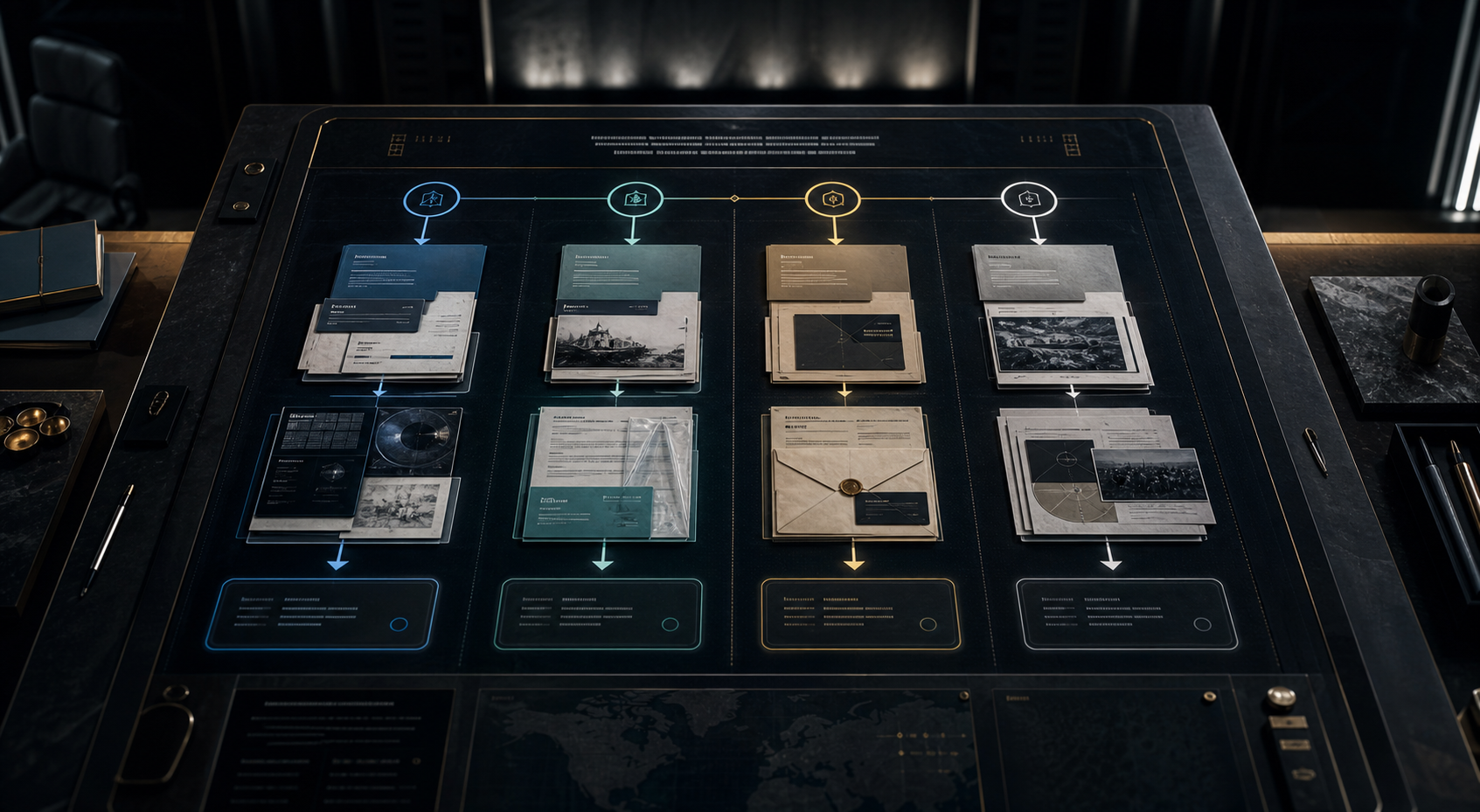
Each lane begins with one inspectable artifact, one named boundary, and one next room.
The image is editorial support for route clarity only. It is not proof of a staffed diligence desk, audited controls, production CRM, or formal capital process. Review the image provenance record.
Start with current posture and proof boundaries.
Use the capital-readiness note or ask for a claim-boundary memo when the core question is what White Noise can verify today versus what still belongs only in a later formal process.
Best first artifacts: capital-readiness note or claim-boundary memoStart with partner fit and the first program shape.
Use the partner-fit memo or a public-surface walkthrough when the decision is distribution, Academy rollout, sponsored research, or whether an institutional path is supportable now.
Best first artifacts: partner-fit memo or surface walkthroughStart with delivery shape and current operating limits.
Use the sample delivery case study, the security and data-handling baseline, or a scoped services route when the real question is whether White Noise can support one bounded workflow without implying mature enterprise proof.
Best first artifacts: case-study sample, security baseline, or scoped routeStart with boundary discipline and provenance.
Use a boundary note, the Exchange launch-status note, or the investor visual provenance register when you are checking how White Noise separates live surfaces, speculative technology, and editorial imagery.
Best first artifacts: boundary note, launch-status note, or visual registerRoute ruleOne role, one surface, one artifact
MatrixOpen the request guideThe cleaner the first request, the more useful the first reply.
Match the decision to the best public first-return artifact.
ResponseOpen the first-response standardSee what the first reply should do and what it should not imply.
TemplateOpen the first-note templateCopy a send-ready note with the right fields already named.
Next stepRoute one bounded noteUse the intake form only after you know which artifact you need first.
Evidence Ladder
Put each diligence ask at the right proof stage.
A first-pass investor, partner, or enterprise review should not sound like a secure dataroom, and a formal-process request should not be answered with public marketing material. The ladder separates public orientation, fit-reviewed artifacts, private diligence records, and formal legal or audit documents.
Board rule
Do not answer Stage 1 or Stage 2 questions with Stage 4 language. If audited, legal-reviewed, security-reviewed, or formal financing material is the real gate, say plainly whether it exists.

Four evidence stages keep public trust, private review, and formal process from blurring together.
The image is GPT-generated editorial support for diligence-stage clarity only. It is not proof of a staffed diligence room, audited controls, production CRM, legal review, formal financing process, customer traction, or operational speculative technology. Review the image provenance record.
Use public artifacts to choose the first question.
Start with the starter brief, proof pack, question map, materials index, and current route notes before asking for a meeting or custom response.
Does not imply a confidential dataroom, audited reporting, or customer traction.Return one bounded artifact after the decision is clear.
The first useful return may be a walkthrough, claim-boundary memo, partner-fit response, scoped services path, or formal-process note.
Does not imply staffed support, monitored CRM, enterprise SLA, or mature workflow proof.Use private records only when fit and record class are real.
Source-rights records, dependency records, permission records, and response evidence logs belong here only after there is a specific reason to review them.
Does not imply every private record exists, is complete, or is legal-reviewed.Reserve formal language for formal evidence.
Audited financials, legal-reviewed financing documents, security assessments, procurement reviews, and signed commercial documents require the corresponding process.
Does not imply active financing, valuation support, compliance certification, or launch readiness.Use ruleMatch proof level to decision stage
LadderOpen the evidence ladderPublic material should orient; formal claims require formal evidence.
Inspect the full stage table, board rule, and review triggers.
MapOpen the question mapChoose the first public artifact for the actual diligence question.
MenuOpen first-return menuSee which first artifact is responsible to return after fit review.
Next stepAsk at the right stageRoute one note with the proof boundary named up front.
Investor FAQ
Answer the serious trust questions before the first note.
The investor route already exposes proof, boundaries, and intake. This FAQ compresses the most common enterprise, partnership, and capital questions into one quick surface so a serious reviewer does not have to infer the answer from five different sections.
Why this helps
Better first conversations start when the counterparty knows what White Noise can show now, what it cannot claim yet, and how to ask for the smallest useful next artifact.
First artifactWhat is the best first artifact to request?
Ask for one bounded artifact tied to the actual decision. Strategic capital and board reviewers should usually start with the capital-readiness note or a claim-boundary memo. Enterprise buyers should usually start with Services, Labs, the sample delivery case study, or the security and data-handling baseline.
Institutional or strategic partners should usually begin with the partner-fit memo or a public-surface walkthrough. The cleaner the first ask, the more useful the first reply.
Current boundaryWhat is not represented as ready in the current public build?
The current public build does not represent audited financial statements, audited KPI reporting, production CRM or enterprise workflow proof, security-reviewed enterprise controls, formal financing documents, live exchange market-operations proof, or proof that speculative White Noise technologies are commercially deployed.
If one of those items is the real gating requirement, the stronger answer today is to say that plainly rather than warming the narrative past the evidence.
Submission ruleIs this page a secure diligence room?
No. This page is a first-pass public diligence route only. It is designed to help a serious counterparty inspect public materials, choose one bounded first artifact, and understand what still sits outside the present build.
Do not use this page to submit sensitive records. Use it to decide whether the next responsible step is a walkthrough, memo, scoped route, or a later formal process note.
Reply targetWhat should I expect after I send a first note?
When live routing is active, the public target is a routed first reply within a few business days. If this environment is only in demo fallback mode, the page should say so plainly, preserve a local backup, and point you to the fallback email route instead of implying monitored enterprise workflow.
The first reply should confirm route state, return one bounded artifact or redirect, and say plainly when a requested material is not represented as ready. Use the public first-response standard and inquiry triage protocol if you want to inspect that rule before you send the note.
Visual proofAre the generated investor visuals being presented as operating evidence?
No. The generated investor visuals are editorial support only. They are paired with provenance records and explicit usage boundaries so they are not mistaken for proof of staffed workflows, audited dashboards, production CRM, or commercially deployed speculative technology.
If you are testing an image-led claim, inspect the visual provenance register first and treat the underlying text artifacts as the evidence layer.
Review cadenceHow often are these materials reviewed?
The investor-facing trust stack is intended to refresh on a dated operating cadence. Core investor, proof-pack, materials-index, and change-note surfaces are reviewed monthly, while stronger claims should be added only when stronger source evidence actually exists.
Use the public review calendar, the operating cadence route, and the manifest-backed freshness signals on this page when you need to know whether a material is current enough for the question you are asking or whether a stronger claim is still blocked by owner or evidence gaps.
Reply Target
Make the first response legible before the first note.
A serious counterparty should not have to guess what happens after submit. This route now states the delivery check, the first-reply target, the expected return shape, and the point where White Noise should say a material is not ready instead of warming the narrative past current proof.
01 · Route state
Show whether routing is live, demo, or unknown.
The intake checks the current environment before submit. If live delivery cannot be confirmed, the page should fall back to local backup and alternate email rather than implying enterprise workflow coverage.
02 · Timing
Use a public target, not an implied SLA.
The current target is a routed first reply within a few business days when live routing is active. That is a bounded operating target only, not a staffed-desk guarantee or contractual response commitment.
03 · First return
Return one artifact, one boundary, one next step.
The first reply should confirm route state and return a walkthrough, boundary memo, scoped route, capital-readiness response, or formal-process note instead of a vague acknowledgment.
04 · Not-ready rule
Say when the requested room does not exist yet.
If the real gate is audited reporting, security-reviewed controls, formal financing documents, or live market-operations proof, the stronger answer today is to say those materials are not represented as ready in the current build.
Operational trust
Inspect the response rule before you route a diligence note.
This is the most practical maturity signal on the page: a serious visitor can now see what the desk should disclose, what the first reply should contain, and where the route stops before secure diligence, enterprise workflow, or formal financing process are earned.
Enterprise Reply Gates
Do not let a serious reply outrun the underlying record.
A first-response target is useful only if White Noise also states what evidence has to exist before a reply can sound more enterprise-grade. These public controls show the acceptance bar behind workflow, service-level, procurement, and dependency language.
01 · Acceptance bar
Start with an accepted source record.
A stronger reply should name the source family, owner, dated window, exclusions, privacy boundary, retained evidence, review date, public-summary boundary, and blocked claim before it warms the narrative.
02 · Service dependency
Check the service behind the promise.
If a reply depends on a material vendor or platform, White Noise should review owner state, terms source, continuity, security relevance, claim boundary, and review trigger before implying service-level maturity.
03 · Review order
Prioritize the next record instead of improvising the claim.
The source-record queue shows which production, payment, inquiry, artifact, permission, dependency, security, and launch records would improve enterprise trust fastest from current public state.
04 · Public fallback
Keep the first reply narrow when the record is missing.
If the source record or dependency review is not accepted yet, the safer answer is a boundary memo, a route clarification, or a formal-process note rather than implied enterprise readiness.
Practical use
Enterprise trust improves when the reply conditions are visible before the meeting.
This layer gives investors, buyers, and partners one concrete test: before White Noise sounds more mature, ask which accepted source record and which dependency review support the claim. If the answer is not inspectable yet, keep the first request bounded.
First Meeting Contract
Define the first meeting before anyone books it.
Enterprise-scale trust starts earlier than a dataroom. A first meeting is more useful when both sides know what should be reviewed in advance, what the decision actually is, what White Noise can return now, and which maturity signals are still absent.
Use boundary
This is a public meeting-prep rule, not a secure diligence room. If the real gate is audited reporting, security-reviewed enterprise controls, procurement review, or formal financing documents, say that before time is booked instead of letting the call carry unearned assumptions.
Arrive with one decision, one proof gap, and one capital-use question.
The first capital conversation should test current posture, live commercial surfaces, and what still belongs only in a later formal process.
Review first
wn-capital-readiness-note.html, wn-commercial-surface-register.html, and wn-investor-update.html.
Bring to the meeting
Name the decision stage, the missing proof that matters most, and the specific capital-use or diligence question you want answered first.
White Noise can return now
A posture summary, a claim-boundary memo, or one next artifact tied to the actual decision.
Do not assume yet
Valuation support, an active securities process, audited reporting, or a full financing pack.
Bring one bounded workflow and the operating constraint that matters.
The first enterprise meeting should stay grounded in a pilot-sized problem, current delivery shape, and clear boundaries around workflow maturity.
Review first
wn-services.html, wn-labs.html, wn-sample-delivery-case-study.html, and wn-security-data-baseline.html.
Bring to the meeting
Name the workflow, timing, stakeholder, and data or privacy concern that would make a first scoped engagement credible.
White Noise can return now
A scoped services path, a public-surface walkthrough, or a boundary memo tied to one delivery concern.
Do not assume yet
A staffed support desk, procurement packet, production CRM proof, or enterprise-ticketing infrastructure.
State the program shape before asking for broader partnership language.
The first partner meeting should narrow to one cohort, channel, or sponsored program shape and keep support-level assumptions explicit.
Review first
wn-partner-fit-memo.html, wn-academy.html, wn-proof-pack.html, and wn-operating-cadence.html.
Bring to the meeting
Name the audience, program format, timeline, and support requirement that would make the partnership concrete enough to evaluate.
White Noise can return now
A partner-fit walkthrough, a scoped program path, or a note naming what support is still not represented as ready.
Do not assume yet
Accreditation, enterprise LMS integration, full implementation staffing, or institution-scale support operations.
Test launch dependencies, rights boundaries, and provenance before upside.
The first ecosystem meeting should clarify what is public now, what is still gated, and which launch dependency or rights question actually matters.
Review first
wn-exchange.html#exchange-soon, wn-exchange-launch-status.html, and white-noise-investor-visual-provenance-register.md.
Bring to the meeting
Name the channel, distribution role, provenance or rights concern, and the gating condition that would change next-step confidence.
White Noise can return now
A launch-boundary memo, a provenance walkthrough, or a note on the dependency still blocking broader rollout.
Do not assume yet
Live market operations, GMV evidence, broad asset clearance beyond named use, or marketplace scale proof.
Meeting ruleBook only when the agenda survives the current proof state.
GuideOpen the request guideThe call should sharpen fit and next artifact choice, not cover for missing audited, security-reviewed, or formal-process materials.
Match the decision to the smallest responsible first-return artifact.
ChecklistOpen the readiness checklistConfirm the meeting is worth booking before sending a note.
Next stepRoute the meeting requestUse the structured intake only after the role, packet, and main boundary are named.
Get in Touch
Send a structured investor note
The investor route now converts inside the page instead of handing every serious visitor off to a separate contact surface. The form below keeps the ask bounded, shows whether delivery is configured in the current environment, and preserves a local backup in demo environments.
Best use
Ask for one artifact, not an undefined dataroom.
Name the role, the first packet item, the surface under review, and the main boundary you want addressed. That makes the first reply legible and keeps the conversation on inspectable ground.
Read the public first-response standard if you want to inspect what the first reply should do before sending the note. The response evidence template shows how those replies should be logged before any public metric or summary exists.
If you are not sure the meeting is ready yet, open the public first-meeting readiness checklist before you route the note.
Need a ready draft first? Open the public investor note template or copy a prefilled version from the form once you enter your details.
Delivery state
Checking whether this environment has a configured inquiry-delivery path.
The form will test the inquiry router and tell you whether this page reports configured delivery or only saves a demo fallback locally. That route-state check is not the same as source-backed proof of staffed workflow or response metrics.
What we can return first
Expect a routed reply, not a vague acknowledgment.
The first response should return the next most useful artifact or tell you clearly that the request belongs in a different room. The public first-response standard now states that rule explicitly on the record.
Public walkthrough
A guide to the proof pack, site surfaces, and the current material limits.
Boundary memo
A direct note on the risk, claim line, or operating constraint you asked about.
Scoped next step
A services, Academy, or Custom R&D route if the request is really commercial or programmatic.
Formal-process note
A clear statement that a question requires separate documentation and eligibility review.
Submission guardrails
Safe to send
Role, decision, public page, and first artifact need
Do not send
Confidential, regulated, credential, or personal-data material
Expect back
Route state, one artifact, one boundary, one next step
Use this route for bounded diligence, not confidential exchange.
The current public investor route is appropriate for first-pass context, one named risk boundary, and one requested artifact. It should not be used as a secure diligence room or a place to submit sensitive records.
Send the counterparty role, the surface being reviewed, the boundary to test, and the artifact you want first.
Do not include unpublished decks, cap-table details, contracts, customer records, credentials, API keys, or regulated/personal information through this public route.
The first reply should confirm route state and return one bounded artifact or a formal-process note if stronger handling is required.
Important notice. This page is for general information only. It is not an offer to sell or a solicitation of an offer to buy any security, and nothing here is investment advice or a promise of financial returns. White Noise Inc. is an educational and creative venture; the technologies described across the site are speculative concepts from White Noise Totality, not commercial products. Any figures shown are illustrative. Forward-looking statements involve risk and uncertainty, and actual outcomes may differ materially. Any future investment would be made only through formal documentation, to eligible investors, in compliance with applicable securities laws.